
Between the moment someone shows interest on your website and the first real conversation lies a stretch full of tripwires: a form with ten fields, a confirmation email with no next step, two days of silence, three emails of scheduling ping-pong. Every one of those spots costs leads - not because your offer is weak, but because the path towards it is exhausting. In this article: what the data says about self-directed B2B buyers, where funnels measurably lose enquiries - and how to build the stretch from enquiry to booked meeting so that nobody drops out along the way.
Why does the funnel decide before your sales team ever speaks?
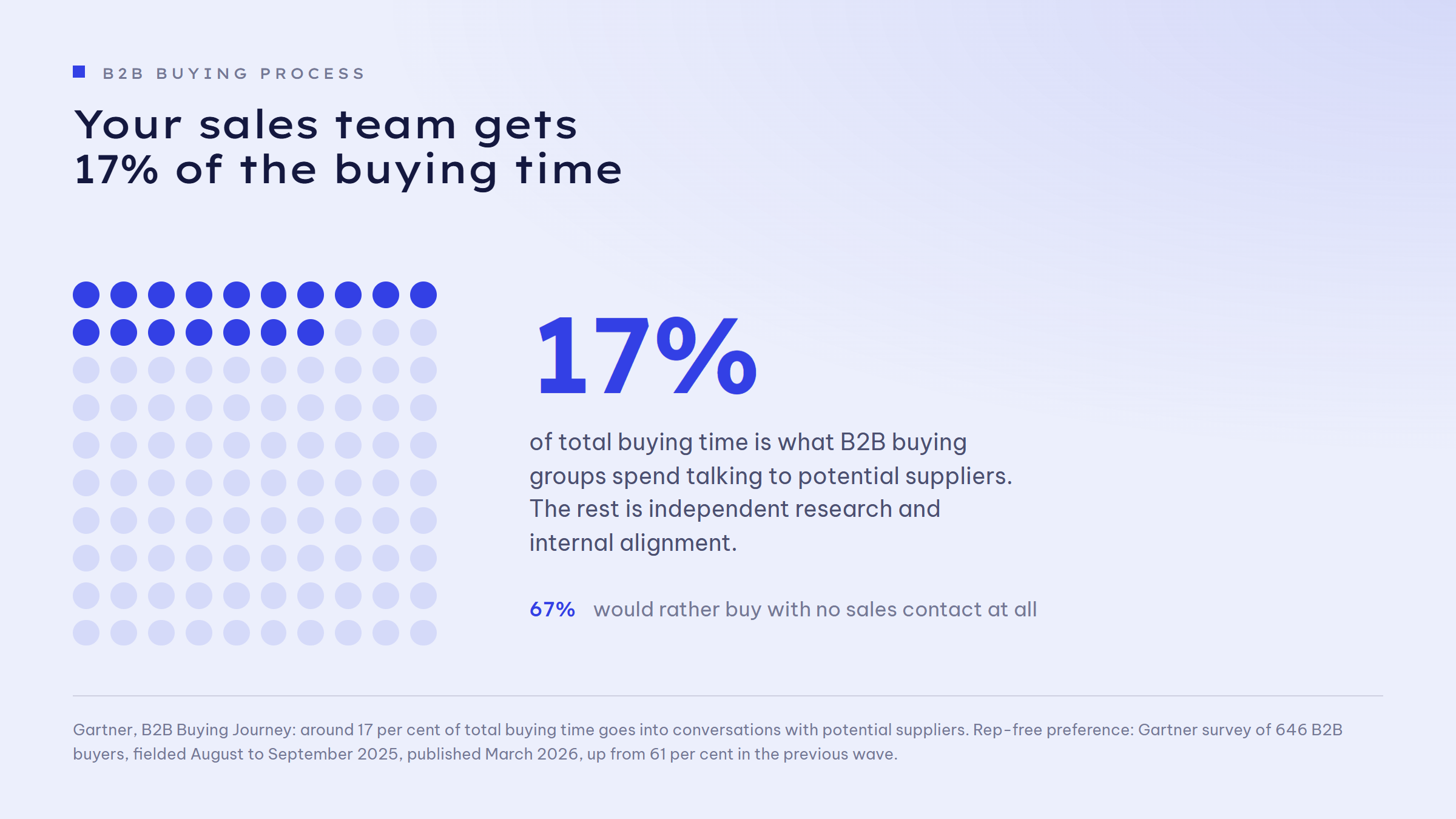
Because the buying process belongs to the buyer now. According to Gartner, B2B buying groups spend only around 17 per cent of their total purchase time in conversations with potential suppliers - the rest is independent research and internal alignment. And the trend is sharpening: in a Gartner survey of 646 B2B buyers (August to September 2025), 67 per cent said they would prefer a buying process without sales rep involvement - up from 61 per cent the year before. On average, buyers consult seven different information sources before they get in touch.
That does not make salespeople obsolete - quite the opposite: according to a further Gartner survey from May 2026, 69 per cent of buyers turn to a human to validate AI-generated research. The roles have simply shifted: your funnel handles informing and qualifying, your team handles confirming and closing. Forcing a sales call for every small step means working against 67 per cent of your prospects.
Where do websites lose the most enquiries?
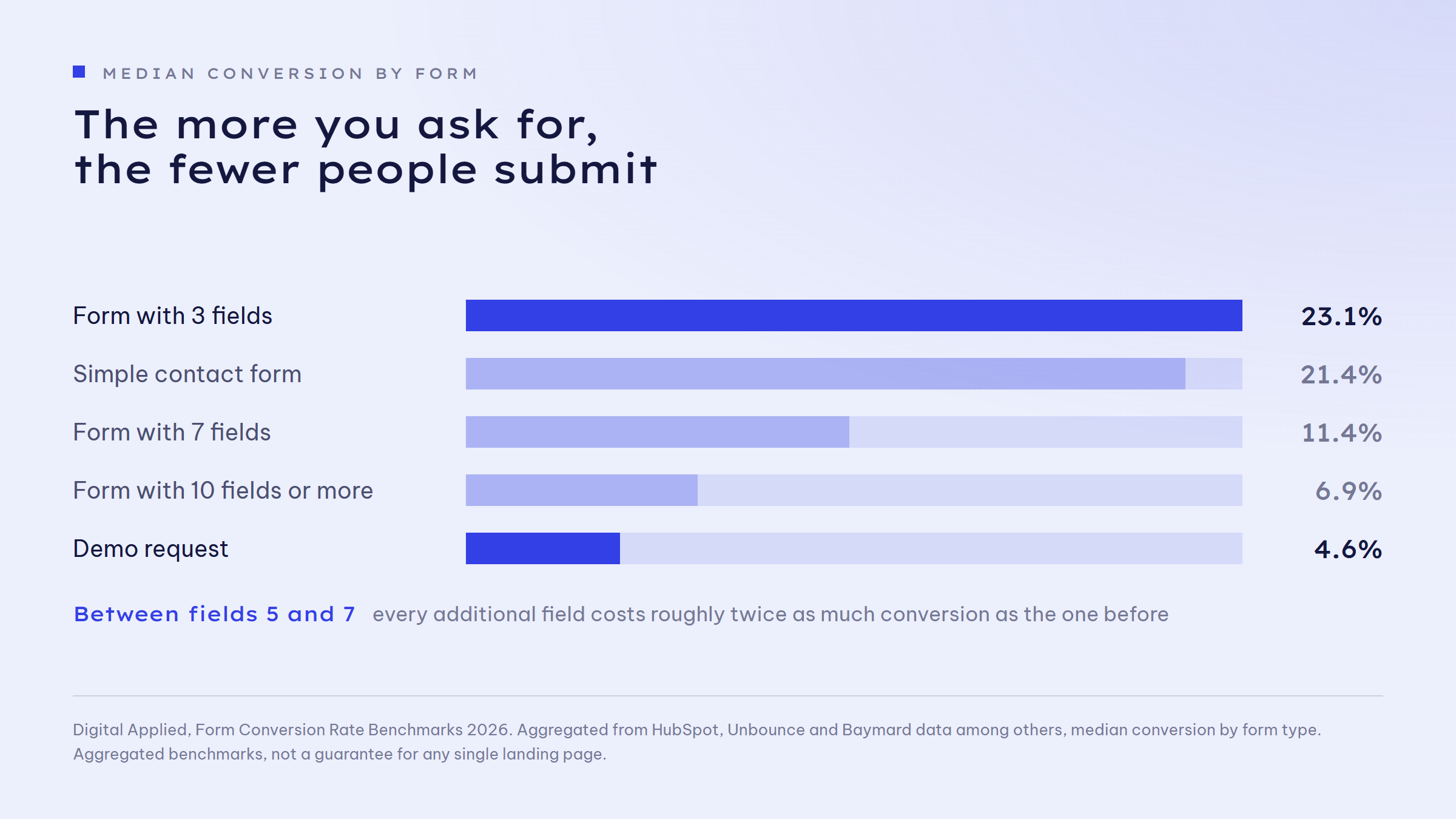
At three measurable points: form length, mobile devices and form type. A benchmark aggregation by Digital Applied (2026, compiled from HubSpot, Unbounce and Baymard data among others) shows the orders of magnitude: a form with three fields converts at a median of 23.1 per cent, with seven fields it is down to 11.4 per cent, and from ten fields onwards 6.9 per cent - and between five and seven fields, every additional field costs roughly twice as much conversion as it did before. Demo requests, the most demanding form type, sit at a median of just 4.6 per cent, simple contact forms at 21.4 per cent. On smartphones there is a penalty on top: for lead-gen forms, mobile conversion runs 32 per cent below desktop, for quote requests 38 per cent.
The good news from the same dataset: multi-step forms - the request first, contact details second - convert on average 14 per cent better than single-page forms with the same number of fields. Important context: these are aggregated benchmarks, not guarantees for your landing page. But the direction is unambiguous and matches everything we see in client projects: any field your sales team could just as well clarify in conversation does not belong in the form. And a high bounce rate on your form page is rarely an interest problem - it is usually a friction problem.
What happens after submission - and why is that the most expensive moment?
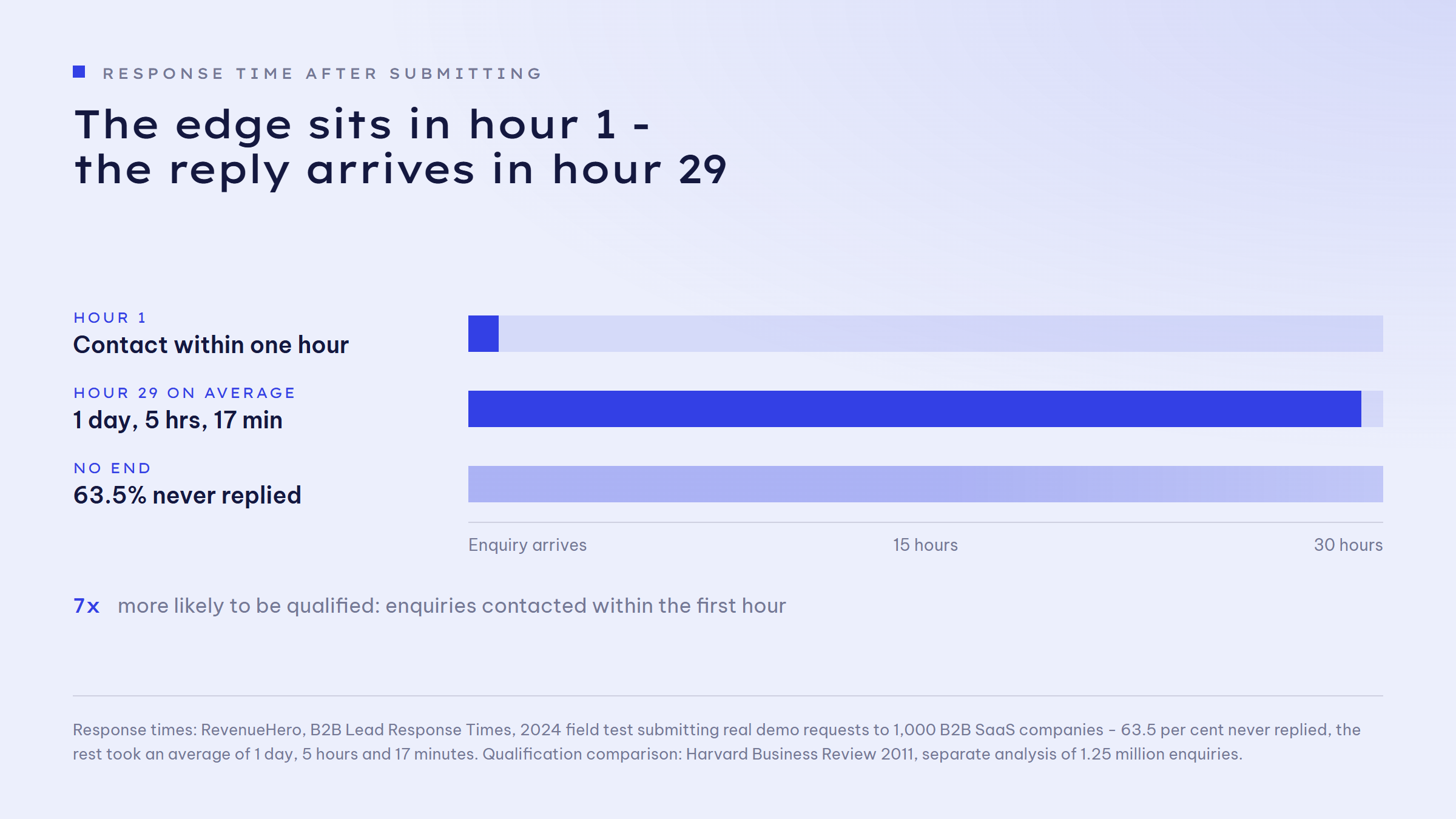
After submission begins the phase where most funnels die: the wait. RevenueHero ran a field test in 2024, submitting real demo requests to 1,000 B2B SaaS companies: 63.5 per cent never replied. Those that did took an average of 1 day, 5 hours and 17 minutes. Yet the link between speed and outcome has been documented for years: the classic HBR study on online leads (2011 - old, but never refuted) found, across an analysis of 1.25 million enquiries, that enquiries contacted within an hour are around seven times more likely to be qualified than those contacted an hour later. The accompanying audit of 2,241 US companies in the same study measured response time only: those that replied at all took an average of 42 hours.
This is exactly where speed to lead pays off as a systems question, not a discipline question. Nobody can reply personally at 11pm - but your funnel can: an immediate, substantive confirmation with the next step, automated lead qualification by budget, timeline and request, and for everyone not ready yet, a drip campaign instead of total loss. This does not replace your team - it makes sure your team finds a sorted list in the morning instead of a cold inbox.
What does the path from enquiry to meeting look like without friction?
Like a continuous track with a single principle: the prospect never has to wait and never has to guess. In practice that means: the landing page has one goal and one primary button, not five. The form asks only what the first step requires - the rest comes later from the conversation or from enrichment in the CRM. And the decisive break with convention: after submission there is no "we will be in touch shortly", but the calendar itself. Whoever submits an enquiry is at peak interest in that very moment - every hour of delay squanders exactly that energy. A calendar with open slots right on the confirmation page turns the hottest moment of the customer journey into a fixed appointment instead of an open promise.
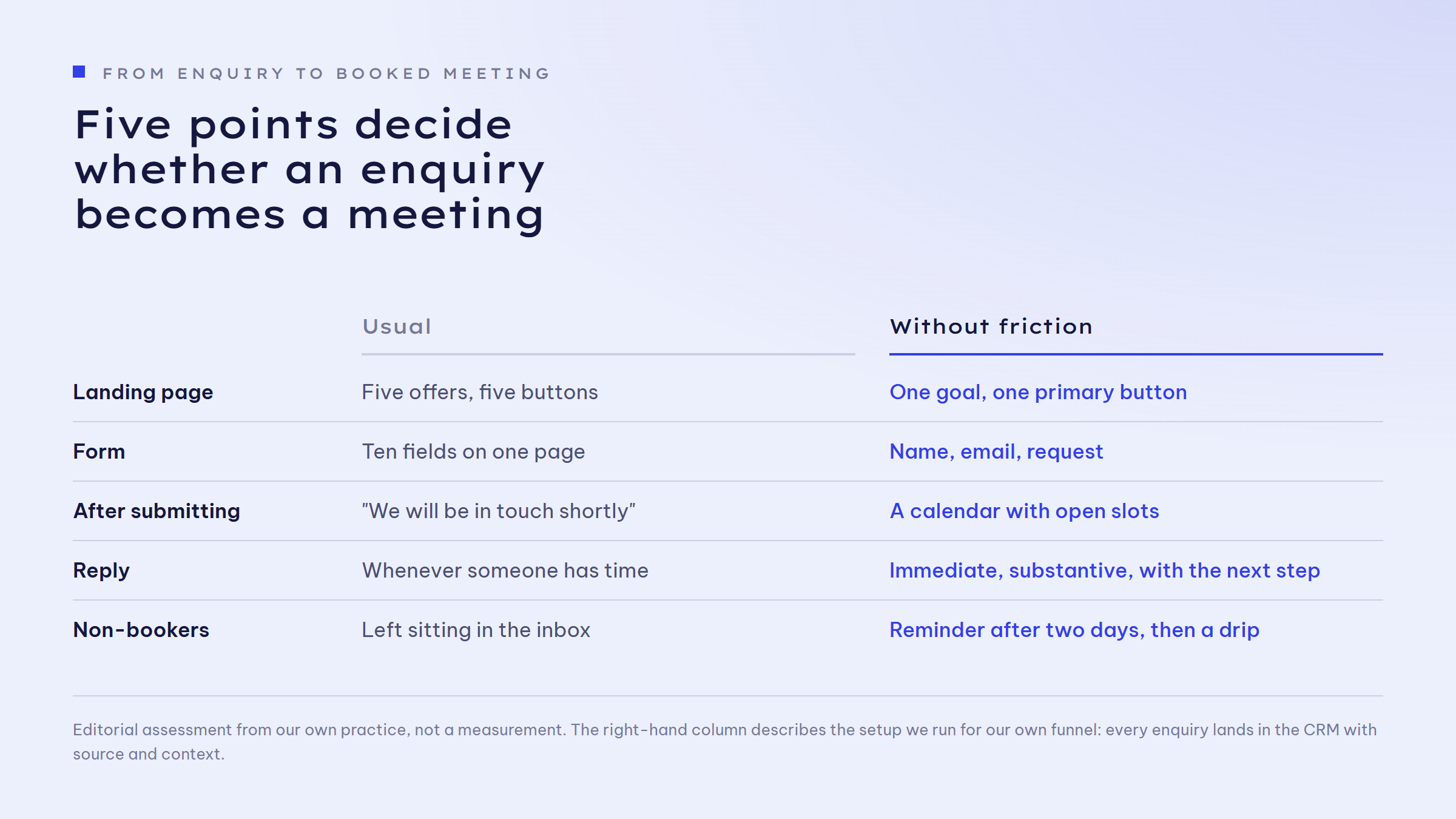
Behind it sits the invisible half of the funnel: marketing automation that politely reminds non-bookers after two days, lead nurturing for the 90 per cent who only came to look today, and a CRM where every enquiry arrives with source and context - not as a bare email address. Only this half turns a pretty form into a funnel: the front is allowed to be light because a system is working at the back.
Where do you start this week?
Three levers worth pulling immediately:
Lever 1: Walk through your own funnel as a stranger. Submit an enquiry through your own form, on a smartphone, in the evening. Count the fields, time the wait until the first substantive reaction, and note whether you knew what would happen next. The result is your most honest audit.
Lever 2: Cut every field the meeting could clarify instead. Name, email, request - the first step rarely needs more. Between five and seven fields, every additional field doubles in cost. Everything else belongs in the conversation or in enrichment.
Lever 3: Replace the promise with the calendar. "We will be in touch" is the most expensive line on your website. Attach the meeting booking directly to the confirmation page and measure for two weeks how many enquiries book straight away.
If you want to feel the difference: our own funnel does not end with a promise but with a calendar - book a meeting right now. 📅