
A well-researched article costs you a day. Reusing it twelve times costs you an hour with AI. That is precisely why content recycling has become the favourite answer to having too little time, and precisely why a lot of teams are now publishing the same thing twelve times over. The difference between a channel that carries weight and a feed full of repetition is not the tool, it is the question of what you are actually recycling. Let us look at why more output rarely means more impact, which parts of a piece translate, where Google draws the line, and how a recycling cycle works in practice.
Why does more output not mean more impact?
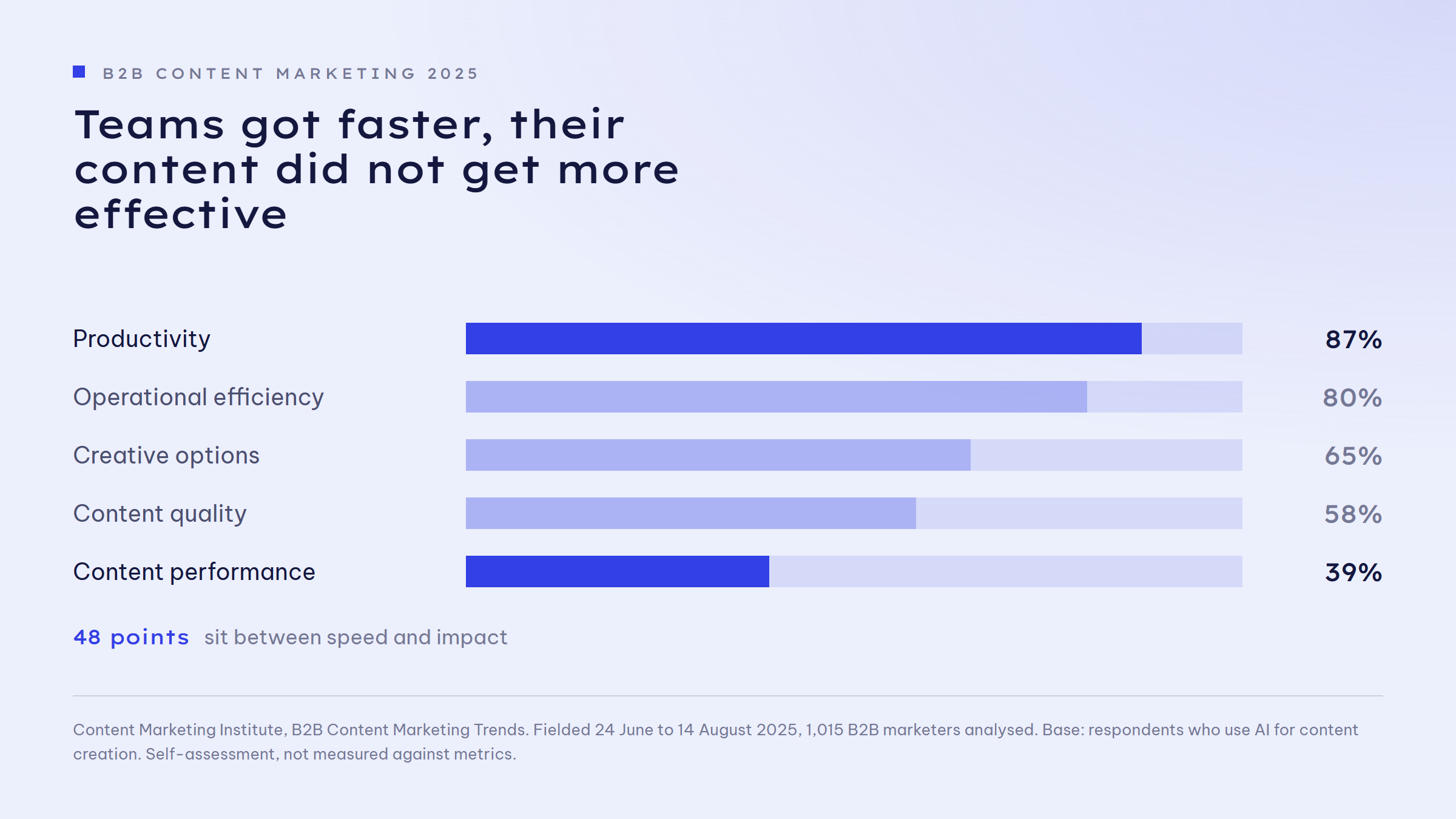
The cleanest data on this comes from the B2B content marketing report by the Content Marketing Institute. It was fielded between 24 June and 14 August 2025, and 1,015 B2B marketers were analysed out of 1,229 responses. 95 per cent of them use AI-powered applications, and 89 per cent of those use them to produce copy. So far, the predictable half.
It gets interesting when you ask what AI actually delivered. 87 per cent report higher productivity, 80 per cent better operational efficiency, 58 per cent better content quality. But only 39 per cent say the performance of their content improved. 12 per cent report that quality went down. The gap between 87 and 39 is the real story here: teams got faster, their content did not get more effective.
It fits with what the same respondents name as their biggest challenge: 40 per cent struggle to create content that prompts a desired action. Resource constraints follow at 39 per cent, measuring effectiveness at 33 per cent. And only 12 per cent rate their own content marketing as highly effective. So the problem is not volume. It is impact per piece, and that does not improve by publishing one piece twelve times.
What can be recycled, and what should you write from scratch?
The mistake sits in the unit. Most teams recycle text. What you should recycle is substance: an argument, a figure with a source, a client example, a contrarian position, a set of instructions, a diagnosis of a common failure. Those parts are valuable regardless of channel because they contain thinking. The text around them is packaging for one specific channel, and packaging travels badly.
In practice: before you move anything into another format, break the piece into its units of substance. A 1,500-word article typically holds four to six of them. Those are your raw materials, not the paragraphs. A unit of substance then becomes a LinkedIn post with its own punchline, a newsletter section with its own opening, a slide, an FAQ block that can win a featured snippet, or an evergreen glossary entry. Twelve assets from one piece is realistic when they come from five units of substance. They are filler when they come from five paragraphs.
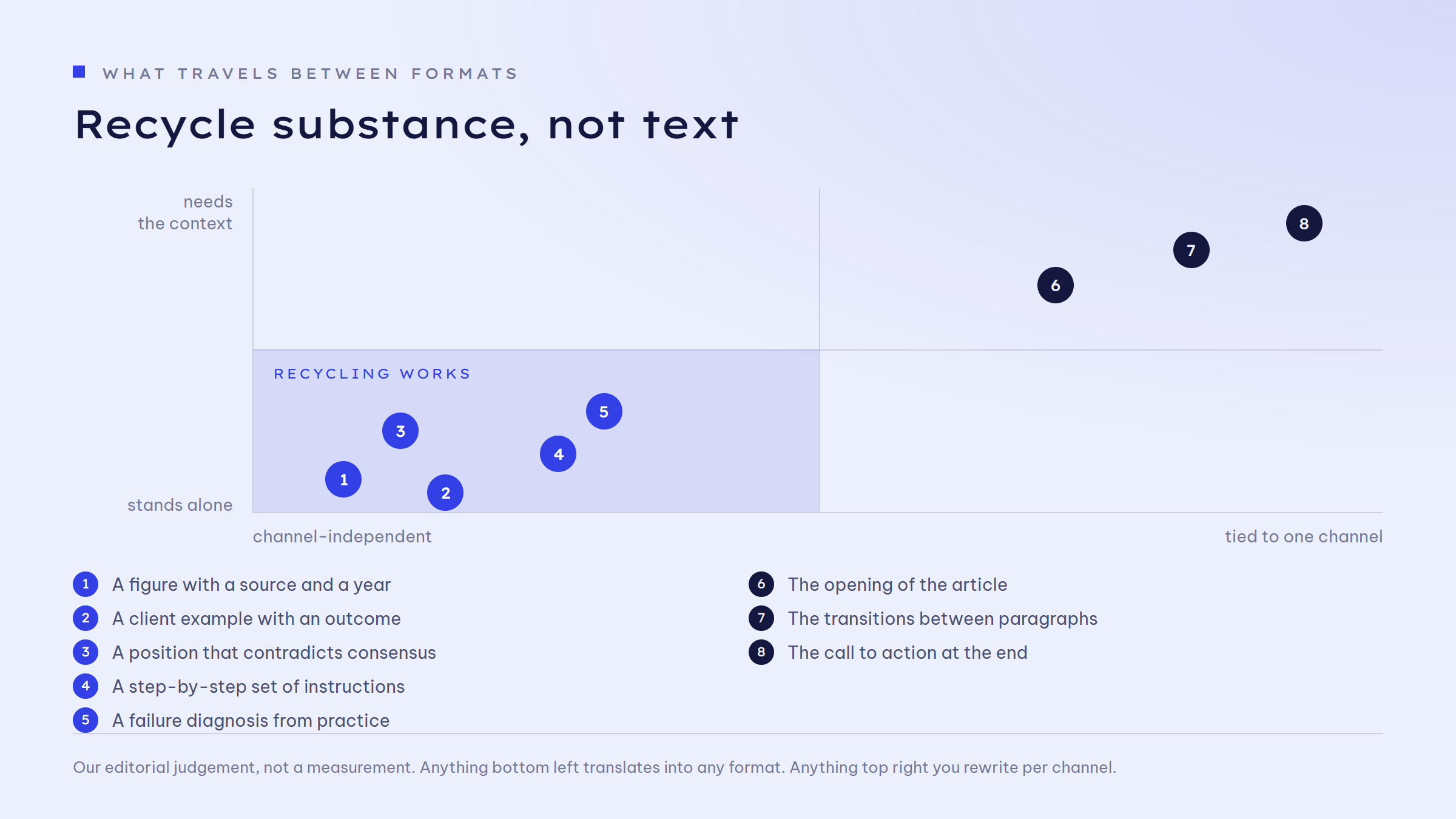
The rest is craft, but a specific kind: every format needs its own opening, its own length and its own punchline. Content repurposing is translation, not duplication. A feed post that starts with the blog opening reads like an extract, and nobody clicks extracts. This is where AI genuinely helps: it can offer five different openings for the same unit of substance, while it remains notoriously weak at inventing the substance itself.
Why you should not trust the recycling statistics in circulation
Research this topic and you quickly hit some very quotable numbers: 94 per cent of marketers repurpose content, repurposed content generates 60 per cent more leads, AI turns one webinar into thirteen assets in two hours instead of eight. We traced those figures for this article. The result: almost all of them come from statistics round-up pages that cite each other, with no verifiable study at the end of the chain. No sample size, no field period, no method.
That is more than a footnote, it is a symptom of the same problem. Those pages are recycling products themselves: substance nobody ever gathered, endlessly repackaged. Two things follow for you. First, never take a number into your own content if you have not seen its primary source. A figure without traceable origin is a risk, not authority. Second, that verification work is exactly the substance that separates your content from recycled noise. What hallucinations are in AI text, these numbers are in content marketing: plausibly phrased, not evidenced.
Where does Google draw the line?
The common fear that recycled content gets penalised is, in that form, wrong. In its spam policies, Google defines scaled content abuse as follows: "Scaled content abuse is when many pages are generated for the primary purpose of manipulating search rankings and not helping users. This abusive practice is typically focused on creating large amounts of unoriginal content that provides little to no value to users, no matter how it's created." That last clause is the one that matters: how the content was produced is irrelevant. It is about volume without value.
Google's guidance on AI-generated content is more specific: "using generative AI tools or other similar tools to generate many pages without adding value for users may violate Google's spam policy on scaled content abuse", and as instruction: "When creating content for the web, focus on accuracy, quality, and relevance, especially when automatically generating the content." Using AI is fine. Running a production line is not.
The second common worry, duplicate content, is also smaller than its reputation. Google's SEO starter guide puts it plainly: "If you have some content that's accessible under multiple URLs, it's fine; don't fret about it. It's inefficient, but it's not something that will cause a manual action." The real risk is not punishment, it is cannibalisation: when three of your own pages serve the same topic in the same words, they compete for the same query and none of them wins it cleanly. So every recycling cycle includes deciding which page stays canonical and which points to it. That is where internal linking and topical authority meet.
What does a recycling cycle look like?
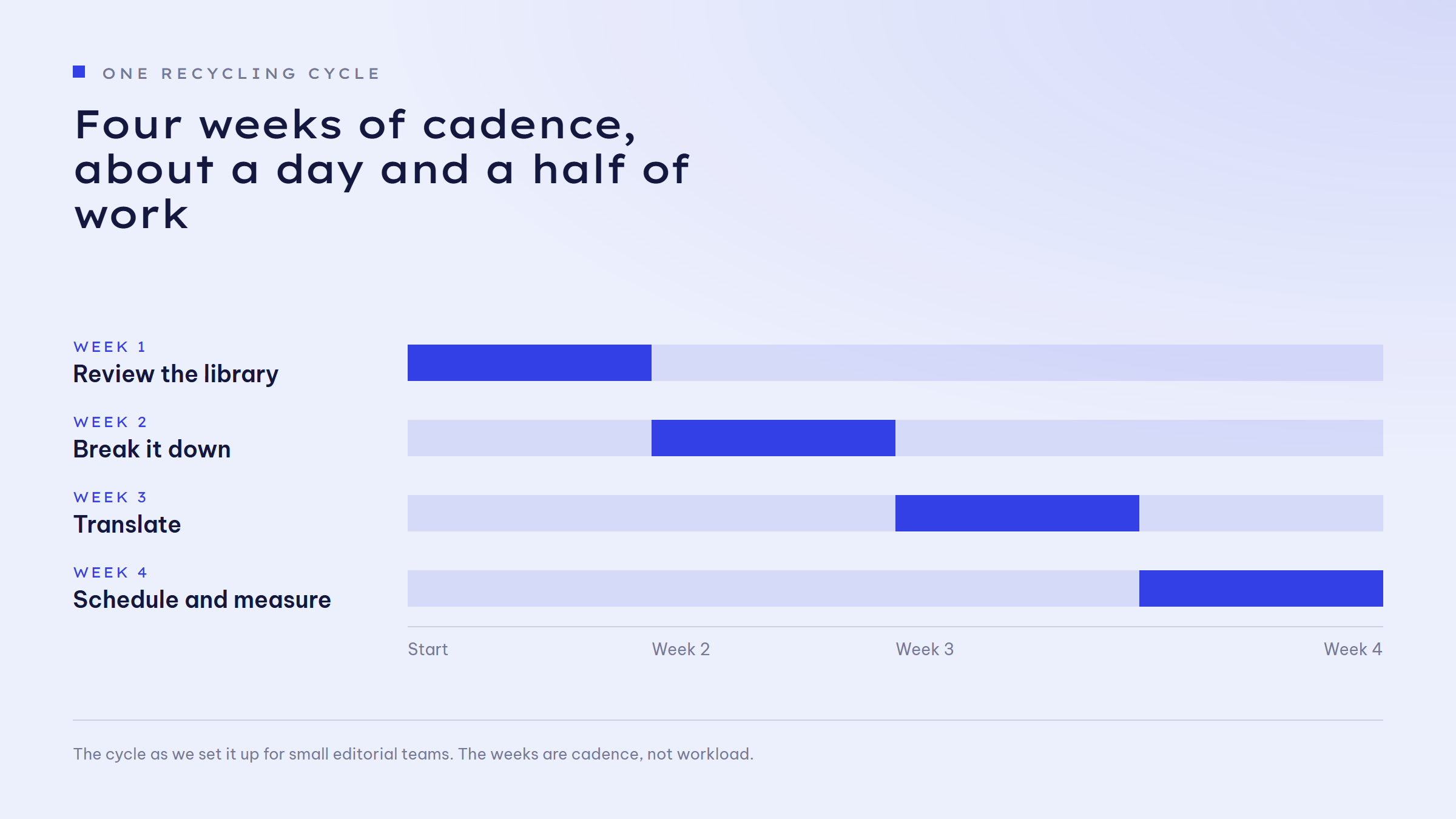
The first step is the one almost everyone skips: the content audit. Without an inventory you recycle whatever comes to mind, which is usually the newest piece rather than the best one. The interesting ones are pieces with good dwell time and weak reach, because there the substance is present and the packaging is at fault. The last step is the second one everyone skips: putting the assets into an editorial calendar instead of scrambling on publication day. Recycling rarely fails at the writing. It fails at the scheduling.
A word on where AI belongs in this: it is strong in the translate step and weak in the steps before and after. It can pour a unit of substance into five formats, offer variations of openings, adjust length. It cannot judge which piece deserves the effort, and it cannot verify a figure against its primary source. If you want to hold your brand voice, hand the model your style guide rather than letting it guess the tone.
Three levers for this week
Lever 1: take the three strongest pieces of the past year. Not the newest. Mark every passage that carries weight without the rest of the text around it. If you find fewer than three, that tells you something about the piece, and it is not a reason to move on.
Lever 2: verify one number you use regularly. Find the primary source, note sample size and year next to it. If you cannot find it in ten minutes, the number leaves your materials. It is uncomfortable and it is the fastest quality gain available to you.
Lever 3: define one metric per recycled asset. Reach for social, open rate for the newsletter, impressions for search pages. Without that mapping you will never learn whether recycling works for you, and you keep producing on a hunch.
If you want an outside view of your library: we go through it with you and sort out which pieces have substance, which belong in a different format and which are better deleted. Book a slot and we will look at your last twelve months together. ♻️