
Price conversations rarely fail over the price. They fail because the number in the proposal stands on its own: no reference point, no alternative, no reasoning. That leaves the one lever both sides understand immediately, and that lever is the discount. The Global Pricing Study 2025 by Simon-Kucher puts a figure on what the reflex costs: over 2,200 business leaders surveyed across 28 countries and 39 industries, fielded in early 2025, more than half of them C-level. Average price realisation sits at 43 per cent. Less than half of what companies set out to achieve actually lands. Let us look at where the pressure comes from, what a discount really costs, what a proposal that carries its own price looks like, which number goes first, and what to do when the discount question is asked regardless.
Where is the price pressure actually coming from?
It is measurable, and it has grown. In the Simon-Kucher survey, 64 per cent of companies report higher price pressure, up from 57 per cent in 2021. The three most cited causes are increased low-price competition (18 per cent), increased customer negotiation power (15 per cent) and increased customer price transparency (13 per cent). Asked what stops a planned increase from landing in full, respondents name customer resistance (23 per cent) and competitive pressure (22 per cent). Only 24 per cent planned any increase above inflation for 2025.
For German-speaking markets, the more recent snapshot comes from the ifo Institute. In its release Weniger Firmen wollen ihre Preise erhöhen of 30 June 2026, price expectations fell to 26.4 points from 30.0 in May. Among service providers the figure dropped to 21.4 points from 25.0. The context ifo supplies itself matters: the 2023 to 2025 average was 18.3 points. So fewer companies plan increases than in spring, and still more than the multi-year norm. The wider mood has improved, with the ifo Business Climate Index rising to 86.6 points on 27 July 2026, after 85.7 in June.
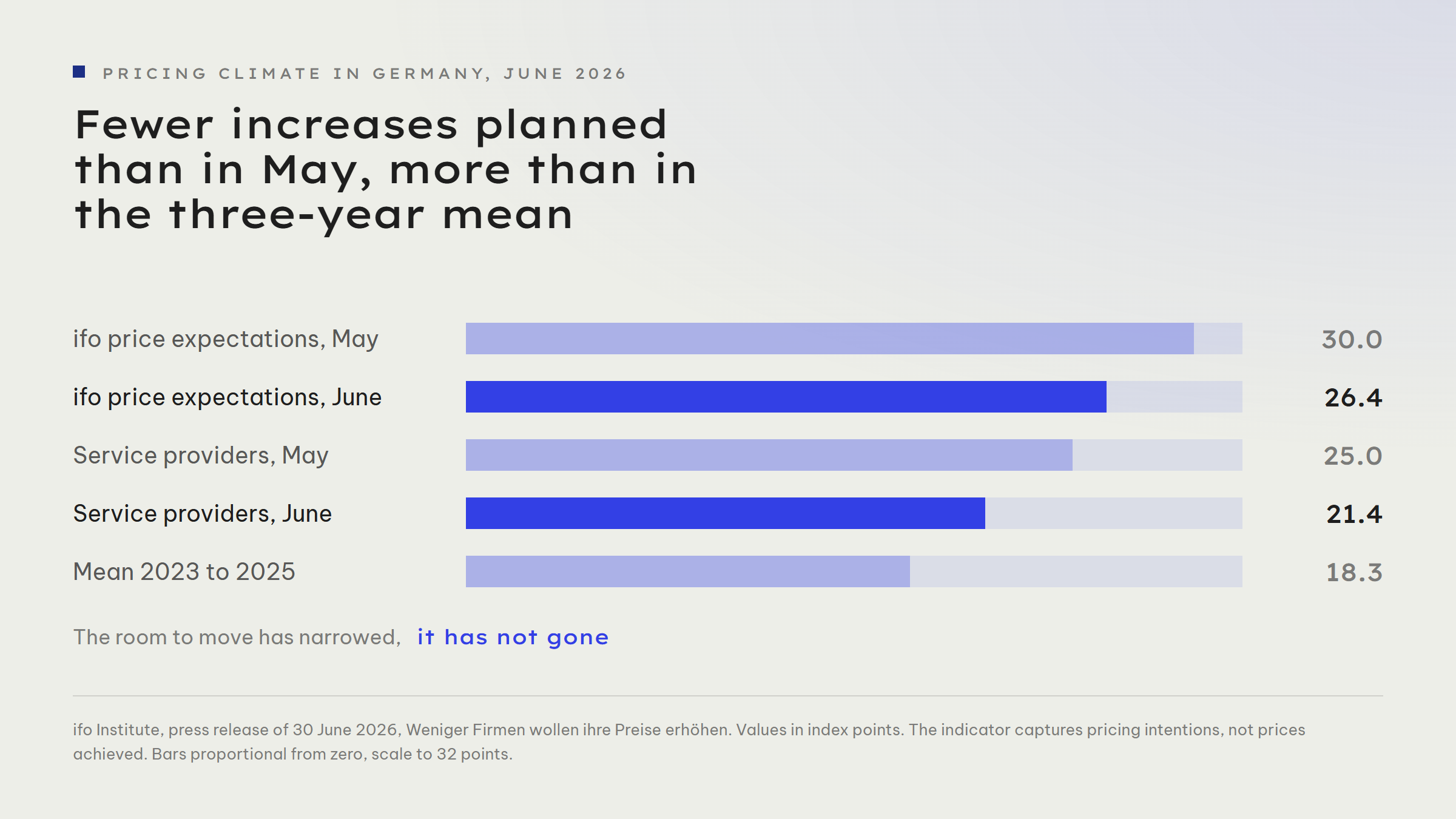
Two honest caveats. The ifo figures capture intentions, not prices achieved. And the Simon-Kucher study is self-reported by executives, not an audit of real invoices. What both show together is this: the room to move has narrowed, but it has not gone. Where it does go is in conversations nobody prepared for.
What does a discount really cost?
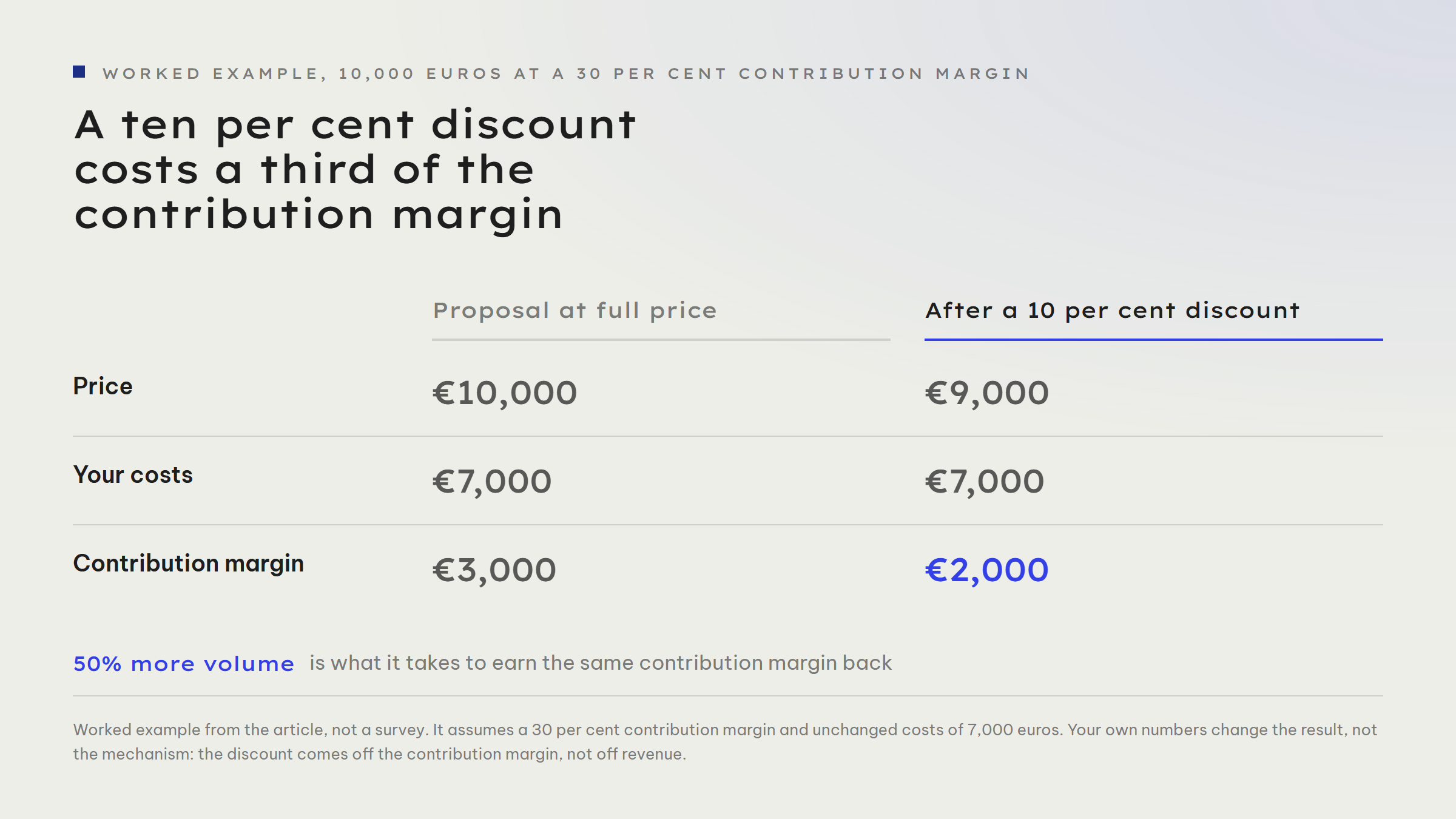
Far more than the percentage suggests, because the reduction does not come off revenue, it comes off contribution margin. A small worked example so the order of magnitude is visible: a 10,000 euro proposal with a 30 per cent contribution margin earns 3,000 euros. Grant 10 per cent, and the price drops to 9,000 euros while your costs stay at 7,000, leaving 2,000 euros of contribution. A tenth off the price cost a third of the margin. To earn the original contribution back, you would need 50 per cent more volume. That is not a study, it is arithmetic, and it works with whatever numbers you put into it.
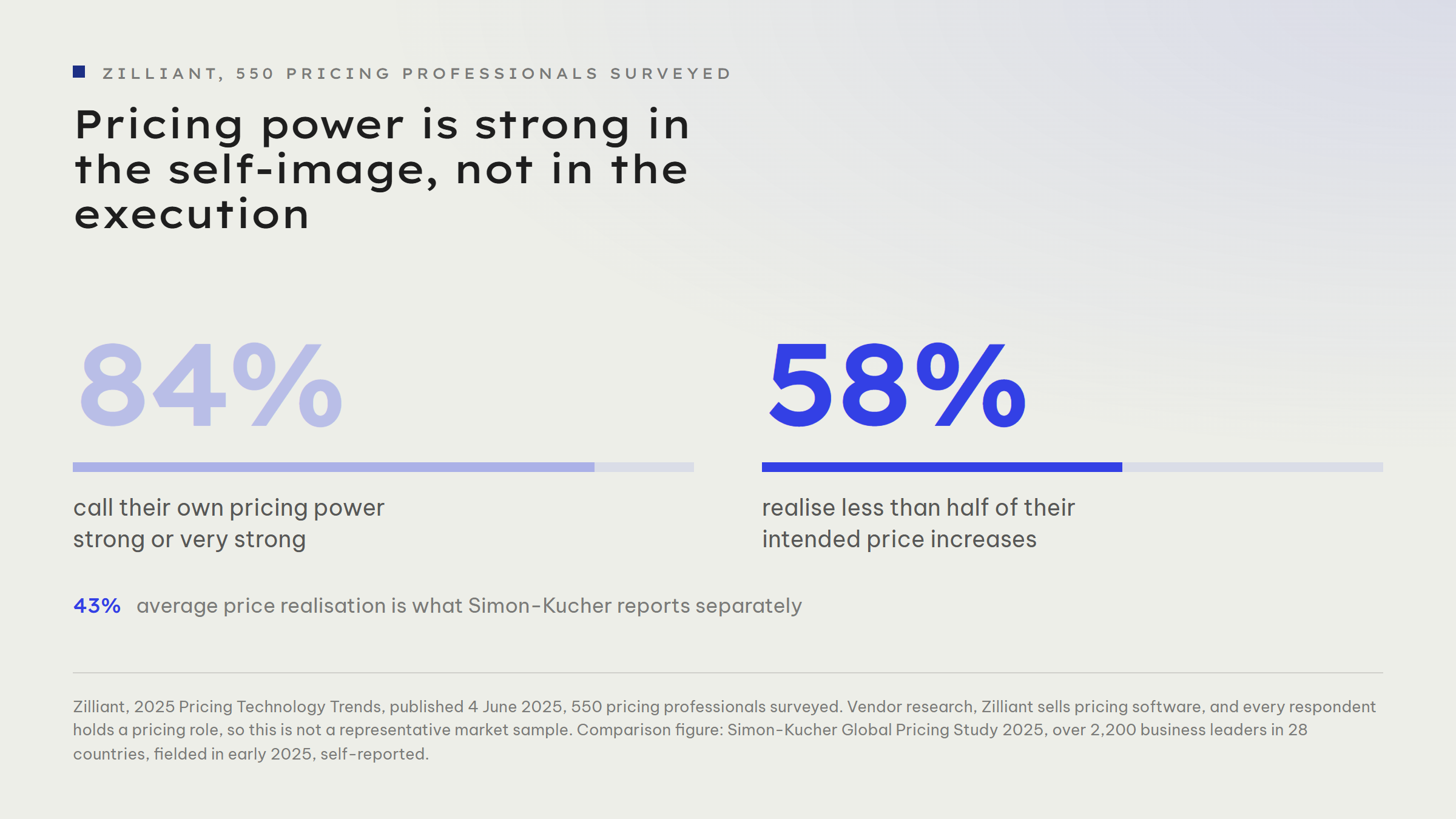
Then there is the gap between intent and execution that keeps showing up in the data. Software vendor Zilliant surveyed 550 pricing professionals for its 2025 Pricing Technology Trends report, published on 4 June 2025. 84 per cent describe their own pricing power as strong or very strong, while 58 per cent realise less than half of their intended increases. Read that with two caveats: it is vendor research, Zilliant sells pricing software, and the respondents all hold pricing roles rather than forming a representative market sample. It still works as a directional signal, because it produces the same diagnosis as the independent survey: self-image and execution have come apart.
The third cost is the one nobody books. A discount granted is a precedent. On the next proposal it becomes the new starting point, and on the one after that the customer is no longer negotiating your price, but your discount.
What makes a proposal hold its price?
Four building blocks that shift the conversation before it starts.
First, the reference point. A price without a comparison is just a number. A price set against the cost of the situation it ends is an argument. What does the half day a week somebody currently spends on rework cost? What does an enquiry sitting untouched for three days cost? That calculation belongs on page one, not in the appendix, and it has to be built from the client's figures rather than yours.
Second, the time horizon. Compare a project against a project and you are comparing prices. List the total cost of ownership over two or three years, including operation, maintenance, onboarding and licences, and you are comparing decisions. The cheaper proposal loses that comparison surprisingly often, and it loses it on your numbers rather than your opinion.
Third, options instead of a single number. Three variants that differ in scope and pace move the question from whether to which. To be honest about it: I know of no robust evidence that three options lift close rates. What they reliably do is give the conversation a second axis. If the price does not work, there is now an answer that is not a discount but a smaller scope.
Fourth, the proof. A value proposition convinces nobody who has already read four similar sentences. A named result with a time frame, a baseline and a source does. How to build a reference page without tipping into assertion is covered at length in the piece on case study pages that sell. For the proposal itself the short form is enough: one line that holds up beats three nobody can verify. That is also the difference between real social proof and decoration.
Which number goes first?
There is genuine research on the order of play. David Loschelder, Johannes Stuppi and Roman Trötschel show in "€14,875?!": Precision Boosts the Anchoring Potency of First Offers (Social Psychological and Personality Science, 5(4), 2014, pp. 491 to 499) that it is not only the level of a first offer that works, but its precision. The abstract states that "precise anchors gain in plausibility and thereby magnify the first-mover advantage". In Study 1, sellers assimilated more strongly to strong and precise anchors than to round ones.
Translated: 14,875 euros lands differently from 15,000 euros, because the odd number sounds like a calculation and the round one sounds like a negotiating position. The practical point is not the trick with the trailing digits, though. Precision works because it is plausible. Quote 14,875 and fail to explain how it breaks down, and the effect is gone the moment somebody asks.
The honest framing: these are two laboratory experiments on negotiations over concrete objects, not a field study on professional services proposals. The direction is well evidenced, the size of the effect in your next proposal is not. What you can take from it costs nothing either way: give the price in conversation, with reasoning, rather than sending it afterwards by email. Otherwise the anchor belongs to the other side.
And when the discount is demanded anyway?
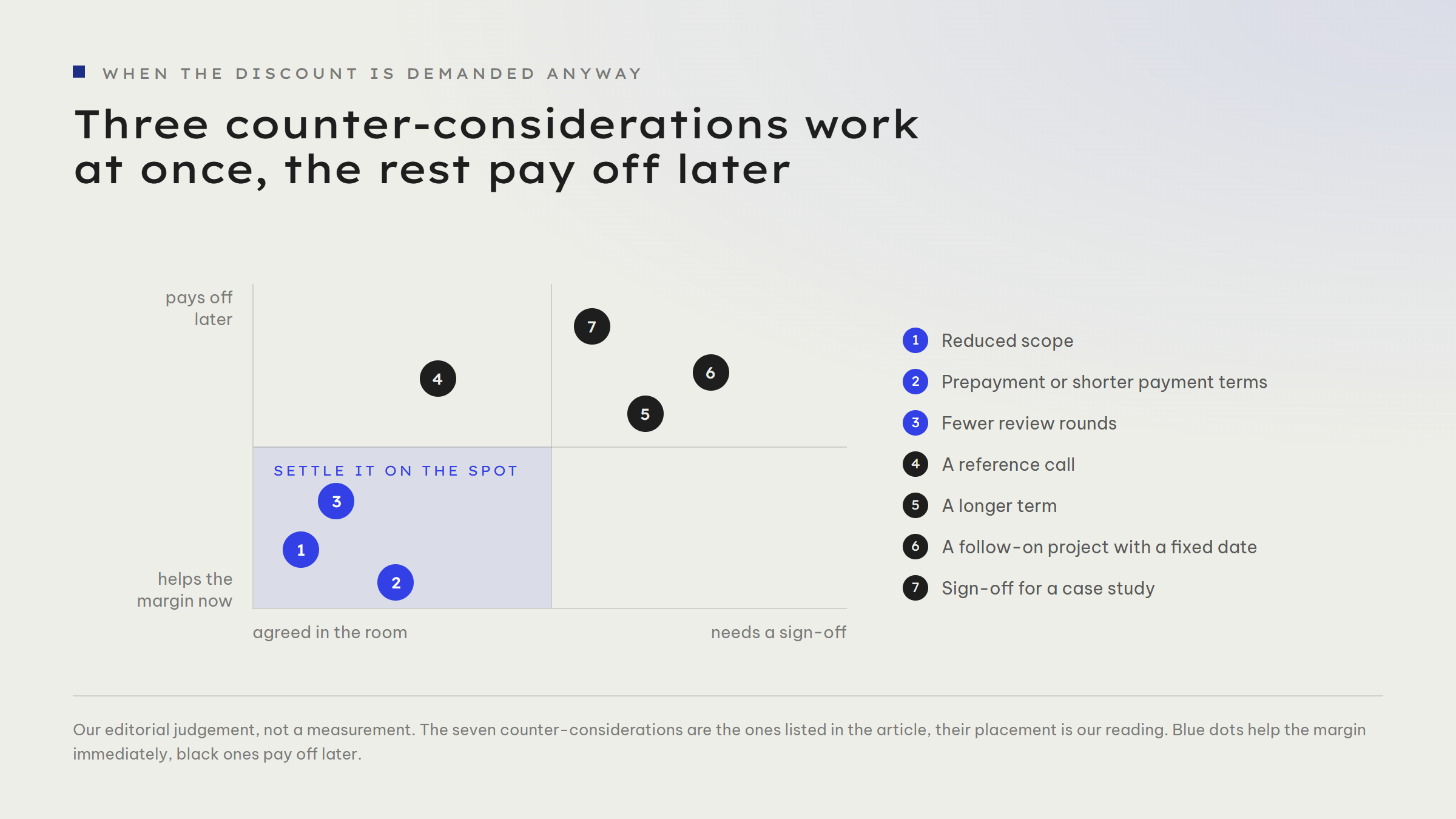
Then you move, but never one-sidedly. Every price movement needs something in return, and the list is longer than it feels in the moment: a longer term, prepayment or shorter payment terms, reduced scope, fewer review rounds, a reference call, sign-off for a case study, a follow-on project with a fixed date. "Yes, at twelve months" is a different answer from "yes". The first protects the price, the second devalues it retroactively.
The second lever is preparation. Decide in advance which segment gets which price and you do not have to improvise in the room. Simon-Kucher lists "strengthening customer segmentation strategies" among the main priorities for 2026, and for B2B companies specifically more dynamic contracts (26 per cent) and indices (18 per cent) as protection against cost volatility. In practice that means a clean customer segmentation with explicit rules on who can be given what, and in exchange for what. Who you actually mean is settled by the combination of an ICP at company level and a buyer persona at person level. They answer different questions: which companies fit, and who is sitting in the meeting and what they are afraid of.
The third lever is the walk-away price you write down before the meeting. Not as a feeling but as a number with reasoning, including an answer to what happens if you do not agree. Go into a price conversation without a stopping rule and you end up negotiating against your own calendar. A client who only buys below your floor is not a client, it is utilisation with extra costs. What they genuinely contribute over the term shows up most honestly in customer lifetime value, not in order size. For ongoing contracts there is one unglamorous clause that saves a great deal: indexation. Simon-Kucher reports that 53 per cent of companies use contract indexation, but only half of them enforce it consistently. A clause you are too polite to invoke is not a clause.
Three levers for your next proposal
Work out once what your standard discount costs. Take your last proposal, your usual reduction and your real contribution margin. The number that falls out changes price conversations more reliably than any negotiation technique.
Build the next proposal with a reference point, three options and a walk-away price. The reference point from the client's figures, the options staggered by scope and pace, the floor on paper before you walk in.
Decide per segment what is negotiable and what is not. And write the counter-consideration next to every possible reduction. Once that list exists, it runs the conversation instead of the reflex.
If you like, we can look at your next proposal together: where the reference point is missing, where the price stands unexplained, and what you can ask for in return the next time a discount comes up. 🙂