
It is the first question every prospect has and the last one many websites answer: what does it cost? Few decisions divide service providers and B2B companies as reliably as whether prices belong on the website. One camp fears giving away negotiating room and showing competitors its maths. The other quietly loses enquiries to providers whose price is one search away. Let us look at what the data says - and where the honest limit of pricing transparency runs.
Why is the pricing question even controversial?
Because two logics collide. Classic sales logic says: demonstrate value first, talk money later - publish a naked price and you get compared before you were allowed to explain. Buyer reality now says something different. Gartner published in May 2026 (645 B2B buyers, surveyed August to September 2025): 70 per cent prefer a completely digital, self-service buying experience, and 67 per cent would rather buy without any sales contact at all - a year earlier it was 61 per cent. The trend is accelerating. The counterweight sits in the same dataset: 69 per cent prefer to validate AI research findings with a human. Your buyers are not choosing between human and machine - they are deciding for themselves when the human enters. And in the phase before that, they research the entire customer journey alone. Leave the most important question unanswered there and you are simply not playing in that phase.
What happens when prospects cannot find a price?
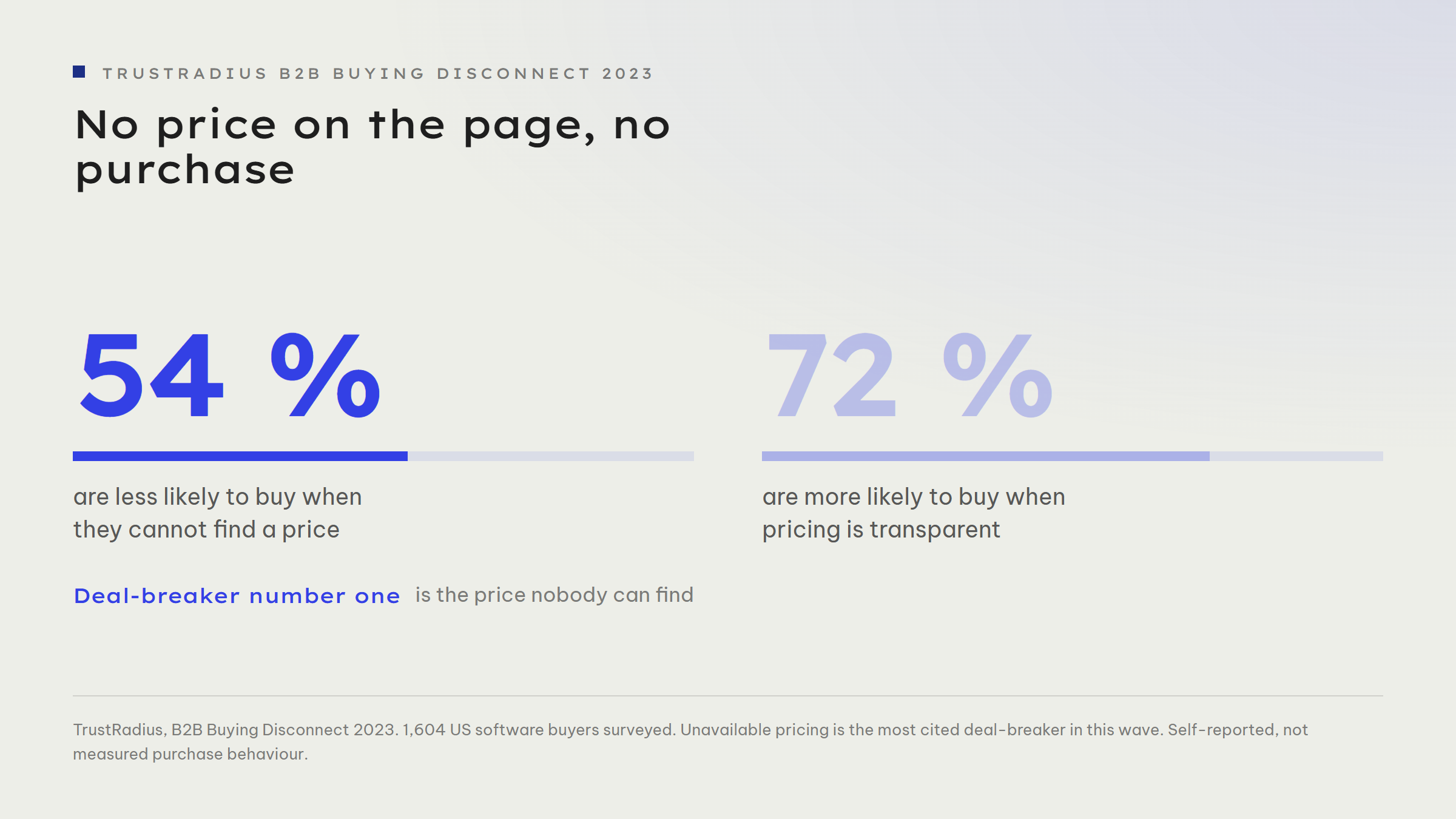
They leave - invisibly. The most detailed numbers come from the TrustRadius "B2B Buying Disconnect" series (US software buyers, though the mechanism is hardly industry-specific). 2022, with 2,185 respondents: 81 per cent want to find pricing information on their own, 54 per cent look for it right at the start of their research - and 16 per cent cross a vendor off the list entirely when they find none. 2023, with 1,604 respondents: unavailable pricing is the number one deal-breaker - 54 per cent become less likely to buy. Conversely, 72 per cent said transparent pricing makes them more likely to purchase.
The treacherous part: this leak shows up in no statistic. Whoever leaves over missing prices never filled in a form and never called - they are simply absent. Your conversion rate only measures those who stayed anyway. The hole sits at the very top of the funnel, exactly where you will never see it without asking the prospects you lost.
And who actually publishes their prices?
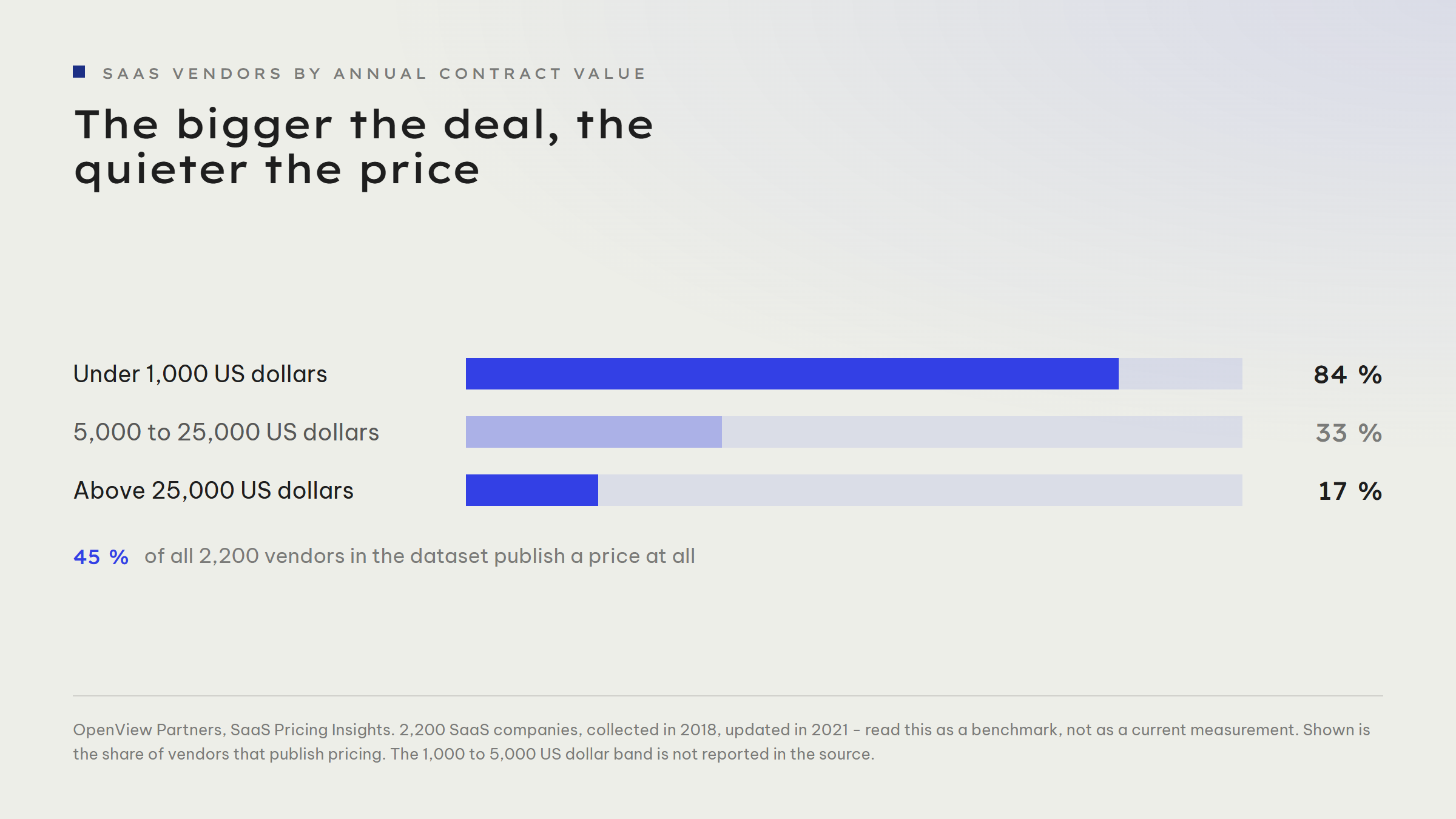
Far fewer providers than the demand would suggest. The largest survey on this comes from OpenView (2,200 SaaS companies, collected in 2018, updated in 2021 - honestly aged, so treat it as a benchmark): 45 per cent publish pricing, 55 per cent do not. The striking part is the split by deal size: for annual contracts under 1,000 US dollars, 84 per cent show their prices; between 5,000 and 25,000 it is 33 per cent; above 25,000 only 17 per cent. The bigger the deal, the greater the secrecy - and the emptier the field for whoever publishes anyway.
The standard objection goes: nobody buys large sums unseen online. The data no longer supports that either. According to McKinsey's ninth B2B Pulse (2024, 3,942 decision-makers), 39 per cent of B2B buyers would be willing to spend more than 500,000 US dollars per order through self-service or remote channels - two years earlier it was 28 per cent. The willingness to pay digitally is there. What is usually missing is just the number on the page.
What does pricing have to do with Google and AI?
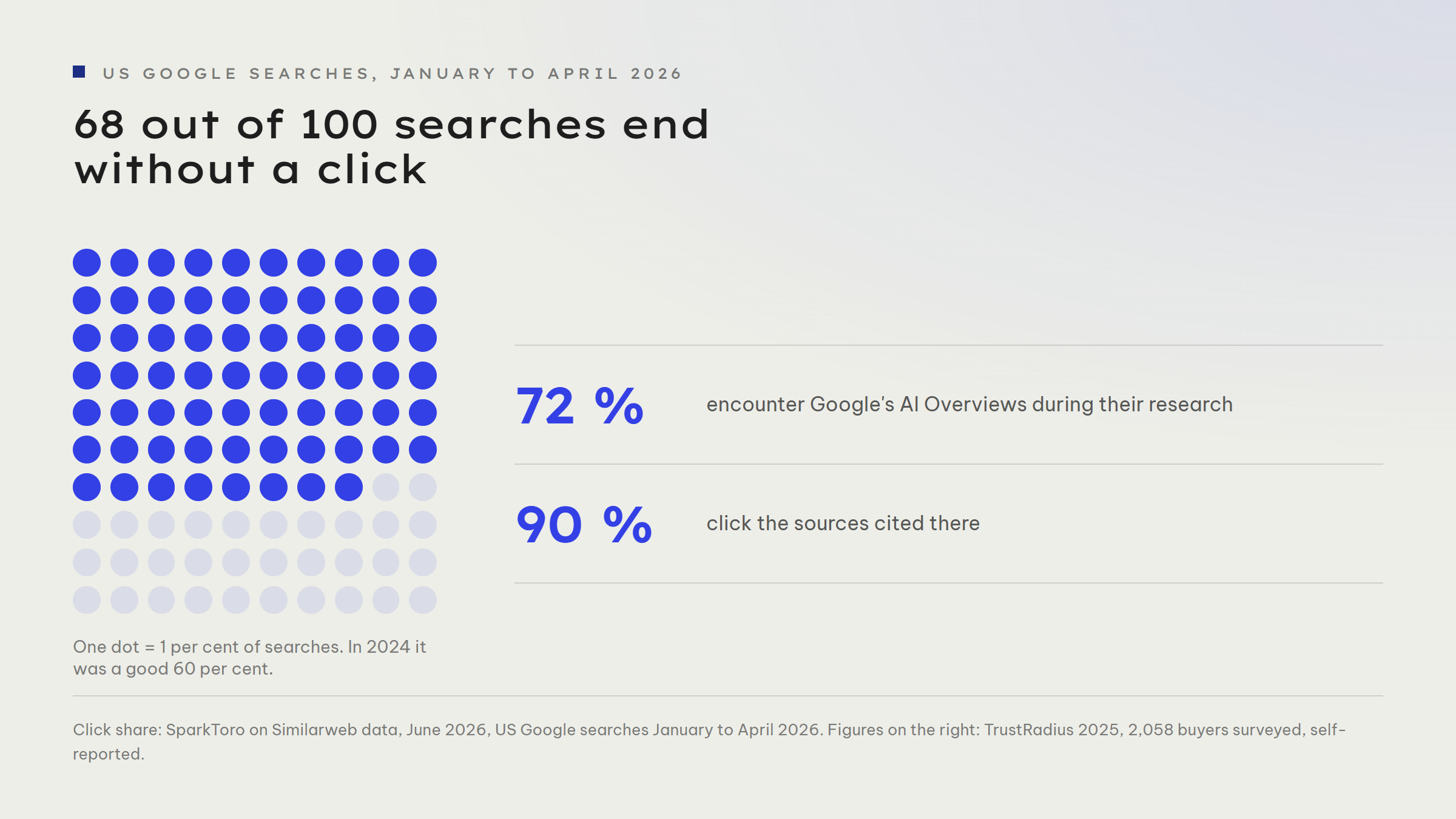
More than ever, because the pricing question has long stopped being asked only on your website. "How much does a website cost", "how much does an accountant cost", "how much does AI consulting cost" - Google increasingly answers such searches directly on the results page, and AI assistants answer them in chat. SparkToro showed on Similarweb data in June 2026: 68 per cent of US Google searches between January and April 2026 ended without a single click, up from a good 60 in 2024. In this zero-click world, visibility belongs to whoever gets cited - and cited is whoever answers the question in a structured way: the pricing question as a heading, an honest range in two to four sentences directly beneath it. Exactly this pattern wins the featured snippet and lands in AI answers.
Two numbers show it pays off: in the 2025 TrustRadius report (2,058 buyers), 72 per cent said they encounter Google's AI Overviews during research - and 90 per cent click through the sources cited there. A small VisibleIQ analysis from March 2026 (75 buying queries, 2,020 citations, so read with care) additionally found: for product questions, ChatGPT links to the vendor's own website in roughly three quarters of citations. Without a pricing page, your answer to the most-asked question simply does not exist in these systems - a comparison portal or your competitor gets cited instead.
When is it legitimate not to show prices?
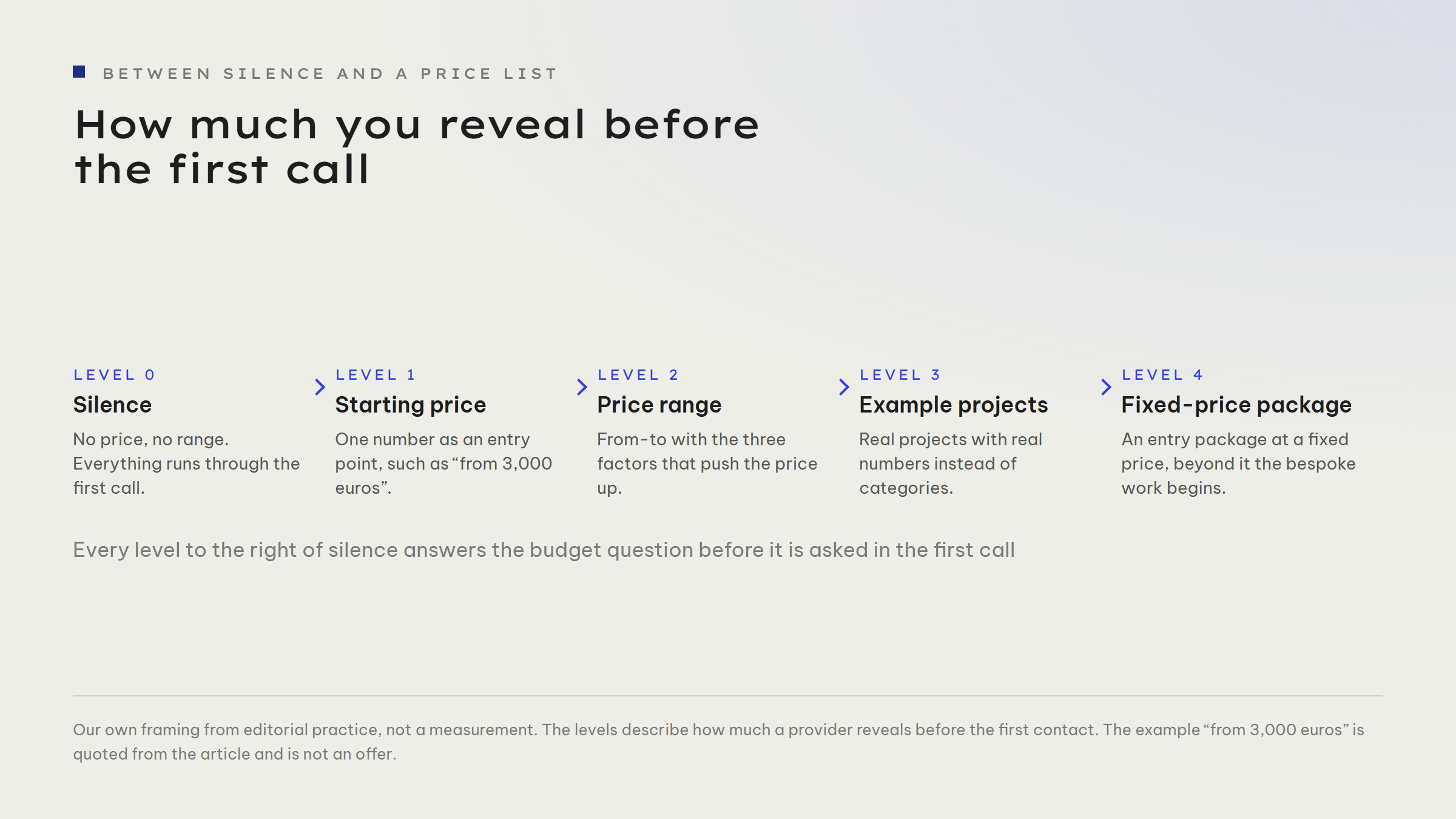
There are honest reasons: genuine enterprise projects whose price is 90 per cent scope, tenders with prescribed procedures, products that cannot be bought without an analysis first. The OpenView split shows that restraint on large deals is market practice. But between a fixed price list and silence lies a whole spectrum. Starting prices. Ranges with the three factors that drive the price. Example projects with real numbers. An entry package at a fixed price, beyond which the bespoke work begins. If you choose complete silence, know what it costs: invisible drop-offs at the top of the funnel - and first calls that are half budget talk, in other words lead qualification your website could have done long ago.
Three levers for a pricing page that converts
Show an honest range instead of nothing. "From 3,000 euros" with the factors that push the price up beats both silence and the fantasy price list with crossed-out numbers. Prospects do not want a guarantee to the cent - they want to know whether their budget plays in your league.
Answer the pricing question where it is asked. A dedicated page that carries "How much does ... cost?" verbatim as its heading and delivers the answer compactly right beneath it is a candidate for the snippet and the AI citation at once. Link it prominently from within your site - with descriptive anchor text like "pricing and packages" instead of a meaningless "learn more".
Use the price as a filter. Pricing transparency rarely lowers demand - it sorts it. Someone who knows your range and enquires anyway is a better lead than three who bail in the first call. Measure the effect properly: an A/B test of the pricing page against the old version shows you, in enquiry quality and booked calls, what transparency really changes for you.
Whether prices belong on your website is no longer a matter of belief in 2026 - the data points clearly in one direction, and the exceptions can be argued honestly. We practise this ourselves, by the way: our packages are on the website with numbers attached. If you want to know what an honest price range could look like for your offer, talk to us - you can book the call directly online. 💶