
The most tempting shortcut right now: put AI on top of your existing CRM and watch follow-ups, lead scoring and personalisation run themselves. The uncomfortable truth: AI does not turn your data into better data. It turns bad data into faster mistakes - politely worded, in your name, sent to real contacts. Put automation on top of a neglected CRM and you are automating the chaos. That is why CRM hygiene is not an optional warm-up project but the actual foundation. In this article: what the data situation in a typical CRM really looks like, what it costs, and a pragmatic route to an AI-ready database.
Why is data quality the point where AI projects actually fail?
Because the model is replaceable and your data is not. Gartner predicts that through 2026 roughly 60 per cent of AI projects will be abandoned because they are not supported by AI-ready data. Not because the technology fails - but because the data underneath makes the results unusable.
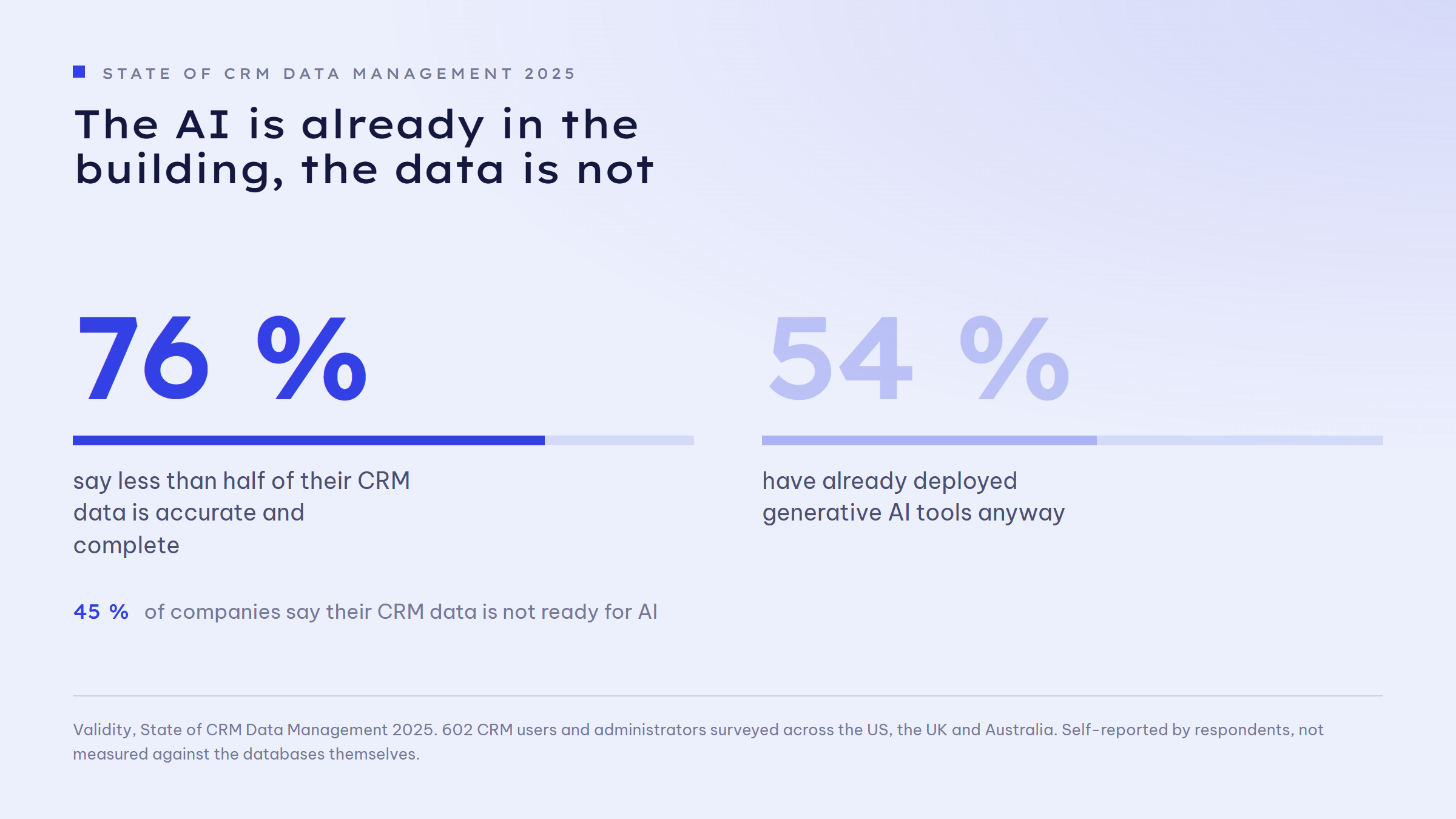
How far ambition and reality have drifted apart is documented in Validity's State of CRM Data Management 2025 (602 CRM users and administrators surveyed): 76 per cent say less than half of their CRM data is accurate and complete. At the same time, 54 per cent have already deployed generative AI tools. Most companies are building the second floor while the foundation is crumbling - and 45 per cent openly admit their data is not ready for AI.
What does bad CRM data actually cost?
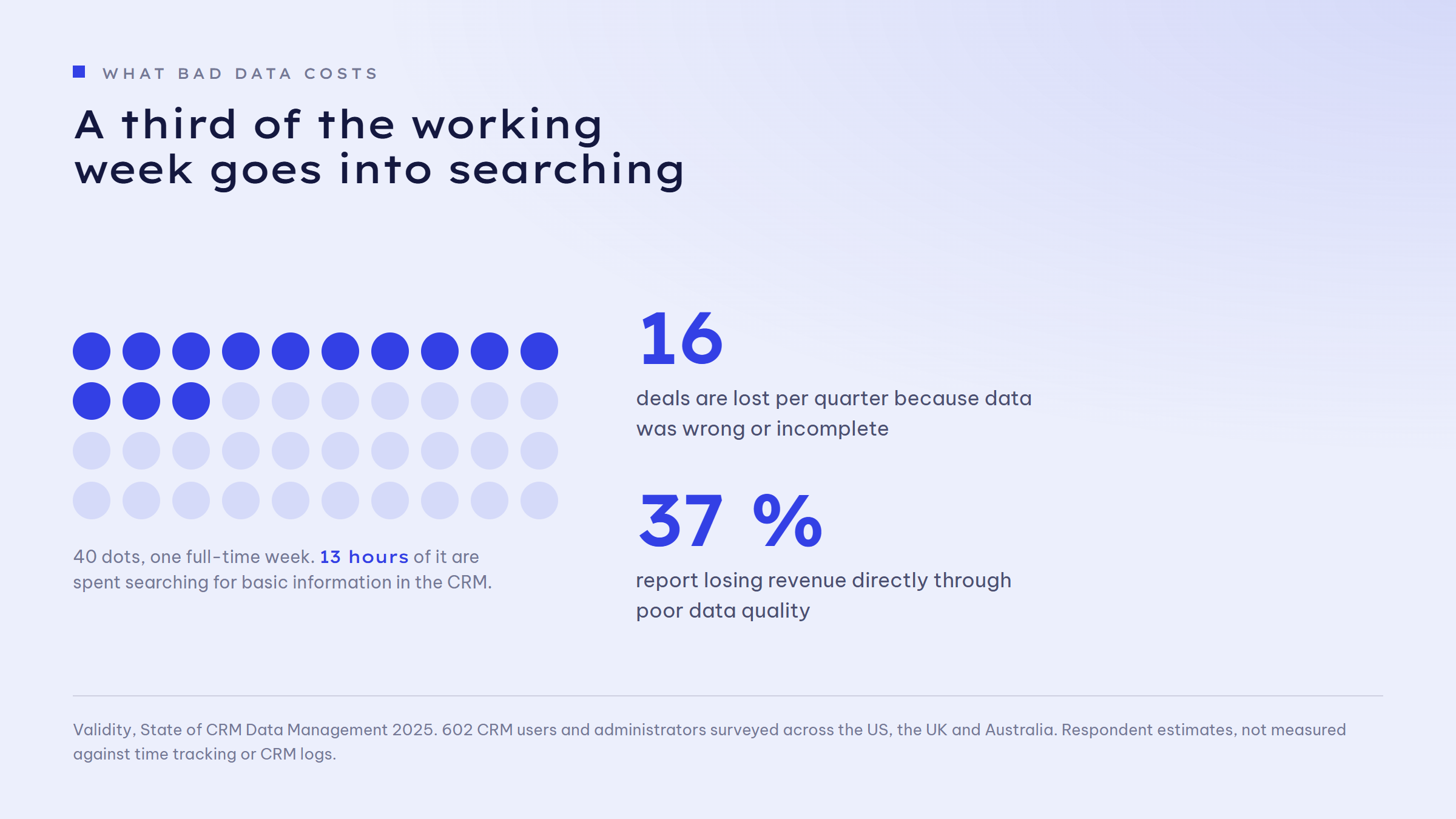
The Validity numbers get uncomfortably specific: on average, 16 deals are lost per quarter because data was wrong or incomplete. 37 per cent of respondents report losing revenue directly through poor data quality. And the working-time side is almost worse - staff spend an average of 13 hours per week searching for basic information in the CRM. That is a third of a full-time role, spent on searching.
Back in 2021, Gartner put the average cost of poor data quality at 12.9 million US dollars per company per year - measured at large organisations, but the mechanism is identical at twenty employees: wrong decisions, duplicated work, burnt trust. One detail from the Validity study should alarm you most: 37 per cent of staff admit to regularly fabricating data when the real thing is missing. That is the input your lead scoring logic is calculating on.
Why does your data age faster than you think?
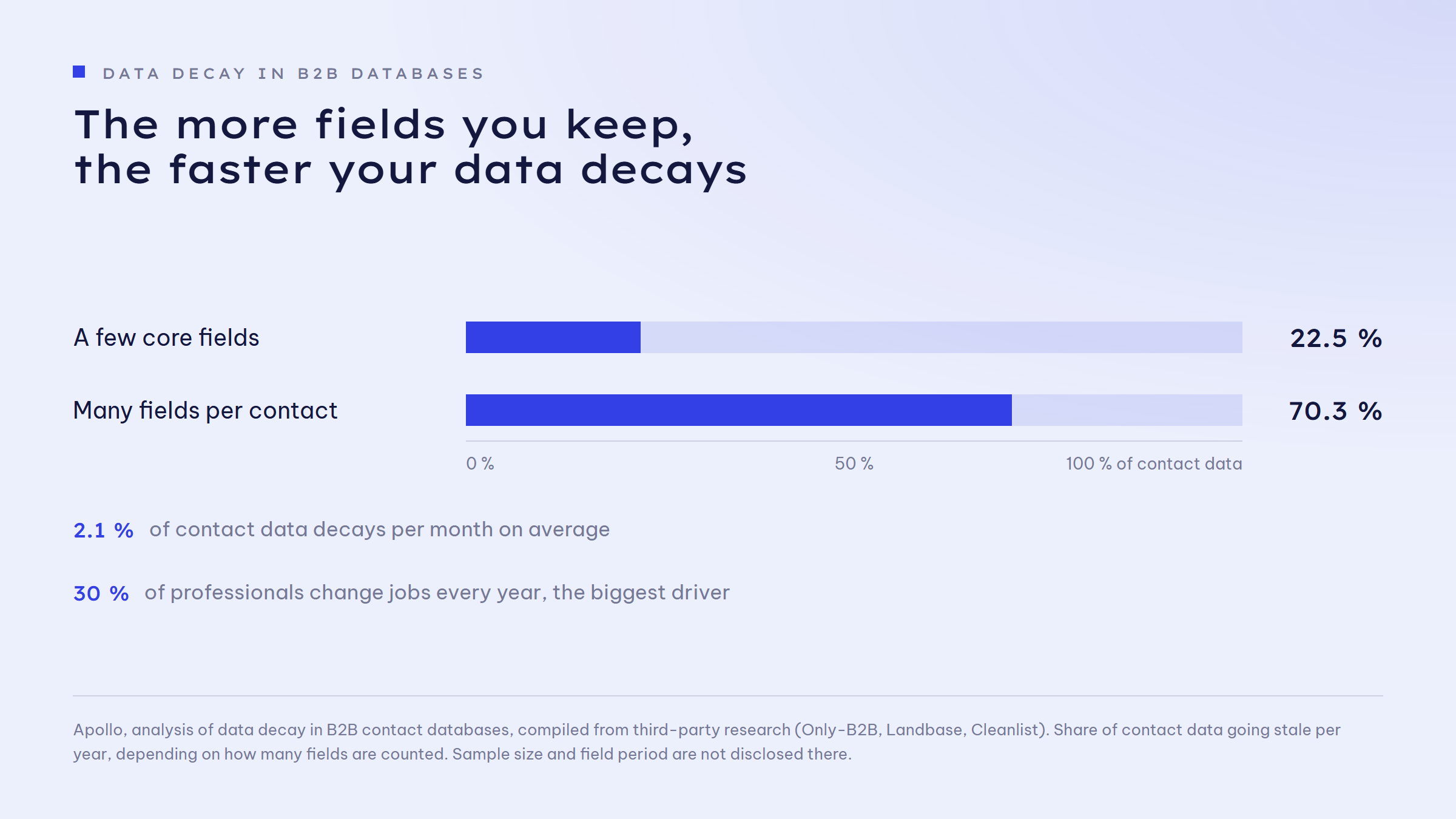
Because your CRM is a snapshot of the outside world, and the outside world moves. Apollo puts the average decay rate of B2B databases at 2.1 per cent per month - depending on how many fields you count, 22.5 to 70.3 per cent of contact data decays per year. The biggest driver: roughly 30 per cent of professionals change jobs annually, and every move kills an email address, a direct line and a job title in every database that holds them.
In practice that means: even if you clean up perfectly today, about a quarter of your contacts will be stale again within a year. CRM hygiene is therefore not a spring clean but a process - like brushing your teeth, not like renovating the house. Once you accept that, you build maintenance into the routine instead of launching a rescue project every two years.
What does AI make of bad data? Confident mistakes
A language model has no guilty conscience. When the data is thin, you quickly get a hallucination: a fluent, entirely confident answer that is simply wrong. In a CRM context that means the AI emails the contact who left the company two years ago, congratulates someone on the wrong role, or personalises around an interest that was never recorded - just invented.
The remedies are well known, and every one of them only works on a clean database: retrieval-augmented generation forces the model to answer from your actual data instead of from memory - but if your actual data is wrong, the AI will quote the error with perfect precision. A good system prompt instructs the model to name missing information instead of inventing it. And human-in-the-loop makes sure a person sees critical messages before they go out. All three layers stand or fall on whether your AI agent is working on data that can be trusted.
How do you clean up your CRM without losing a year?
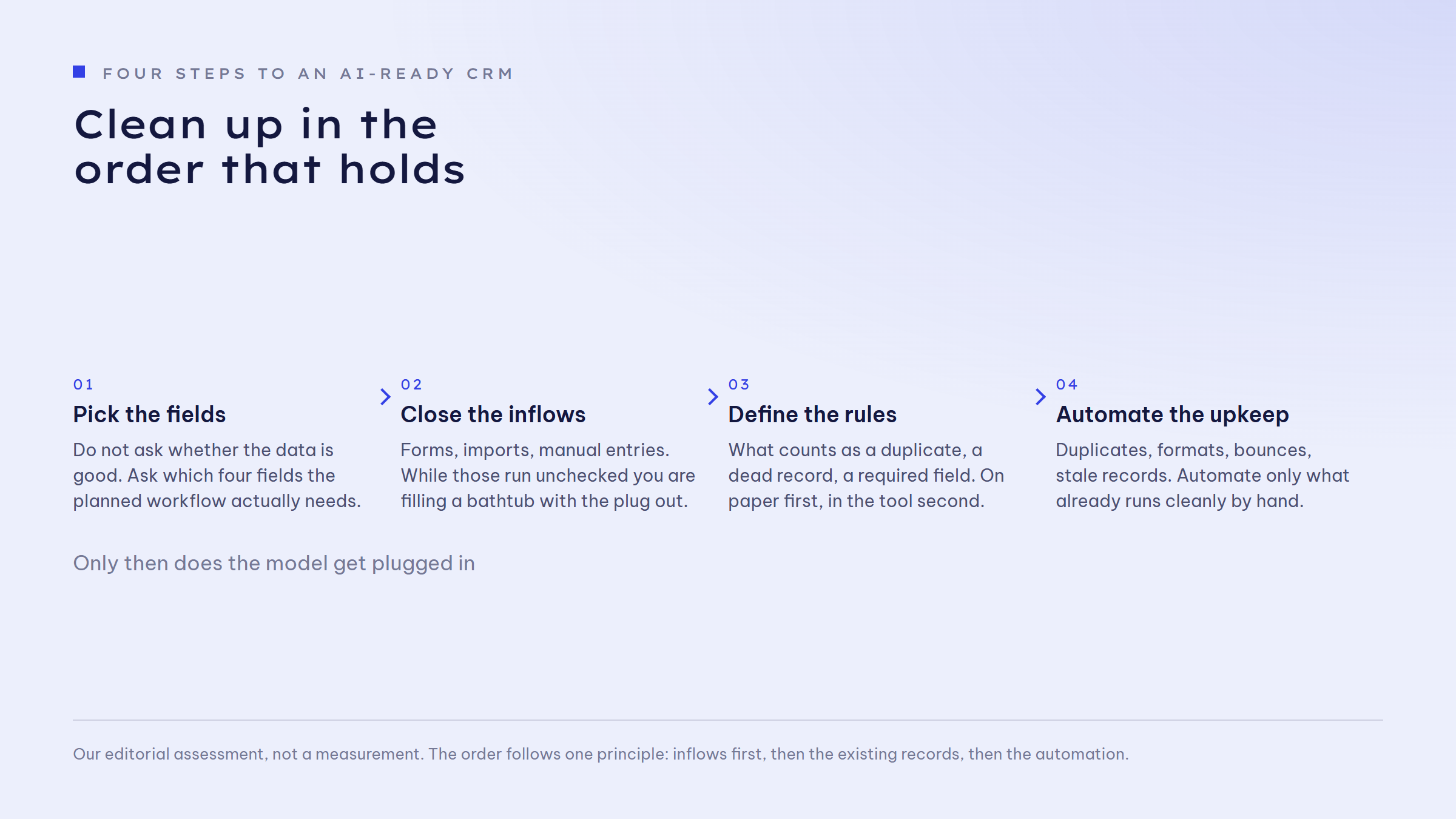
The mistake is aiming for completeness. You do not need a perfect CRM - you need reliable core fields for the processes you want to automate. A pragmatic sequence:
First: audit along the automation. Do not ask "is our data good?" - ask "which fields does this specific workflow need?". For automated follow-ups that is usually: valid email, current contact person, stage in the funnel, last touchpoint. Getting four fields verifiably clean is achievable - forty is not.
Second: fix the inflows before scrubbing the stock. As long as forms, imports and manual entries flow into the CRM unchecked, you are filling a bathtub with the plug out. Cut required fields radically, validate at the source, check for duplicates on creation - and collect first-party data consistently at the moments a contact is already talking to you.
Third: automate the maintenance, but keep control. Ironically, data upkeep is itself a grateful candidate for automation - duplicate detection, format normalisation, bounce processing, resurfacing stale records. The order matters: define the rules first, then automate them. Otherwise an overeager tool will merge two real customers into one.
Where do you start this week?
Three levers that pay off immediately:
Lever 1: measure your starting point honestly. Pull a sample of 50 contacts and check the four core fields by hand. The rate you find is your baseline - and usually the best argument for prioritising the clean-up.
Lever 2: close the biggest inflows of dirt. One required field fewer on the form, one validation more, a duplicate check on creation. An hour of work that keeps working every day after.
Lever 3: automate only the process you already master manually. If your team runs the workflow cleanly by hand, it knows the exceptions - exactly the list your AI setup will need later. If not, the AI merely documents that the process never existed.
If you want to know where your CRM stands on the road to AI readiness: drop us a line - we will look at your data together before anyone plugs in a model. 🧹