
There is a moment that shakes anyone's faith in marketing attribution: you ask a new customer how she found you. She says "a colleague recommended you, then I googled you". Your dashboard has long since filed the same event - as "organic search". The recommendation, the actual reason, appears nowhere. Marketing attribution promises to assign every channel its share of revenue. In 2026, the honest verdict is this: part of it is measurable, part of it never was - and anyone who confuses the two ends up optimising for the wrong signal.
That is no reason to stop measuring. It is a reason to look more closely at which number is a measurement and which is merely a model. Let's start with the gap.
How big is the gap between dashboard and reality?
Bigger than most are willing to admit. US agency Refine Labs ran a twelve-month double measurement of its own pipeline in the study "The Attribution Mirage": once via attribution software, once via buyers' own accounts ("How did you hear about us?"). 620 enquiries, 21.5 million dollars in closed revenue. The result: the software credited 78 percent of conversions to web search - the buyers themselves named search in only 12 percent of cases. 85 percent located their first contact in channels no pixel can see: social media, podcasts, communities, recommendations. The podcast, responsible for 53 percent of revenue according to self-reported data, simply did not exist in software attribution: zero percent.
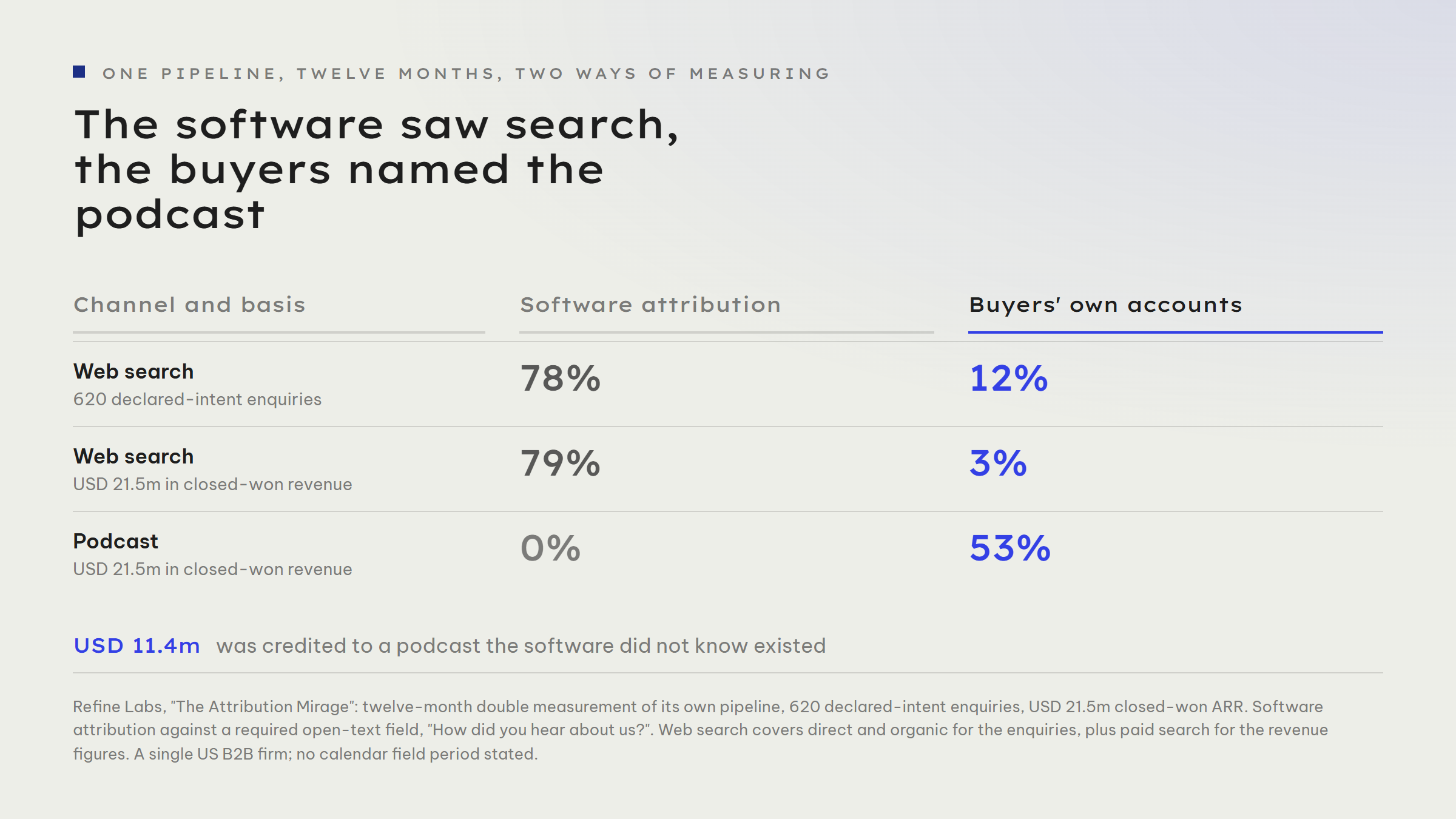
To be fair: those are the figures of a single US B2B firm over twelve months, not a universal law. But the mechanism behind them is universal. Software attribution measures the last technically visible click before the conversion - and that is almost always a search for your name or a direct visit. Everything before it, the actual decision along the customer journey, stays dark. Your dashboard systematically rewards the channel that harvests and overlooks the one that sows.
What can you technically still track in 2026?
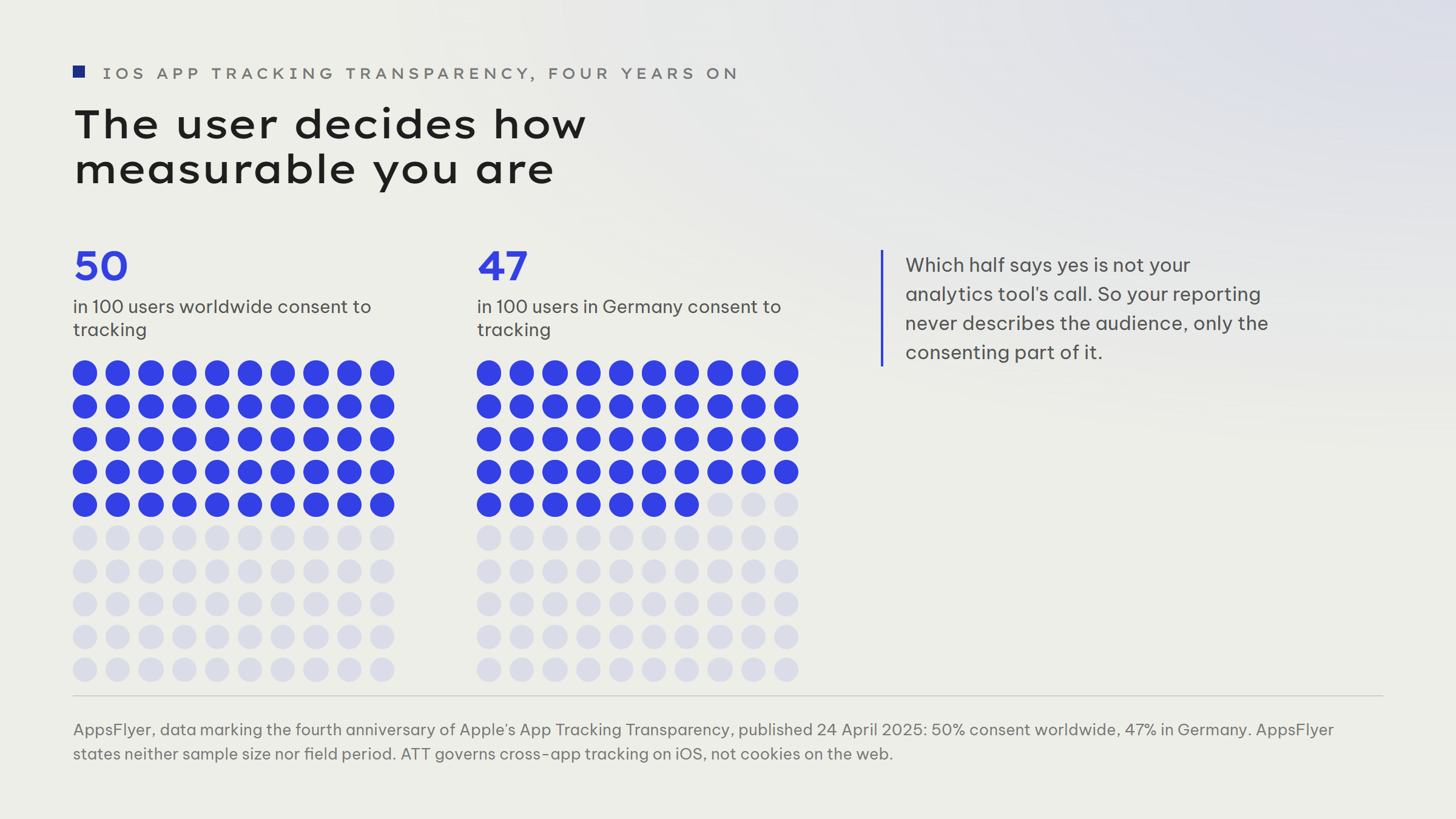
Less than the dashboards suggest - and it is not your setup's fault. On iOS, apps have had to ask permission before tracking users across apps since 2021. AppsFlyer reported in April 2025 that 50 percent of users consent globally, 47 percent in Germany. Put differently: roughly half of your mobile audience is invisible to cross-channel tracking - and which half is decided not by your analytics tool but by the user.
The cookie situation is stranger still. On 22 April 2025, Google officially announced that it would not remove third-party cookies from Chrome after all - after years of announced deadlines. That is still no all-clear: Safari and Firefox have long blocked third-party cookies by default, and in the EU a consent banner stands between you and every tracking script, and plenty of visitors decline it. Your analytics therefore never see "the visitors", only the subset that used the right browser and clicked accept. Every conversion rate you derive from that carries this blind spot within it - as does retargeting, which is built on the same signals.
Why is everyone suddenly talking about marketing mix modelling again?
Because the industry is quietly admitting that click tracking alone cannot answer the question. Marketing mix modelling, MMM for short, estimates each channel's contribution statistically from aggregated data - spend in, revenue out, no cookies involved. The method is decades old and was long considered an enterprise tool. That Google, of all companies, open-sourced its own MMM "Meridian" for everyone in January 2025 is the most honest admission the world's largest advertising business could make: understanding impact takes more than attribution pixels.
For small and mid-sized teams, honesty also means this: MMM needs long data histories, meaningful budgets across several channels and someone who understands the model. Below a few thousand euros of monthly budget per channel there is simply too little signal to model. The direction still holds at small scale: away from the illusion of following every click, towards the question of whether the funnel as a whole closes more when you turn a channel up or down.
What can you measure reliably instead?
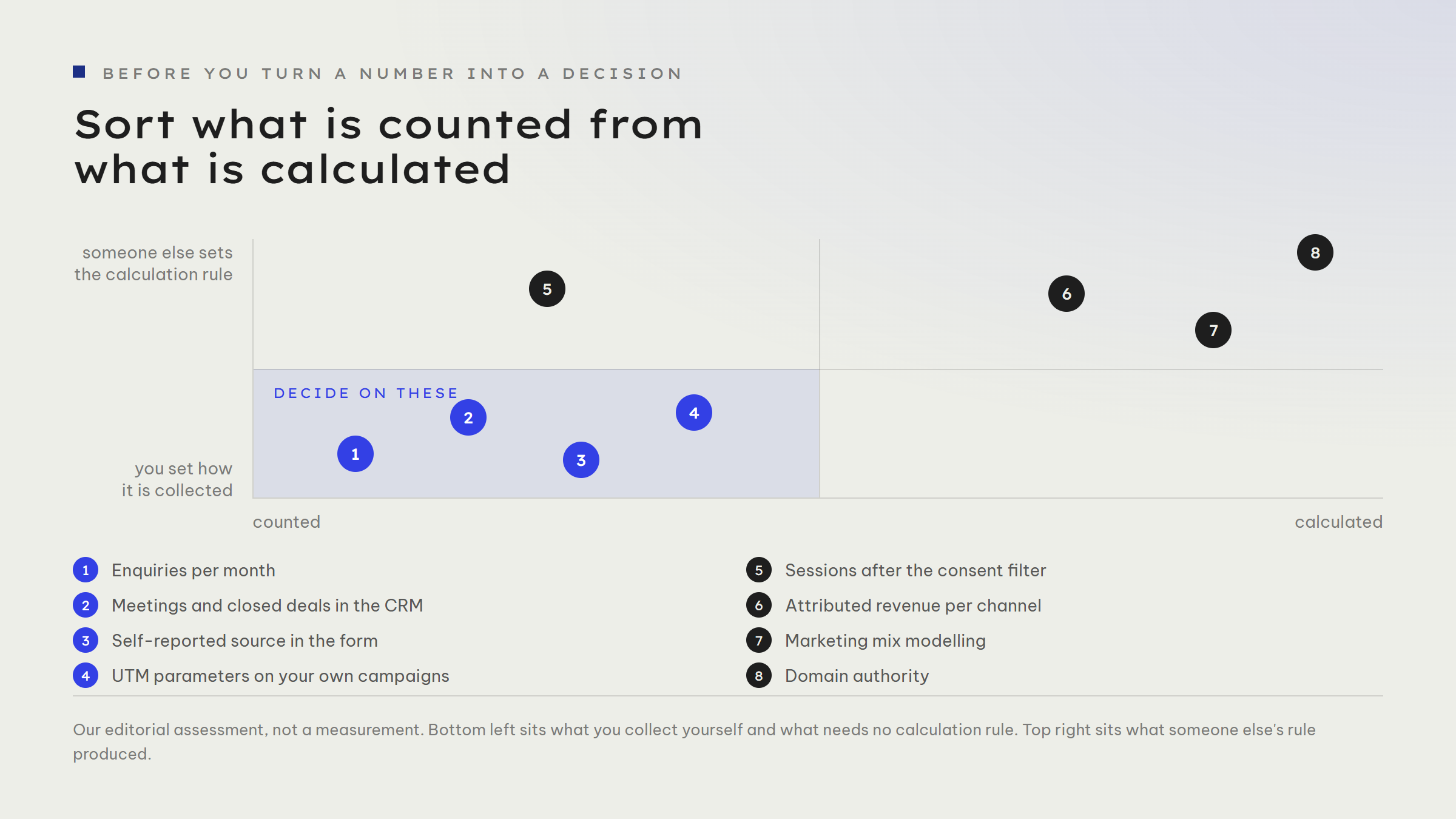
Four things hold up, and none of them is exotic. First: UTM parameters on everything you send and run yourself - named consistently rather than improvised creatively. They make your own campaigns cleanly distinguishable; they naturally cannot help with organic discovery. Second: a required "How did you hear about us?" field in every form. It was exactly this self-reported answer that surfaced the podcast the software had estimated at zero in the Refine Labs study - and a free-text field beats any dropdown. Third: first-party data in a well-kept CRM, where source and self-reported answer are attached to the contact and travel with it to the closed deal. Fourth: the business figures themselves - enquiries, appointments, closed deals per month. They are incorruptible because they need no model.
And learn the cross-check: distinguish measured numbers from modelled ones. A received enquiry is a fact. "Attributed revenue per channel" is an estimate produced by a calculation rule - just like popular third-party scores such as domain authority, which simulate authority rather than measure it. Models may inform decisions. Facts should make them.
Three levers for honest attribution
Ask your customers instead of only tracking them. A required "How did you hear about us?" field costs an hour to set up and uncovers the channels no pixel sees. Review it monthly next to your software attribution - the difference between the two is the most interesting number in your reporting.
Bring discipline to what you control. Consistent UTM conventions, clean source fields in the CRM, one A/B test instead of three parallel changes. You cannot measure everything - all the more reason for the measurable part to be right.
Decide at the level of business figures. Whether a channel stays should depend on what happens to enquiries and closed deals when you change it - not on the share a model assigns to it. Turn a channel up for a month, watch the business figures, then decide: that is the incrementality test for teams without a data science department.
Attribution in 2026 does not mean finding the perfect assignment - that never existed. It means measuring what is measurable with open eyes and honestly treating the rest as an estimate. If you want to know what a measurement setup looks like for your team in practice, talk to us - book a slot directly online. 📊