
Likes. Hashtags. Reach. For years, these were the numbers everyone talked about on social media. But something far more interesting is happening in the background - and almost no one is talking about it.
Instagram understands content far better today than it did a few years ago. The platform analyses text, video, audio and user behaviour, and recognises ever more precisely what a post is about and who it's relevant for. At the same time, social media is increasingly becoming a search engine. So the decisive question is no longer "How do I get more reach?", but: Am I found, understood and recommended?
Do the platforms really understand what you're talking about?
Yes - and increasingly precisely. What used to hang on a handful of hashtags now follows from the content itself. The platforms read the spoken words in your reel, the text on screen, the caption, even the image content. From that, they build an understanding of which topic a post covers and which person gets something out of it.
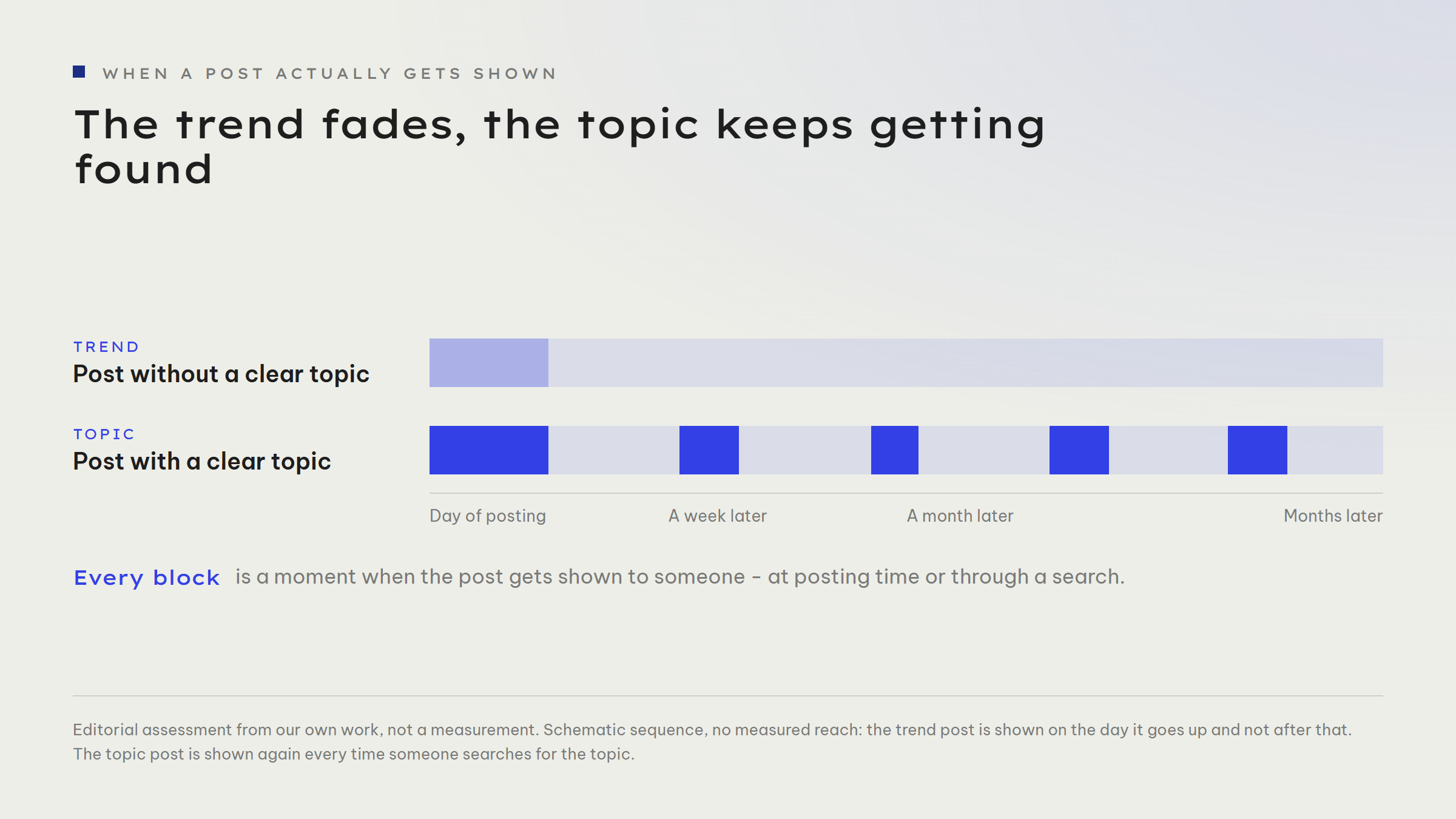
For you, that means the algorithm no longer just rewards what grabs attention for a moment, but what is unmistakable. A post that makes clear what it's about, who it's for and which problem it solves gets shown to the right people - even weeks later. A post that only rides a trend fizzles out the moment the trend is over.
Why is social media becoming a search engine?
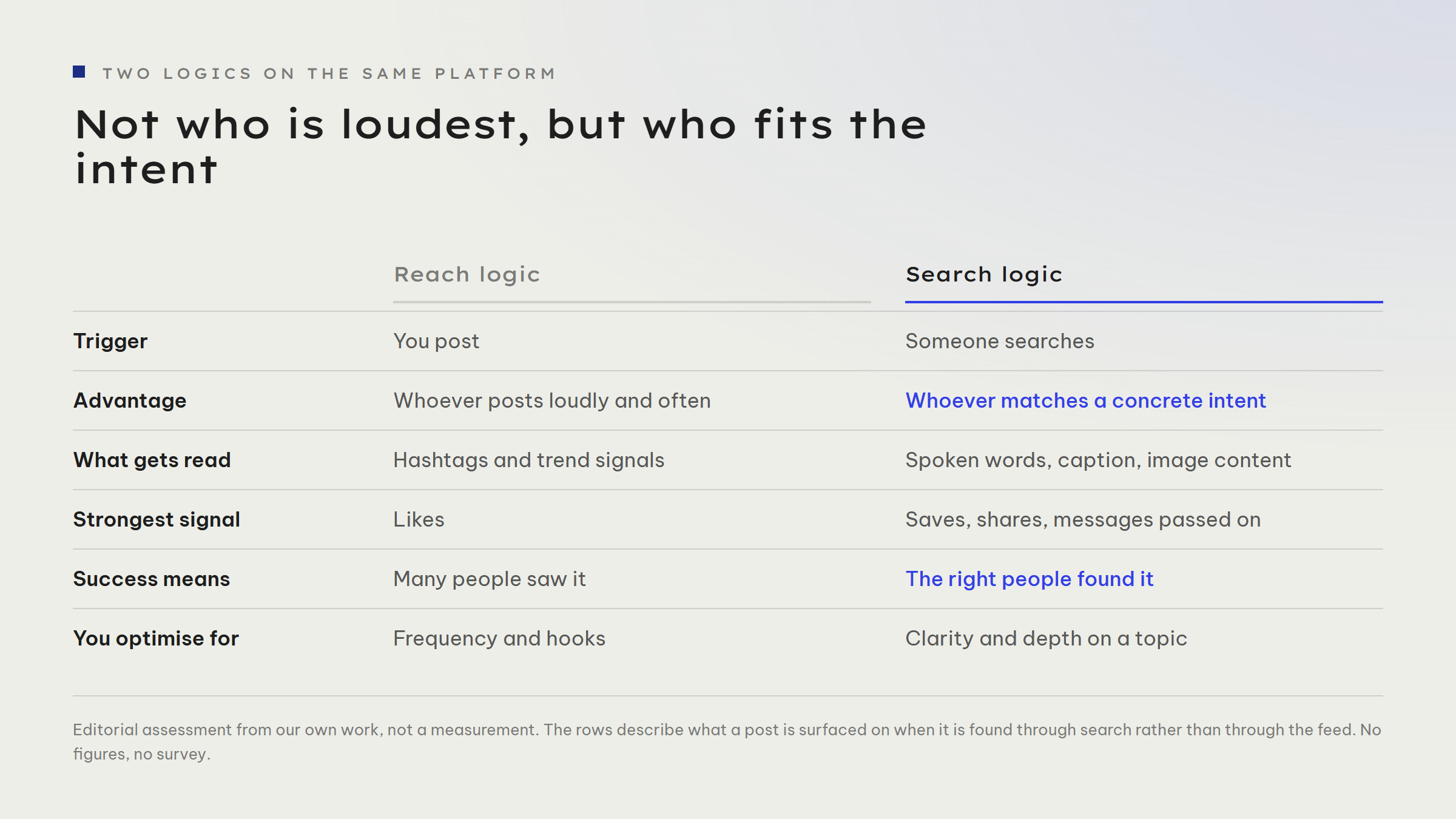
Search behaviour is shifting. Restaurants and hotels are searched for on Instagram and TikTok, not just on Google. Products are discovered and bought directly inside social platforms with built-in shops. Many people now type their question into an app's search bar first - and expect an answer there, not an ad banner.
Suddenly, the rules we know from classic search apply to social media too. What counts isn't how loud you are, but how well you match a concrete intent. Visibility no longer happens only the moment you post - it happens every time someone searches for exactly your topic.
The new core question: are you found, understood, recommended?
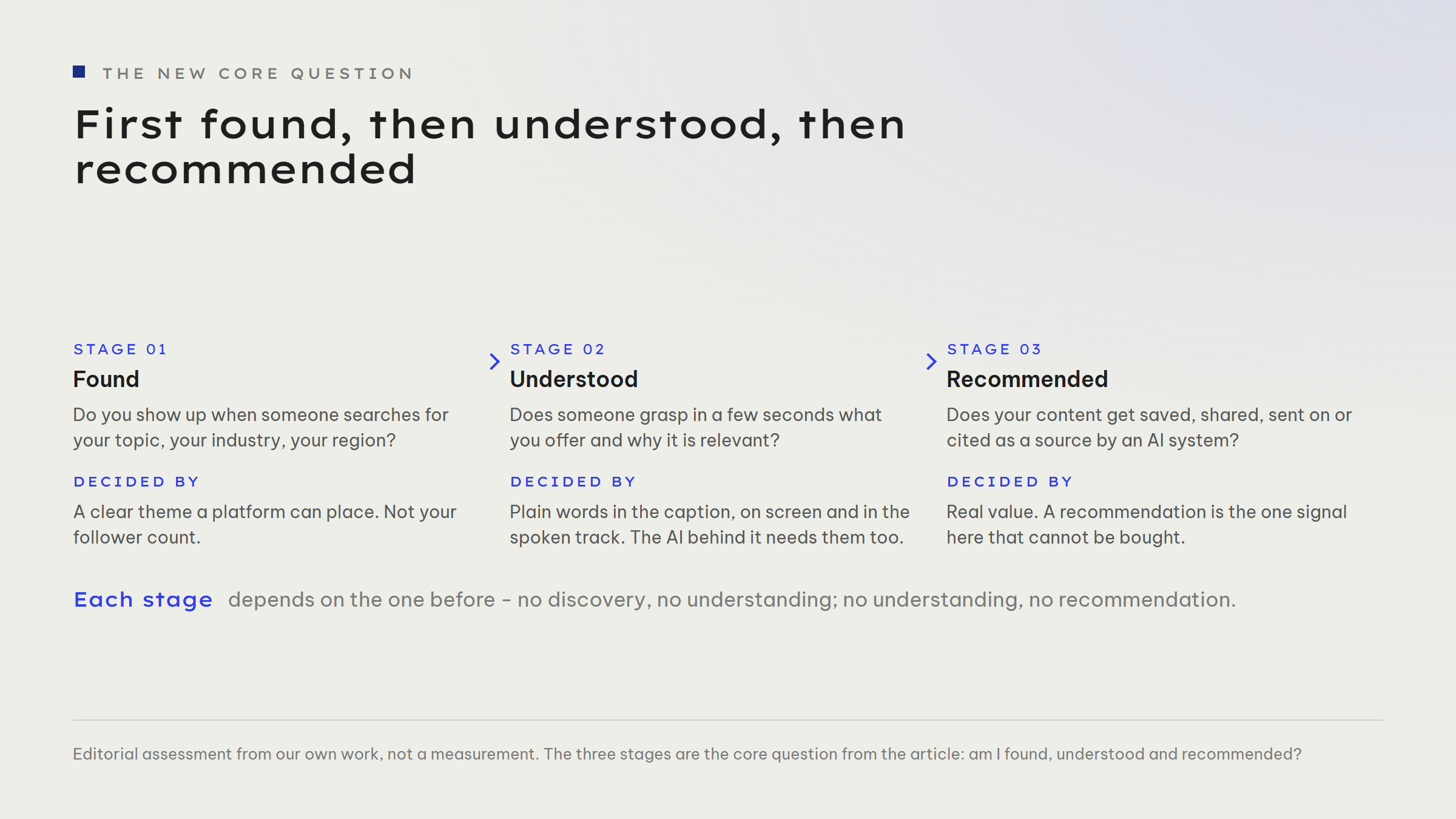
Three things decide in this new environment - and they build on each other.
Found: Do you show up when someone searches for your topic, your industry, your region? That depends on whether your content has a clear theme a platform can place - not on your follower count.
Understood: Does someone grasp in a few seconds what you offer and why it's relevant? That clarity is needed not only by the person in front of the screen, but also by the AI behind it that decides who gets shown your post.
Recommended: Does your content get saved, shared, sent in a message - or cited as a source by an AI system? A recommendation is the strongest signal of all, because it grows out of real value and can't be bought.
How are social, search and AI converging?
Here's the interesting part: behind Google, Instagram, TikTok and AI answer systems like ChatGPT, there's increasingly the same logic. They all try to understand what a piece of content means and match it to the person searching for it right now. Whoever makes their content unmistakable, well structured and thematically clear becomes visible across all of these channels - not just one.
That's exactly why we believe social media, search and AI will keep growing together over the next few years. It no longer pays to think of every channel in isolation. It pays to clarify, once and properly, what you stand for - and to make that consistently understandable everywhere.
What does this mean concretely for your company?
Three levers that do more today than any reach optimisation:
Say plainly what you do. In the caption, in the on-screen text, in the spoken word. Not "new project 🚀", but "this is how hotels in Vienna find new guests through social media". What a platform doesn't understand, it can't surface.
Own topics instead of trends. A few clearly defined topics you keep saying something substantial about make you findable and memorable. Constantly shifting trends make you interchangeable.
Build a visible next step. Whoever finds and understands you should know what to do next - a request, a booking, a newsletter. Visibility without a way forward leads nowhere.
Reach was never a business model - and it's now becoming a side note for good. Whoever makes sure the right people find them, understand them instantly and recommend them is building visibility that lasts.
If you'd like to think through what this concretely means for your company, just send us a message. 💌