
Product pages are usually the best maintained pages on a website. Fresh images, correct prices, a description that has been through three rounds of editing. And still, the AI answer to "which model fits my case" quotes somebody else's comparison article. That is rarely a writing problem. It happens because an AI answer pulls product facts and product judgement from two completely different sources, and your page is normally built for only one of them. Let us look at what measurably changed in 2026, where these systems really get their product data, which page types get cited, and what has to stay on the page because no data channel carries it.
What broke between ranking and citation?
For a long time there was a comfortable rule of thumb: rank in the top 10 and you get cited in the AI answer. Ahrefs checked that in July 2025 against 1.9 million citations from one million AI Overviews and found 76.1 per cent overlap. Only 14.4 per cent of cited pages did not rank in the top 100 for the same query at all.
In March 2026 the same team repeated the analysis, this time across 863,000 keyword SERPs and 4 million citation URLs. The figure is now 37.9 per cent. The rest splits almost evenly between positions 11 to 100 (31.2 per cent) and pages that do not appear in the top 100 for that query at all (31.0 per cent).
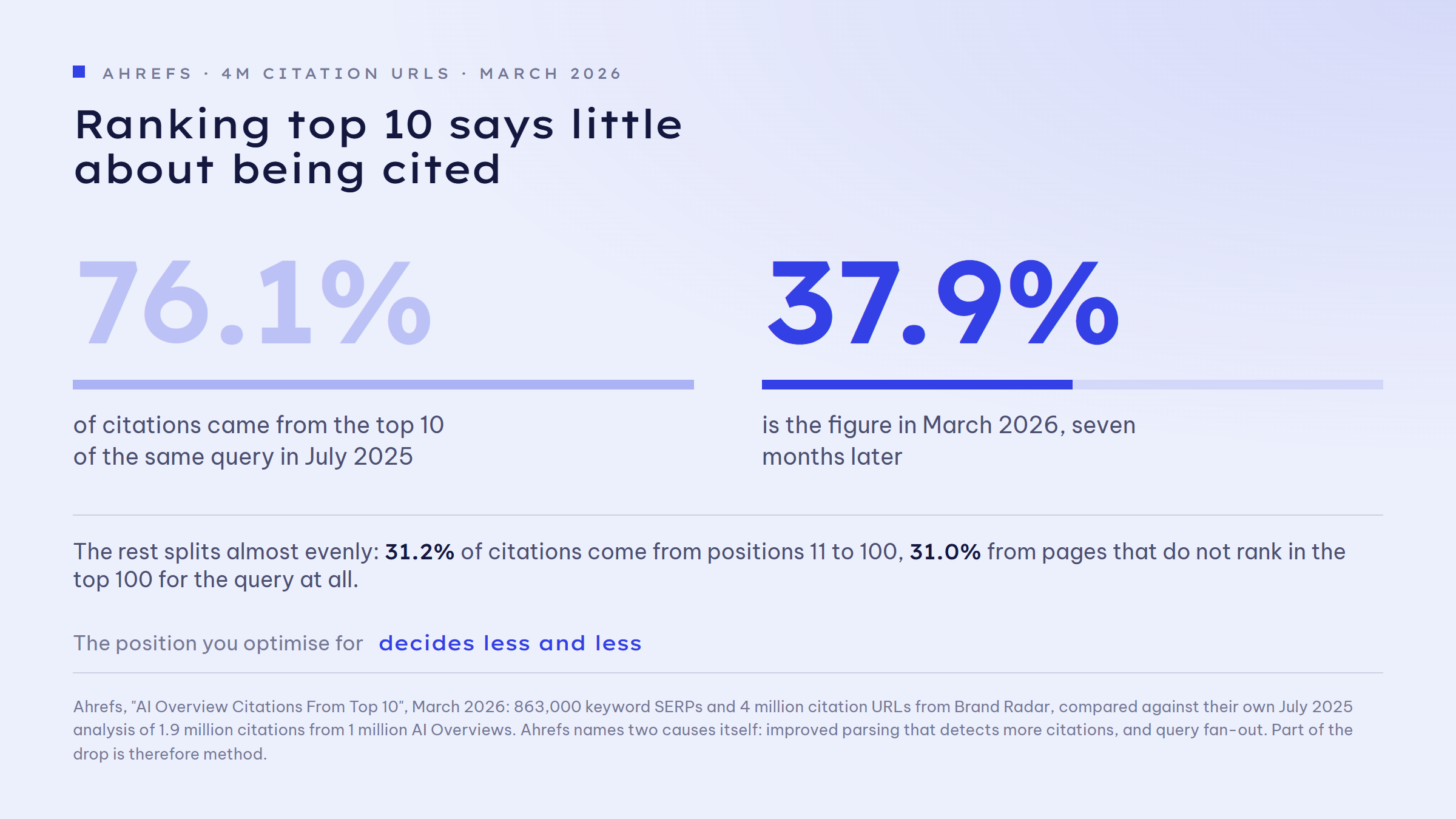
Both causes belong in the picture. Part of the jump is method: better parsing picks up citations that were previously missed. The other part is query fan-out. Google splits a query into sub-questions, searches for each one separately, and then cites the pages that keep showing up across those sub-searches. Your position for the single term you optimised for therefore decides less and less. Incidentally, YouTube is now the single most cited domain in AI Overviews, at 5.6 per cent of all citations and up 34 per cent in six months.
Why AI does not read price and availability from your page
This is where it gets uncomfortably concrete for product pages. The large systems do not take a product's hard facts from your HTML. They take them from a catalogue you supply yourself.
Google put a number on its Shopping Graph in November 2025, verbatim: "more than 50 billion product listings, 2 billion of which are updated every hour". It is fed by what retailers submit directly through Merchant Center and by what retailers and brands publish across the web. With OpenAI it is even more explicit. The Product Feed Spec describes a catalogue that merchants deliver as a file, over SFTP, in TSV, CSV, XML or JSON. The reasoning sits in the specification itself: "OpenAI relies on merchant-provided feeds - this ensures accurate pricing, availability, and other key details." The system accepts updates every 15 minutes.
For you that means price, availability, variant and product identifier are a data product, not a text product. If feed and page drift apart, the page is not automatically treated as the truth. And if you have no catalogue because you sell services rather than products, you have the same problem one level up: the facts that carry weight need to sit on the page in machine-readable form, through schema markup, not only as a sentence in the copy.
Which page types actually get cited?
The agency DeltaV Digital analysed 25,337 citations across 21,075 AI answers between 14 April and 13 July 2026, covering ChatGPT, Perplexity, Gemini, AI Overviews and AI Mode, for eight brands in eight industries. The split by page type: articles 23.7 per cent, listicles 19.6 per cent, product pages 16.3 per cent, other 11.8 per cent, homepages 10.8 per cent, category pages 5.2 per cent, how-to guides 4.5 per cent, comparison pages 4.1 per cent.
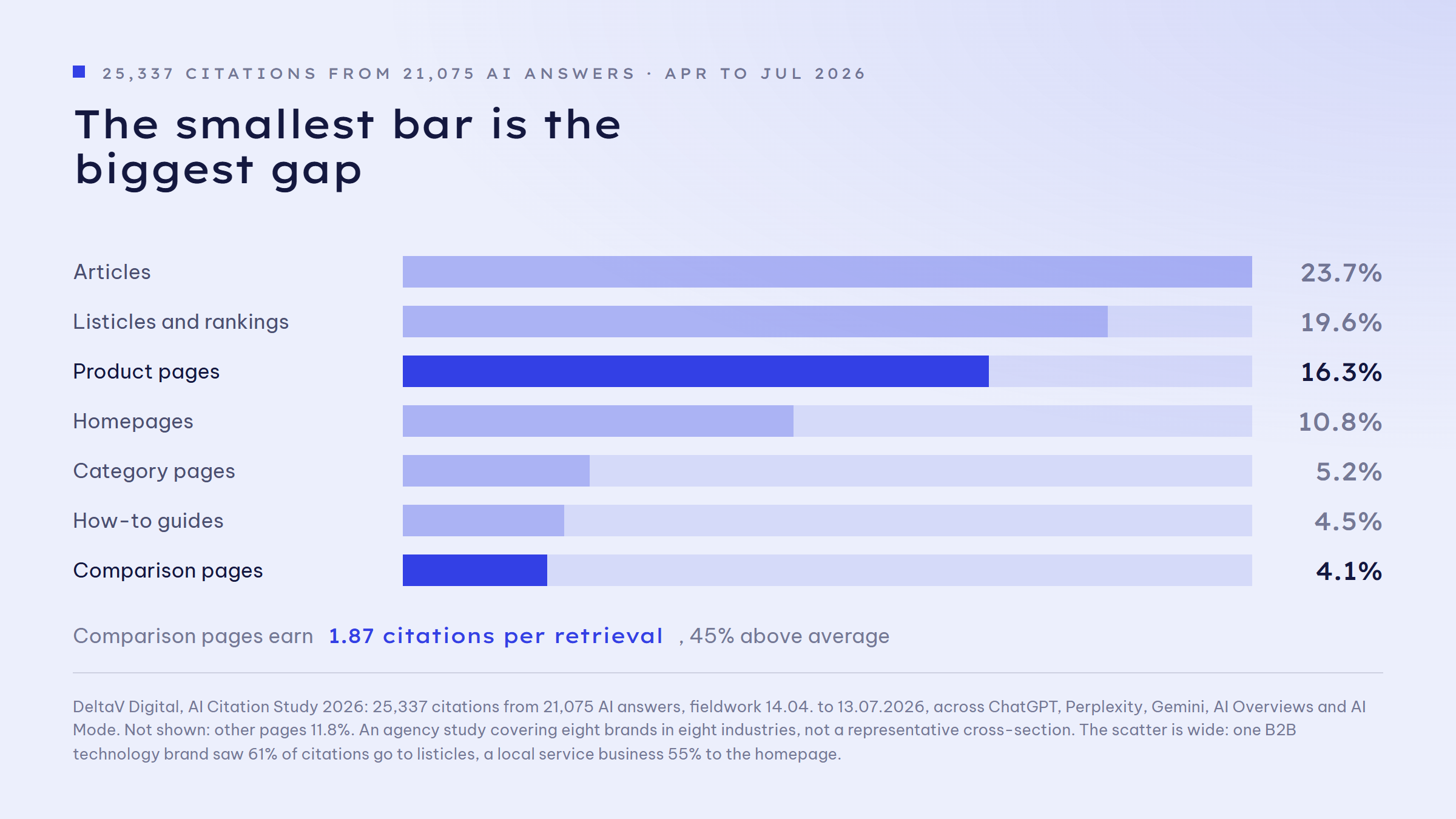
Two things matter more than the ranking order. First, the result scatters wildly by industry: for one B2B technology brand, 61 per cent of all citations went to listicles, while for a local service business 55 per cent went to the homepage. There is no general "this is how it works" rule, but there is a reason to check your own answers yourself. Second, the weakest bar is the interesting one. Comparison pages hold only 4.1 per cent share, yet in the same study they earned 1.87 citations per retrieval, 45 per cent above average. There are simply too few of them.
What can only your page deliver?
If price and availability come out of the catalogue, what remains for the page is everything a catalogue field cannot hold. That is exactly the part most product pages leave out, because it feels like it gets in the way of a sale.
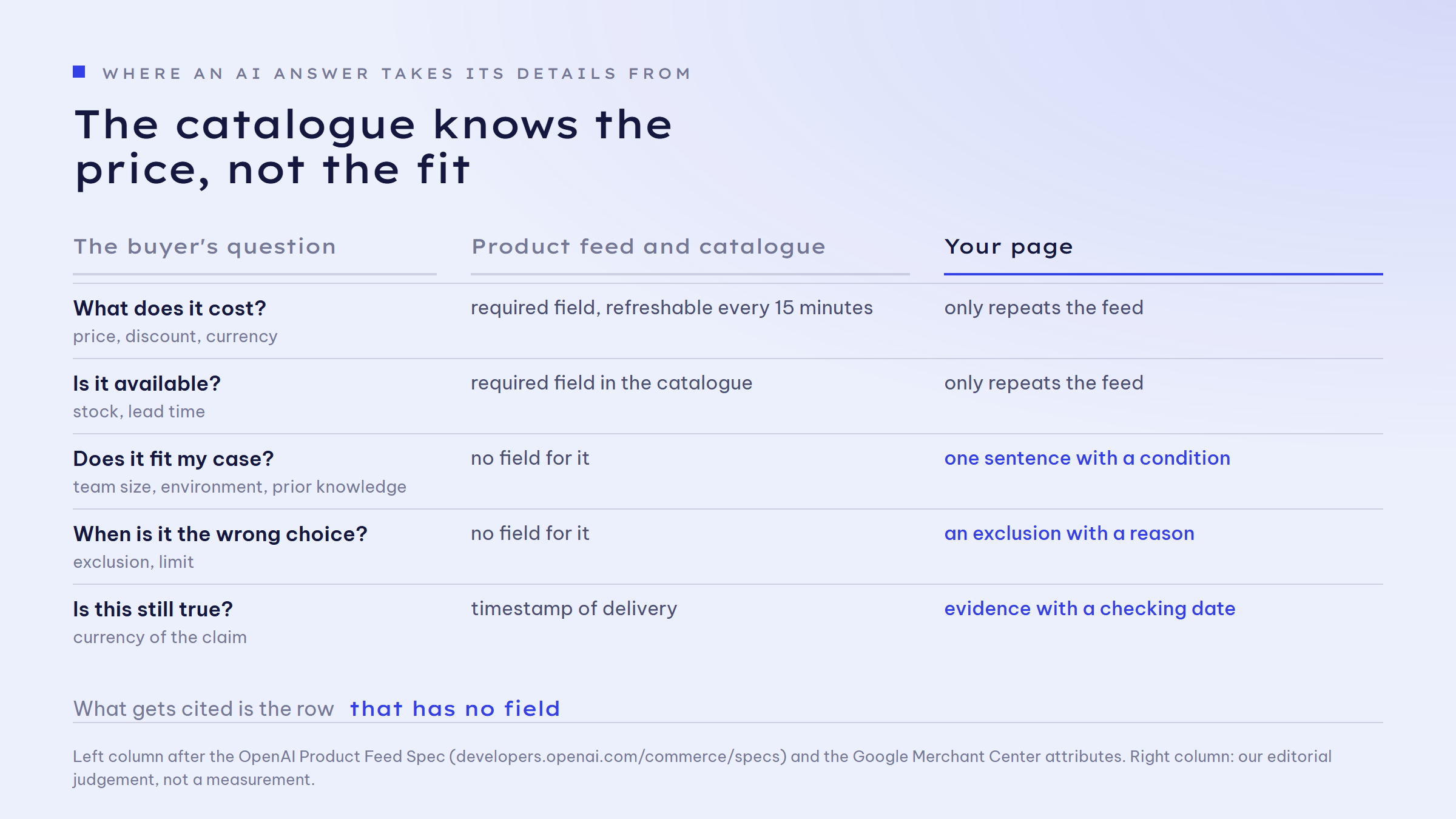
A sentence such as "for teams under five people the smaller variant is the right one, above twelve workstations this model stops paying for itself" appears in no feed and on no spec sheet. It is the kind of statement a language model can cite, because it answers a question somebody actually asked. The same goes for drawing a line against the alternative, for exclusions, and for figures with a checking date. Writing down what your product is not good for supplies the one piece of information no competitor supplies about you.
The effort pays off even at small visitor numbers. In its study on AI search and SEO traffic, Semrush measured that a visit from an AI source is on average 4.4 times as valuable as a visit from classic organic search, measured by conversion rate. That figure comes from a vendor selling an AI visibility product, so read it with that in mind. The direction matches what we see with clients though: whoever arrives through an AI answer has already done the comparing.
How do you check this in four weeks?
All of this becomes manageable once you set it up as a measurement rather than a project.
Week 1: collect 20 questions your customers genuinely ask in a sales conversation. Not keywords, real sentences. Put them into ChatGPT, Google AI Mode and Perplexity, and note for each answer who gets cited and with which page type. It takes an afternoon and it replaces every assumption about which SERP features and answer formats are relevant to you at all.
Week 2: reconcile feed and page. Same price, same availability, same product title, same identifier. Check whether your schema markup carries the same values as the visible page. Contradictions between the two are the most common silent error.
Week 3: build one honest comparison page on the question that came up most often in week 1. With limits, with cases where the alternative is better, with a date.
Week 4: repeat the 20 questions from week 1 and record what changed. A visibility index from a tool is nice for this, but your own list sits closer to reality, because it contains your questions rather than those of an average market.
The three levers
1. Get feed and page onto the same state. Price, availability and identifier are the part these systems take without any detour through your text. A contradiction there does not cost you a ranking, it costs you trust in the catalogue.
2. Write down what the product is not good for. Suitability, boundaries and exclusions are the only information no feed and no competitor supplies. They are the reason an AI answer names your page as the source rather than someone else's.
3. Fill the comparison-page gap. A 4.1 per cent citation share at above-average citation density means there are too few of them, and the ones that exist are usually written by somebody who sells neither product.
If you want to know which of your pages currently appear in AI answers and which do not, we can go through it together using your own 20 real customer questions. One hour, and you will know whether your problem sits in the catalogue or in the copy. 🔍