
At some point in every AI project, somebody says: "We could build this ourselves." The sentence sounds like control, like independence, like a solution that fits your processes exactly. And sometimes it is even true. But the numbers from two years of enterprise AI mostly tell a different story - one in which the internal build ends up on the shelf far more often than in production. Let us look at what the data says about the make-or-buy question, and how to answer it properly for your organisation.
Why do so many companies want to build?
The motives are understandable: nobody wants to hand sensitive data to a vendor, and nobody wants to depend on a tool that doubles its price next year. The building blocks look within reach, too - connect a language model via API, add some prompt engineering, plug in your own documents via RAG, and your in-house assistant is done. The prototype does indeed appear within days. That is precisely the trap: a prototype that works in a demo call is about as far from a system that performs reliably every day as a concept car is from series production.
What does the data say about building?
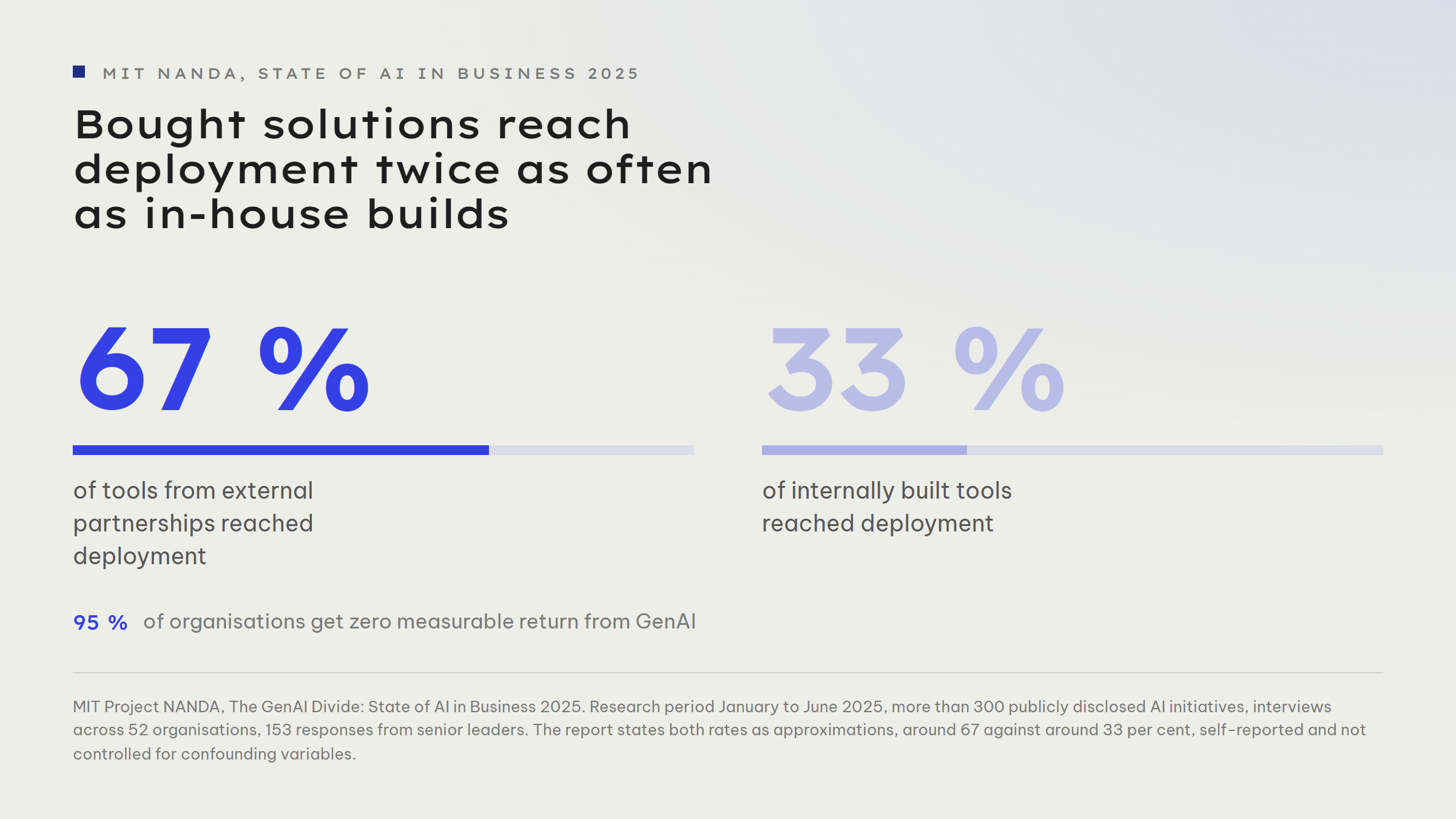
The hardest number comes from MIT: the report "The GenAI Divide: State of AI in Business 2025" by MIT's NANDA project (interviews across 52 organisations, 153 surveyed senior leaders, more than 300 AI initiatives reviewed) concludes that 95 per cent of organisations get no measurable return from GenAI - against 30 to 40 billion US dollars of enterprise investment. Only around 5 per cent of custom enterprise tools ever reach production, internally built and vendor-sold alike. And the sentence that matters most for the make-or-buy question is in the report verbatim: external partnerships see twice the success rate of internal builds, around 67 against around 33 per cent in the sample.
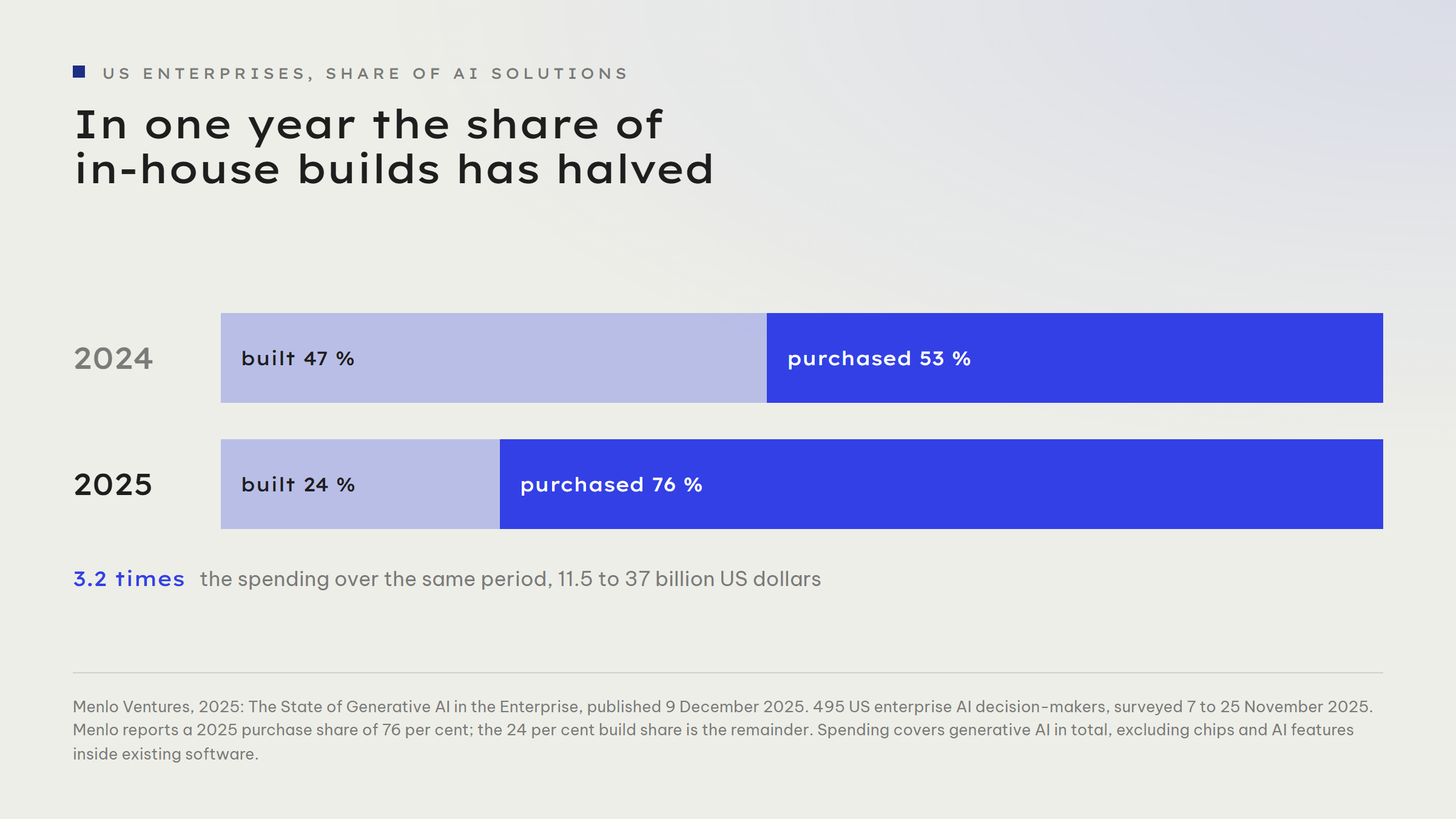
The market has already priced that lesson in. Menlo Ventures published in December 2025 (495 US enterprise decision-makers, surveyed in November 2025): in 2024, 47 per cent of AI solutions were still built internally; in 2025, only 24 per cent - three quarters are now purchased. At the same time, spending more than tripled, from 11.5 to 37 billion US dollars. Companies are spending more on AI than ever, but they are increasingly putting it into ready-made solutions. The reasoning in the same report is remarkable too: AI deals reach production 47 per cent of the time, almost twice the 25 per cent of traditional SaaS purchases - bought AI is no longer a gamble, it is the more reliable route.
What actually kills internal builds?
Rarely the technology alone. Gartner predicted back in July 2024 that at least 30 per cent of all GenAI projects would be abandoned after proof of concept - naming four reasons that have been confirmed ever since: poor data quality, inadequate risk controls, escalating costs and unclear business value. Gartner puts custom model initiatives at 5 to 20 million US dollars - a league most mid-sized companies never intended to play in. But even the smaller variant, the internally assembled assistant, carries running costs that are invisible in the prototype: model updates that break prompts. Hallucination checks. Access management. Monitoring. An AI agent is not a script you write once - it is a product that wants maintaining, by people who know how.
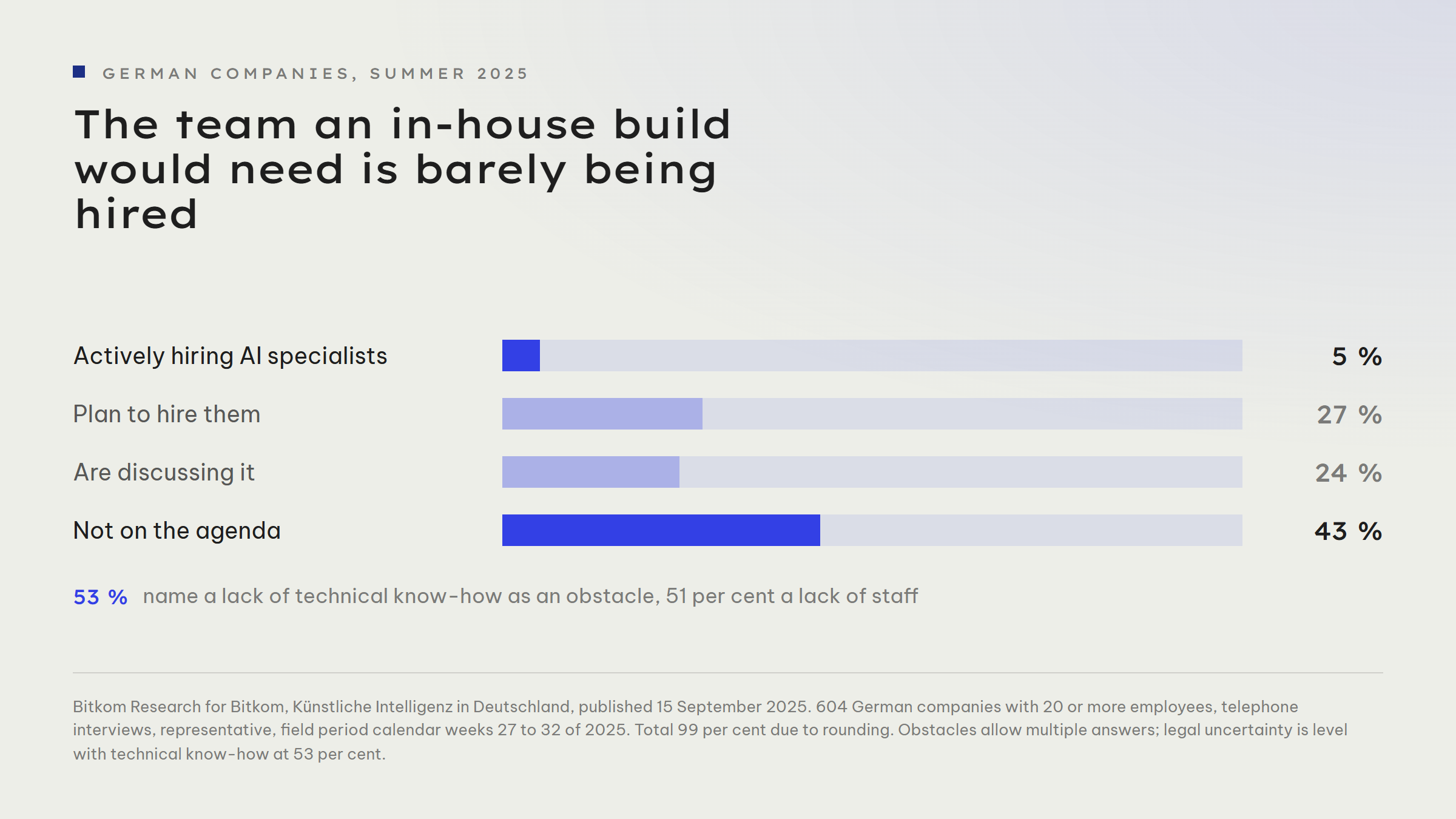
And this is where it gets concrete for the German-speaking Mittelstand. The Bitkom study "Künstliche Intelligenz in Deutschland" (604 companies with 20 or more employees, surveyed in 2025) shows: 36 per cent of companies now use AI, almost twice as many as the year before at 20 per cent. At the same time, 53 per cent name a lack of technical know-how and 51 per cent a lack of staff as their biggest obstacles, level with uncertainty over legal hurdles at 53 per cent as well - and only 5 per cent specifically hire AI specialists. If you have no AI team and are not building one, your hand in the build game is not weak - it is empty. The honest question then is not "make or buy" but "buy or nothing".
When is building still the right call?
There are good reasons to build - a quarter of all solutions were still created internally in 2025, and they are not all mistakes. Building pays off when three conditions coincide. First: the use case is core to your value creation, not administration around it - an insurer automating claims assessment is building its product; a machine builder generating proposal texts is not. Second: your data or your process is so specific that no vendor covers it - genuine special logic, not "our emails are somehow different". Third: you have people who will keep developing the system after launch, not just an agency that sets it up once. If one of the three is missing, buy - or have it built and operated for you, which is in substance also buying, just tailored.
The lock-in argument against buying is weaker than it sounds, by the way: if you buy through open interfaces and make sure your data stays exportable via API and events reach other systems via webhook, you can switch vendors. If you own an internal build whose only developer has left, you cannot.
How do you decide properly?
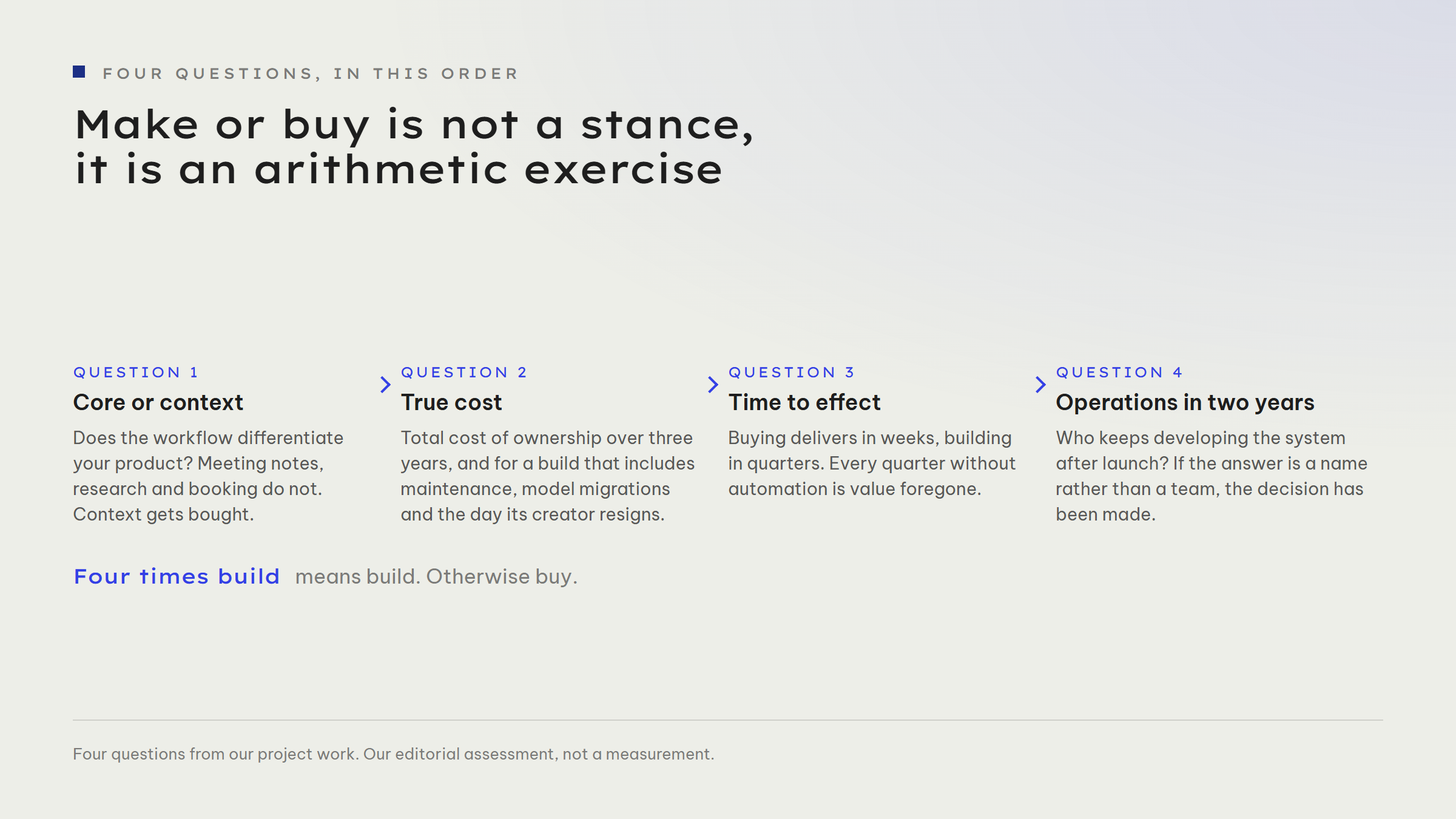
With four questions, in this order. First: is this core or context? Anything that does not differentiate your product - meeting notes, research, email drafts, appointment booking - is context and gets bought. Second: what does the solution really cost? Calculate the total cost of ownership over three years; for a build, include the developer hours for maintenance, model migrations and the day its creator resigns. Third: how quickly do you need the effect? A purchased solution delivers in weeks, a build in quarters - and every quarter without automation is value foregone. Fourth: who operates this in two years? If the answer is a name rather than a team, the decision has been made. Only when all four answers point towards building is it the right choice - and then with clear guardrails, human-in-the-loop and an operating concept from day one.
Three levers for your make-or-buy decision
Start with the process, not the tool. Write down which workflow is to be automated, what it costs today and how you will measure success - before anyone talks about models. Gartner's abandonment reasons are almost always visible before the project starts, if you look honestly: no clean data, no clear business value, no owner.
Buy the standard, build the difference. The robust middle path is rarely "build everything" or "buy everything": purchased components for everything interchangeable, your own logic only where your knowledge lives - connected via APIs and webhooks rather than in one monolithic build nobody dares touch. That way every component stays individually replaceable.
Cost the build honestly to the end. The prototype is a tenth of the truth. Put three years of operating costs on paper, including the staffing risk, and compare them with the subscription price of the purchased option. If the build still wins, build it - with our blessing. In most cases it does not win.
Make or buy is not an ideological question in AI - it is an arithmetic exercise with four variables: core or context, true cost, time to effect, operations. If you would like to run that calculation for your specific case together - we do this regularly, sometimes with the result "buy elsewhere". You can book the appointment directly online. 🧮