
More and more buying decisions no longer start with ten blue links but with an answer from ChatGPT, Perplexity or Google. Whether your website appears in those answers is not down to luck - it is decided at very concrete, testable points. That is exactly why we built the free AI visibility check: 20 checks across four categories, one score from 0 to 100. In this article you will read what the categories mean, which mistakes we see most often, and where the real levers for your AI visibility sit.
Why should you measure AI visibility at all?
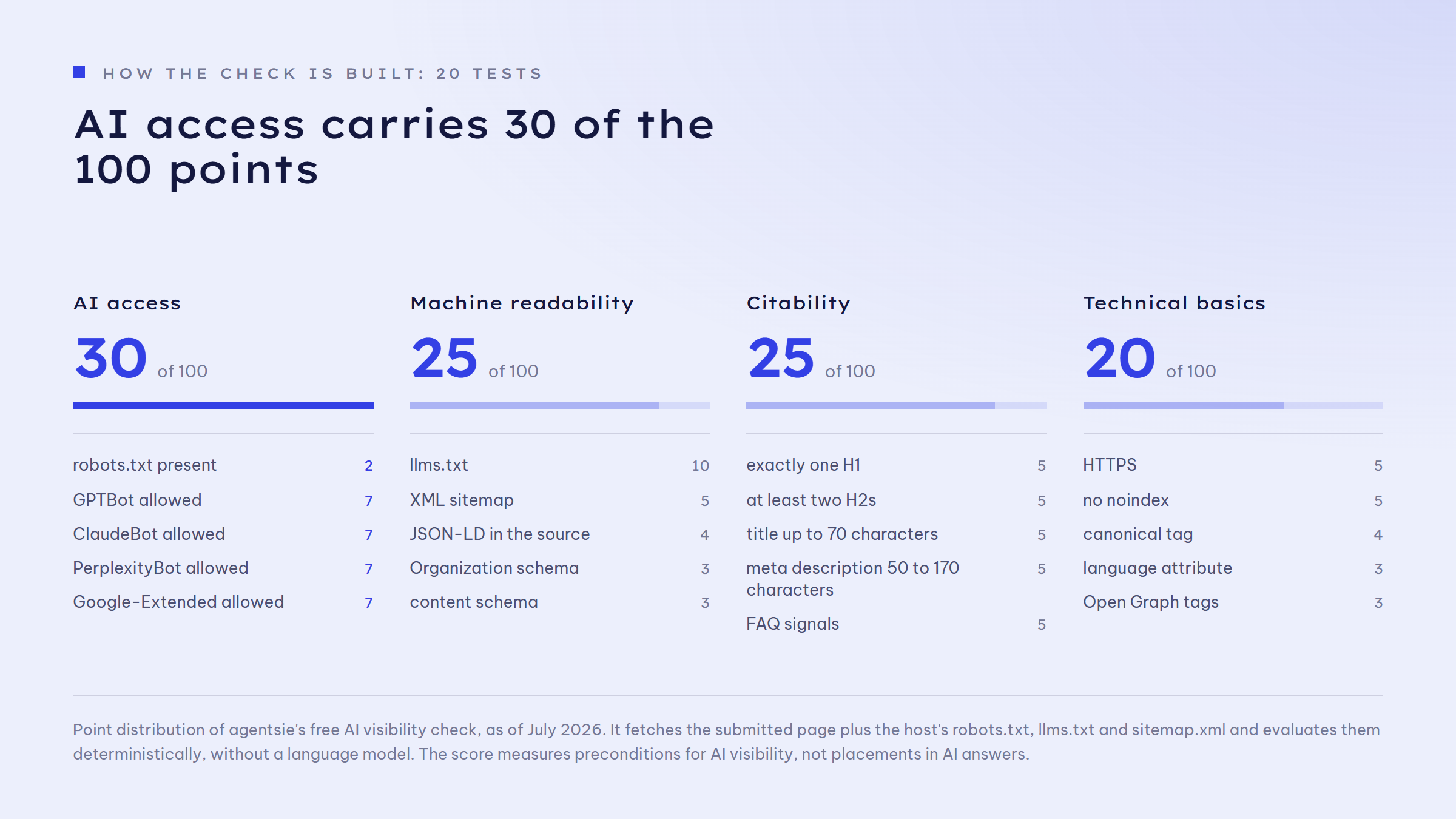
Because traffic from AI assistants is small but unusually valuable. The Semrush study on AI search traffic puts the average visitor from an AI search at 4.4 times the value of a visitor from traditional organic search, measured by conversion rate. The reason: someone who lands on your site after an AI conversation has already compared their options and arrives with concrete intent.
At the same time, the Semrush analysis of billions of web visits shows how early we still are: AI traffic grew 66 per cent in 2025, faster than any other channel, yet still accounts for just 0.14 per cent of total visits. Precisely this combination - small volume, high growth, high quality - is the window in which positions can be claimed cheaply. As with zero-click search, the rule holds: wait until the channel is big, and you will be competing against everyone.
Do the AI crawlers even reach your website?
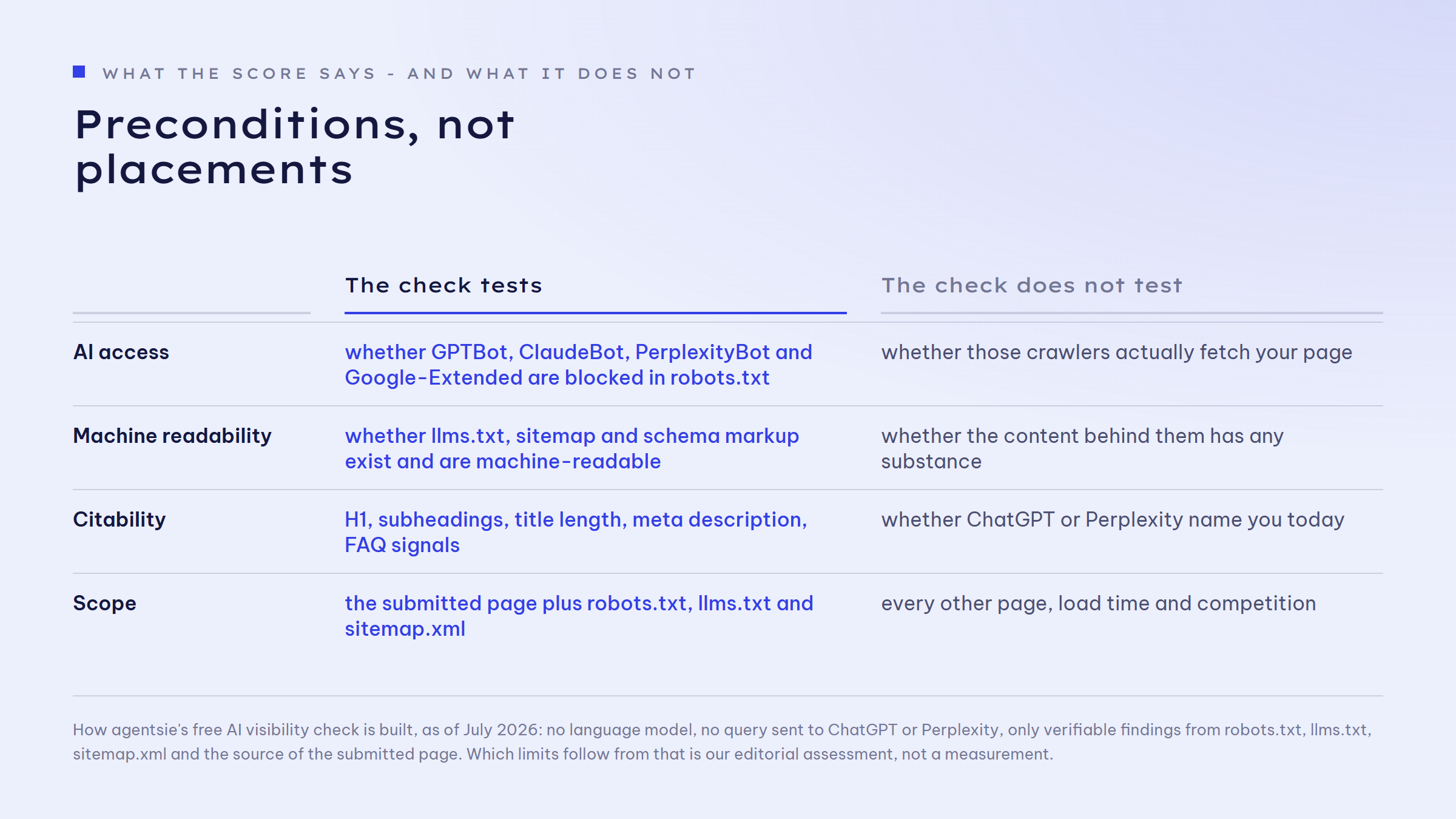
The first and most heavily weighted category in the check is AI access: does a robots.txt exist, and are the four most important AI crawlers - GPTBot (OpenAI), ClaudeBot (Anthropic), PerplexityBot and Google-Extended - allowed to read your content? This sounds trivial, but it is not: according to Cloudflare, only around 37 per cent of the top 10,000 domains have a robots.txt at all, and GPTBot is explicitly disallowed in just 7.8 per cent of those files.
In other words: most websites have never consciously decided what AI systems are allowed to do with them. Either choice can be right - if you want to protect your content, you may block the crawlers. But then AI invisibility is a decision, not a surprise. The check makes the current state visible so you can decide deliberately rather than by accident.
Can machines actually read your content?
AI assistants increasingly answer questions via retrieval-augmented generation: they fetch live web pages, parse them and quote from them. The second category therefore tests how easy your website is to process by machine: is there an llms.txt serving as a table of contents for AI systems? A clean XML sitemap? And structured data via schema markup - once for the organisation (who are you?) and once for the content type (article, FAQ, service, product)?
Structured data is the part most often missing entirely in the checks we see. Yet it is the cheapest fix: an Organization schema and a matching content type can be built in an afternoon and help every machine - Google search just as much as the AI assistant.
Would an AI actually cite you?
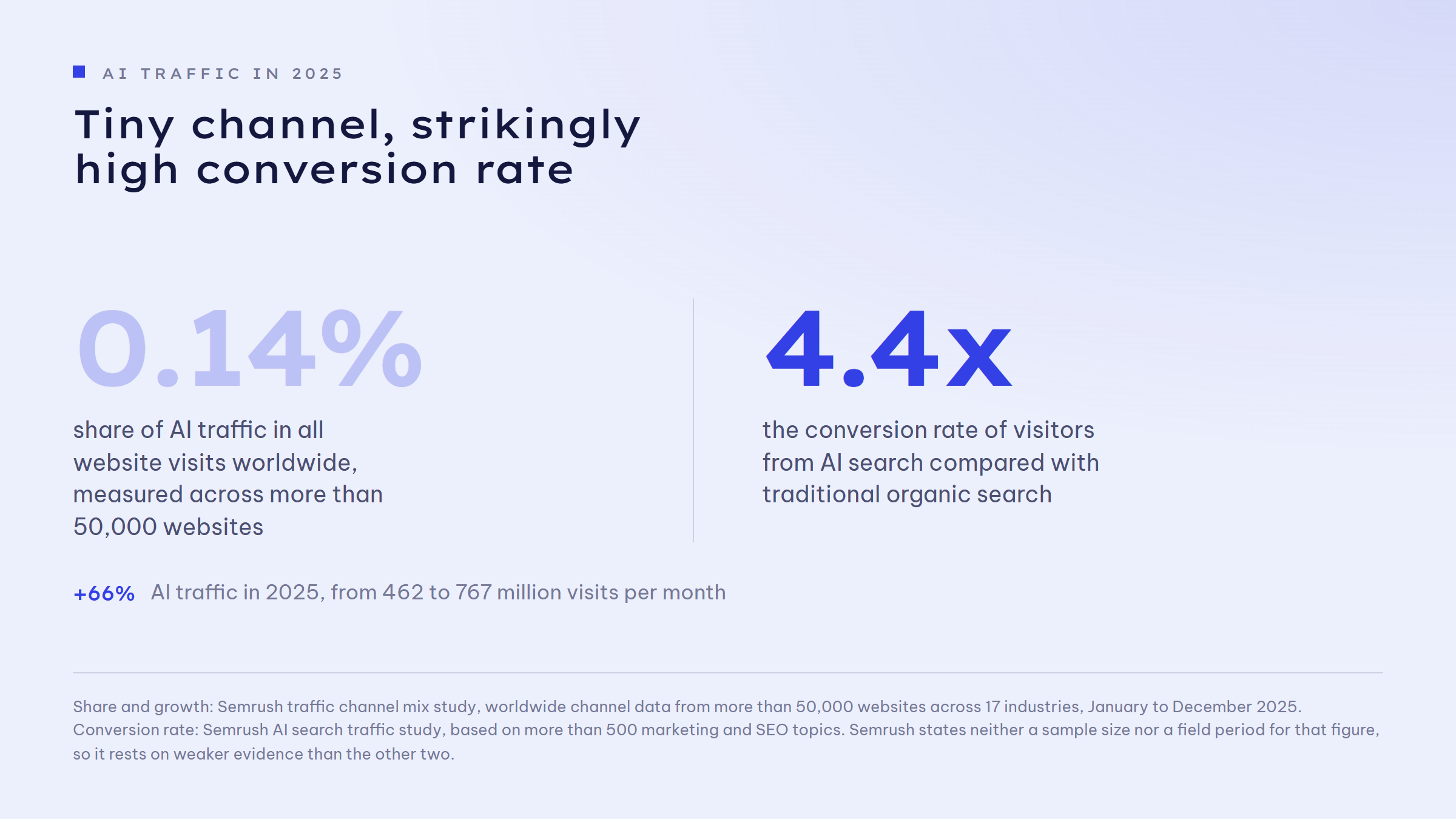
Being crawled is a long way from being cited. Cloudflare measured in June 2025 how often AI providers crawl compared with the traffic they send back: Google sat at roughly 14 crawls per referral, OpenAI at 1,700, Anthropic at 73,000. Being cited is the exception - which is exactly why the third category tests whether your pages make it easy for an AI.
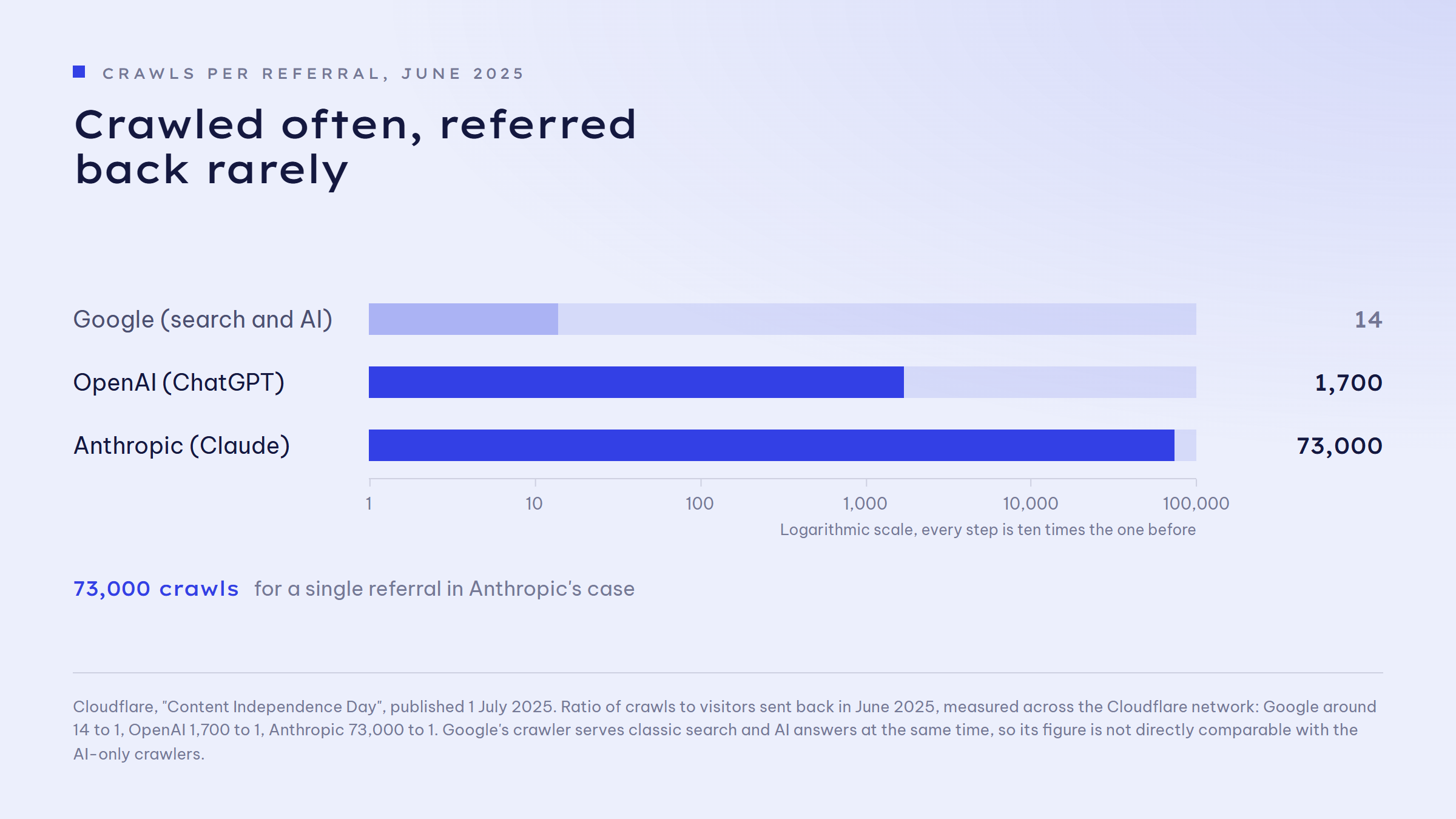
Concretely: exactly one H1 per page, a clear subheading structure - ideally phrased as questions, because that is how people ask AI systems -, a title under 70 characters, a meta description between 50 and 170 characters, and FAQ signals. None of this is secret AI knowledge; it is clean craft. A self-contained passage that answers a concrete question with a sourced figure is citable for humans and machines alike.
And what about the technical basics?
The fourth category tests the foundations where visibility quietly fails: HTTPS, a canonical tag, a set language attribute and Open Graph tags. Plus the most common own goal of all: a forgotten noindex that survives a relaunch on the live site and removes the page from every search system. Five minutes of checking here saves months of invisible damage.
Three levers for your AI visibility
Measure first, build second. Run the check and work through the categories in order: access before machine readability before citability. A perfectly structured page achieves nothing if the crawler is locked out.
Build citable passages. Questions as headings, one sourced figure per section, references linked. And because AI visitors convert 4.4 times better according to Semrush: make sure solid conversion rate optimisation turns those few, high-quality visits into enquiries.
Set up the machine essentials once, properly. llms.txt, sitemap, Organization schema plus a matching content type - a one-off project of a few hours, not a treadmill. From then on it works for every single page.
The check is free, needs nothing but your URL and runs in seconds: to the AI visibility check. And if you would like to talk through your results, just drop us a line. 💌