
Most service businesses treat their Google Business Profile like a directory entry: filled in once, then forgotten. Yet for location-bound enquiries it is the first page anyone sees of you - reviews, opening hours, photos and phone number, long before a click ever reaches your website. If it looks thin, you lose the enquiry in a moment no analytics report will ever show you. Let us look at what Google actually evaluates in local ranking, which entries carry a suspension risk, how to turn reviews into a channel instead of luck, and what changes now that a growing share of recommendations comes from AI tools.
Why does your profile decide things before anyone sees your website?
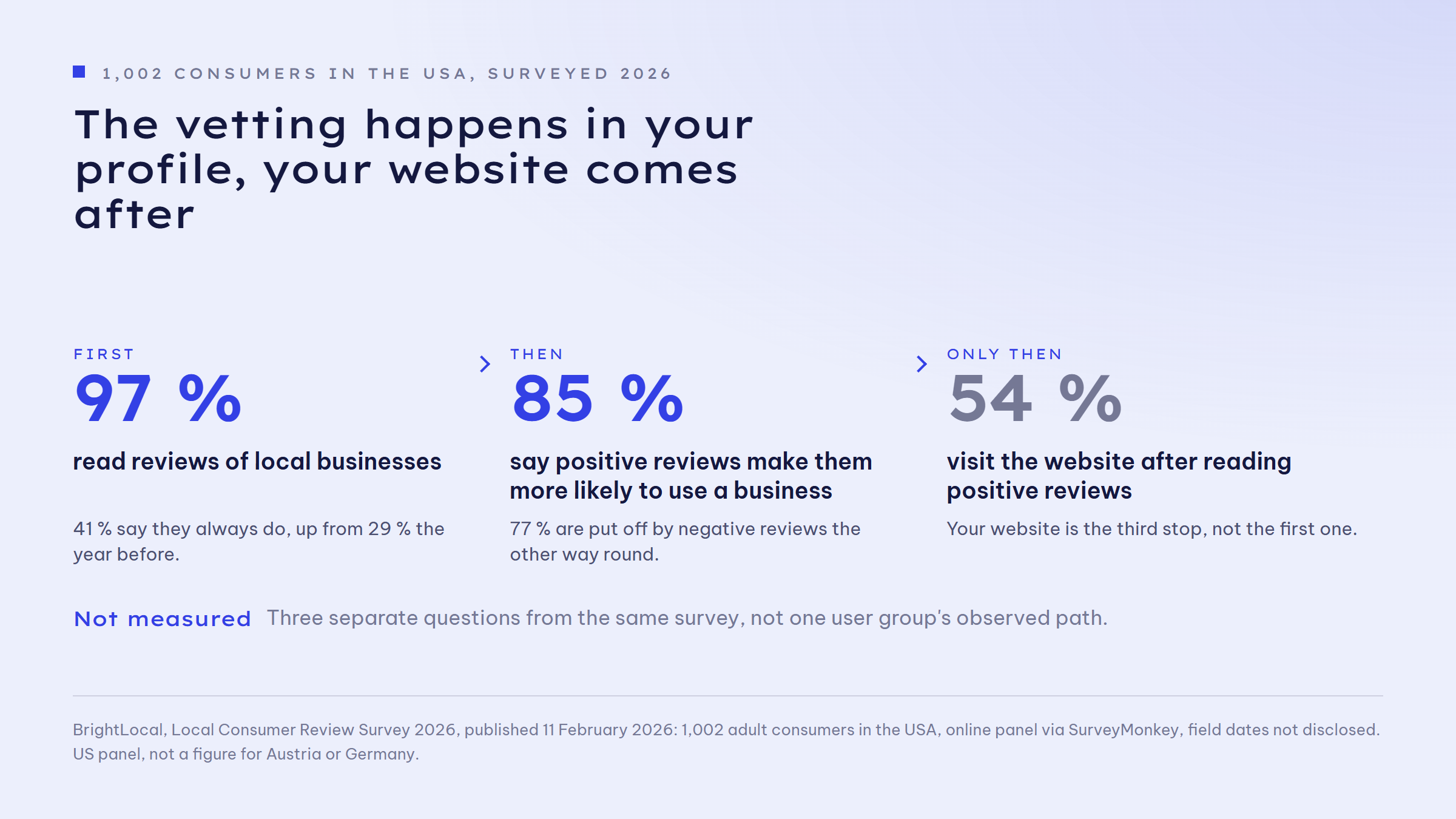
Because the vetting happens there, not with you. The Local Consumer Review Survey 2026 by BrightLocal (published 11 February 2026, 1,002 adult consumers surveyed in the USA) found that 97 per cent read reviews of local businesses and 41 per cent say they always do, up from 29 per cent the year before. 85 per cent say positive reviews make them more likely to use a business, 77 per cent are put off by negative ones. Only then does your website enter the picture: 54 per cent visit it after reading positive reviews. One caveat for context: this is a US panel, not a figure for Austria or Germany. The sequence, though - profile first, website second - matches what we see in client projects.
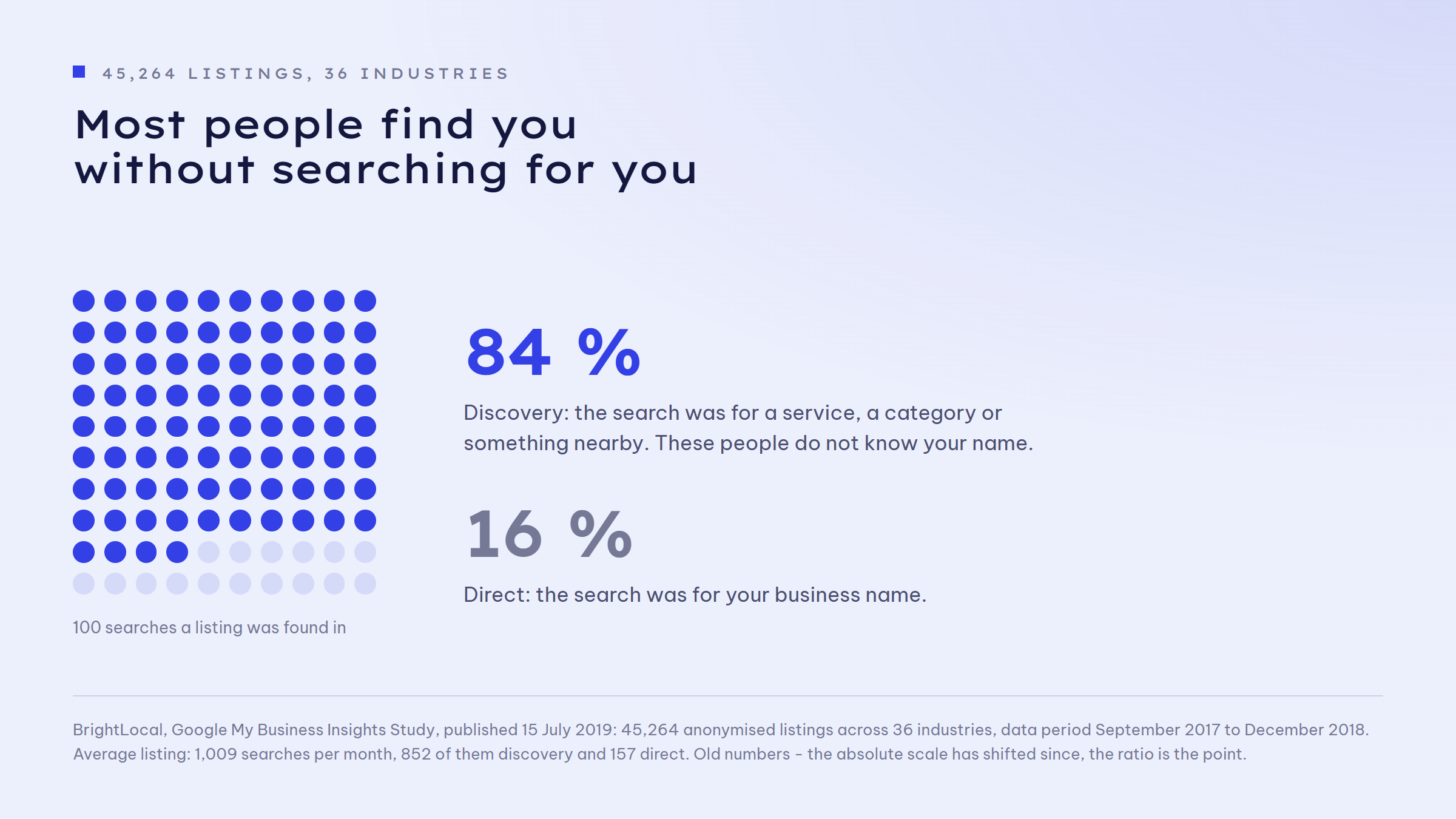
There is a second point most owners underestimate: the majority of views do not come from people who know your name. The broadest public analysis on this remains BrightLocal's Google My Business Insights Study, covering 45,264 anonymised listings across 36 industries. It is honestly old - published on 15 July 2019, with data running from September 2017 to December 2018 - and the absolute numbers have moved since. Its structural finding holds up anyway: 84 per cent of the searches a listing was found in were discovery searches, meaning category or service queries, and only 16 per cent were direct searches for the business name. Your profile is not a nameplate for existing clients, it is a channel for people who do not know you yet. Around 5 per cent of profile views led to an action back then: a website click, a call or a directions request.
What does Google actually evaluate in local ranking?
Google describes it in its own help pages with three factors. Relevance is how well a Business Profile matches what someone is searching for. Distance refers to how far each business is from the person searching. Prominence means how well known a business is. Two further sentences undo a lot of what gets sold in this market: "Businesses with complete and accurate info are more likely to show up in local search results" and "There's no way to request or pay for a better local ranking on Google."
Of those three factors you can influence exactly two. Distance is fixed, it depends on the searcher. You steer relevance through your category, listed services, description and whether your website carries the same subject as your profile. Prominence is built outside the profile: reviews, mentions, links, entries in credible directories. Google puts it plainly: "More reviews and positive ratings can help your business's local ranking." One detail from the practitioner side is worth noting. Whitespark's Local Search Ranking Factors 2026, a survey of local SEO specialists published on 6 November 2025, counts being open at the time of the search among the influential factors, with the authors reporting rankings that soften in the final hour before closing. That is expert judgement rather than a Google statement, but acting on it costs nothing: keep opening hours and public holidays current, or you are simply not in the running for part of the searches.
Which entries are mandatory - and which are a trap?
The trap is almost always the name. Google's guidelines for representing your business require the real-world name as used on your signage, website and stationery. Marketing taglines, location descriptors and keywords do not belong in it. "Sample Painting - Cheap Painters Vienna" is therefore not a clever trick but a policy violation, and Google explicitly reserves the right to suspend profiles that breach the guidelines. A suspended profile means the channel disappears, without warning, mid-year.
Three further points where service businesses regularly get stuck. First, the address: if you travel to customers rather than receiving them, you are meant to hide the address and set a service area instead. An office in a coworking space may only be listed, per the guidelines, if it has clear signage, is staffed during business hours and actually receives customers there. Second, the category: Google asks for as few categories as possible and frames the rule as a sentence opener - the business is an X, not: it offers X. The primary category is the single most consequential content decision in the whole profile; everything else belongs in your services. Third, consistency: name, address and phone number must read identically everywhere - in the profile, on your website, in your legal notice and in every directory. The detail sits in the glossary under NAP consistency and Google Business Profile.
How do reviews become a channel instead of luck?
By asking. The BrightLocal data is unusually clear here: 83 per cent of people who were asked for a review went on to write one. At the same time expectations have hardened - 74 per cent look specifically for reviews written in the last three months, 47 per cent will not use a business with fewer than 20 reviews, and 31 per cent only consider businesses at 4.5 stars or above. A profile with twelve enthusiastic reviews from 2023 is not a credit balance, it is a warning sign. The lever is a system rather than a campaign: after every completed job, one short request with a direct link, the same sentence every time, at the same point every time. Then the flow tracks your business instead of arriving in waves.
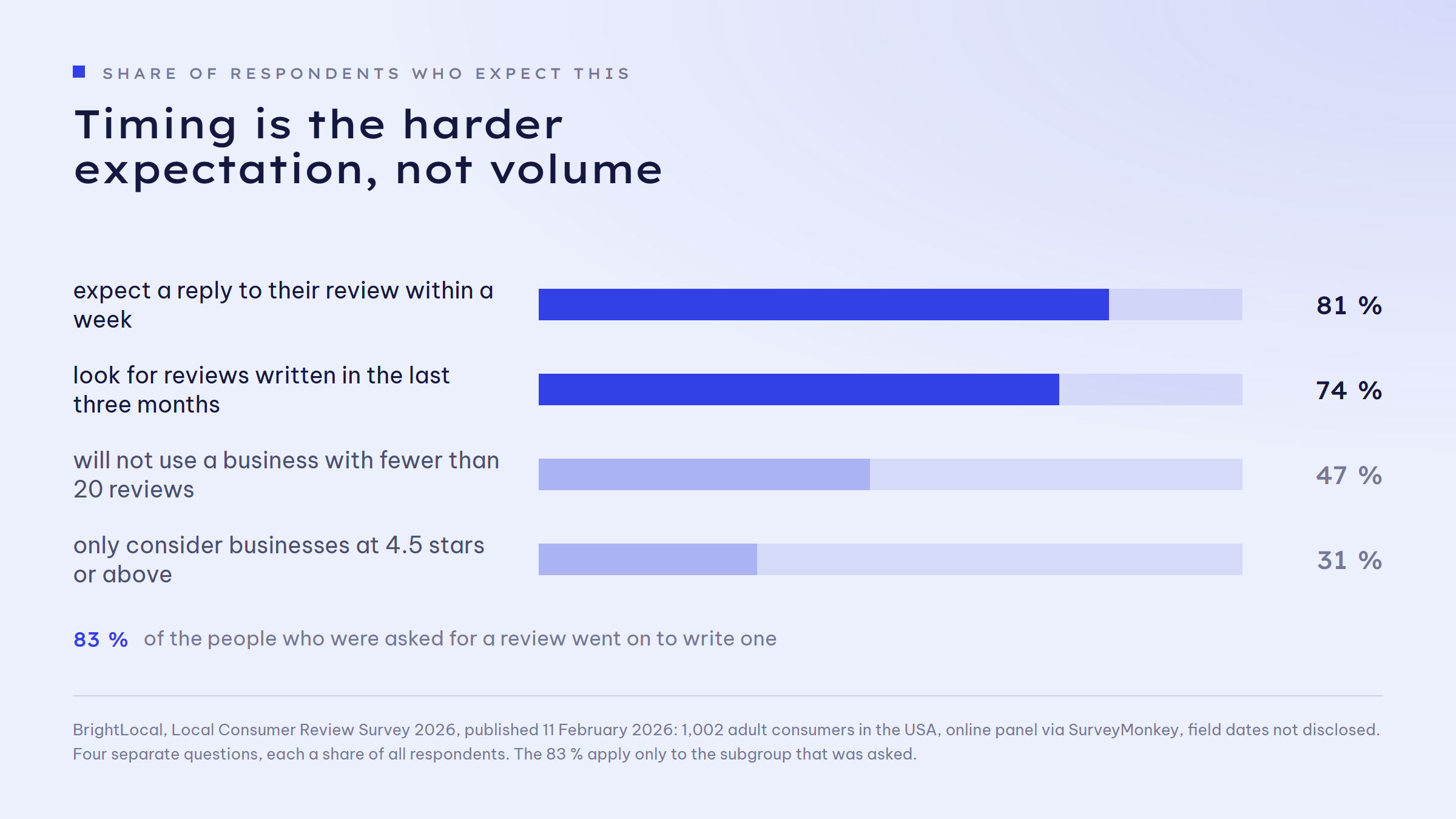
Two limits belong with that. The legal one first: the annex to the German Act Against Unfair Competition (UWG) explicitly prohibits fake reviews in item 23c, and item 23b bars claiming that reviews come from genuine users without reasonable verification. Section 5b(3) additionally requires disclosure of whether and how the authenticity of published reviews is ensured. Bought stars are not a grey area. The operational limit second: 81 per cent of respondents expect a reply to their review within a week, 19 per cent even the same day. Replying is not a courtesy exercise, it is the only part of your reviews that you write yourself - and the only place where a bad review can still turn into social proof.
What changes when the recommendation comes from an AI?
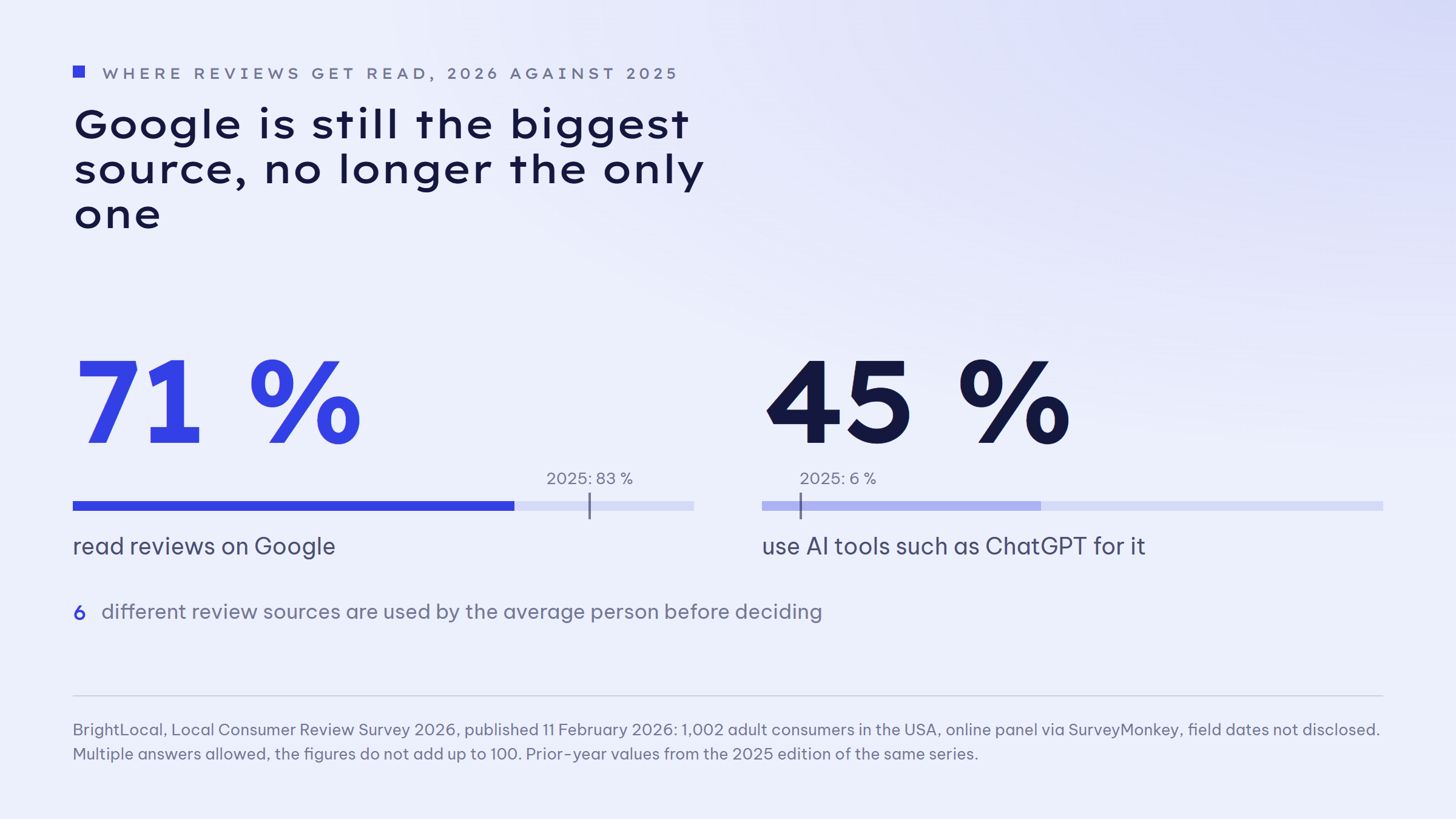
The source fragments. In the same BrightLocal survey, Google's share as a review source fell from 83 to 71 per cent, while AI tools such as ChatGPT jumped from 6 to 45 per cent; on average respondents use six different platforms. For you that means a well-kept Google profile remains the foundation, but it is no longer the only place where you are judged. If reviews exist only there, you look empty everywhere else.
Three practical consequences follow, all of them about data hygiene. First, your core details must be identical everywhere, otherwise a machine cannot decide which version is true - that is exactly what NAP consistency means. Second, services, service area and price range belong on your website as text, not only in the profile and certainly not only inside a graphic; that text is the raw material AI Overviews and answer engine optimisation build answers from. Third, clean schema markup of type LocalBusiness helps by putting the same details in machine-readable form where the profile already states them. The honest caveat: there is no defensible public figure for how often AI systems cite profile data. What is documented is the usage by customers, not the mechanism behind it - enough reason to be consistent, not enough for promises.
And the point that has least to do with technology: a local search almost always carries intent to act. Someone typing "tax adviser near me" wants to reach a person today. If your profile collects the enquiry and nobody calls back for three days, you have a speed to lead problem, not a local SEO problem.
The three levers
1. Audit the profile for policy compliance. Name without keywords, correct primary category, address shown or hidden depending on your model, opening hours including public holidays. An hour of work that removes a suspension risk.
2. Turn reviews into a process. A fixed request at job completion, a direct link, a reply within a week. Recency decides more than volume.
3. Align your core details everywhere. Name, address and phone number identical across profile, legal notice, website and directories - plus LocalBusiness markup on your contact page.
If you like, we can go through your profile together: what is compliant, where enquiries are leaking away and which three entries you should change this week. 🙂