
Someone messages you at nine in the evening because a delivery has not arrived. The assistant on your website asks for the order number, gets it, asks for the postcode, gets that too, and then answers: "I am afraid I cannot help with that." What happens in that second decides the whole case. Either the transcript is on someone's desk tomorrow morning with a name beside it, or the customer types everything again into a contact form, or they take it somewhere else entirely. The debate has been about how well the tool understands for years now. The more expensive question is the handover point: the place where a case leaves the machine and arrives with a person. This piece looks at what actually happens there, what a high-effort transition costs, what has to travel across it, and how you can tell that yours is missing.
Why does almost nobody use the assistant you built?
Because they have tried one before. Gartner surveyed 3,566 B2B and B2C customers in February and March 2026 and published the answers on 2 September 2026: 49 per cent say they would have used a chatbot for their most recent service issue if the company had provided one. The share who actually did is seven per cent. The gap between stated willingness and real behaviour is the finding, and Gartner names the reason: if a bot has previously misunderstood an issue, given generic information or made it harder to reach a person, customers choose another channel next time.
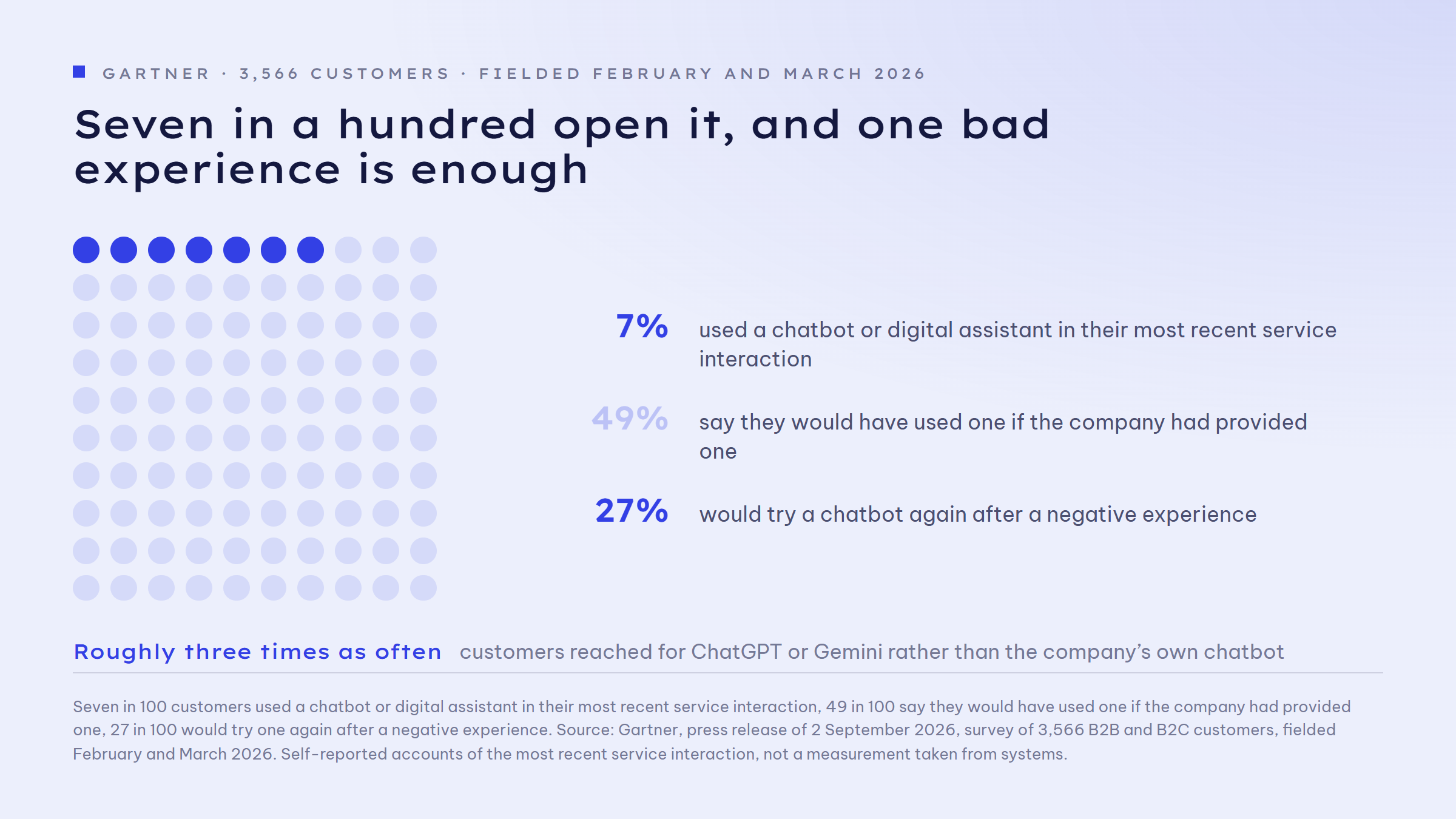
Gartner calls it a leaky bucket: a single unsuccessful interaction keeps people away from future ones, even after the tool has got better. Only 27 per cent would try a chatbot again after a negative experience. The third number from the same survey makes it uncomfortably concrete: for their most recent issue, customers were roughly three times more likely to use third-party tools such as ChatGPT, Gemini or Copilot than the chatbot of the company they had the problem with. Anyone arguing today about their assistant's accuracy is arguing about a tool most of their customers never open.
What happens in the second when it runs out of answers?
Three things, and only one of them is acceptable. First: the case moves on, carrying everything the customer has already said, to a named person and with a deadline. Second: the customer lands on a contact form and starts from scratch. Third: they give up. The difference is not a question of model quality but of construction. An AI chatbot knows perfectly well when it is unsure, because intent recognition always returns a confidence score alongside the answer. Ignoring that score throws away the only information the system holds about its own uncertainty. The same mechanism governs the automatic sorting of incoming messages, which we took apart in the piece on requests that get sorted automatically.
Gartner puts the consequence unusually plainly in the same release: chatbots should be seamless connectors to human support, not containment traps. If the chatbot cannot resolve an issue with high confidence, it should provide a visible path to a human agent and pass along the information and context already collected. The goal is explicitly not to keep every interaction inside the chatbot. Yet in a great many projects that is exactly the metric the tool is judged on: the share of conversations that never reach a person. That metric rewards the dead end.
What does a high-effort transition really cost?
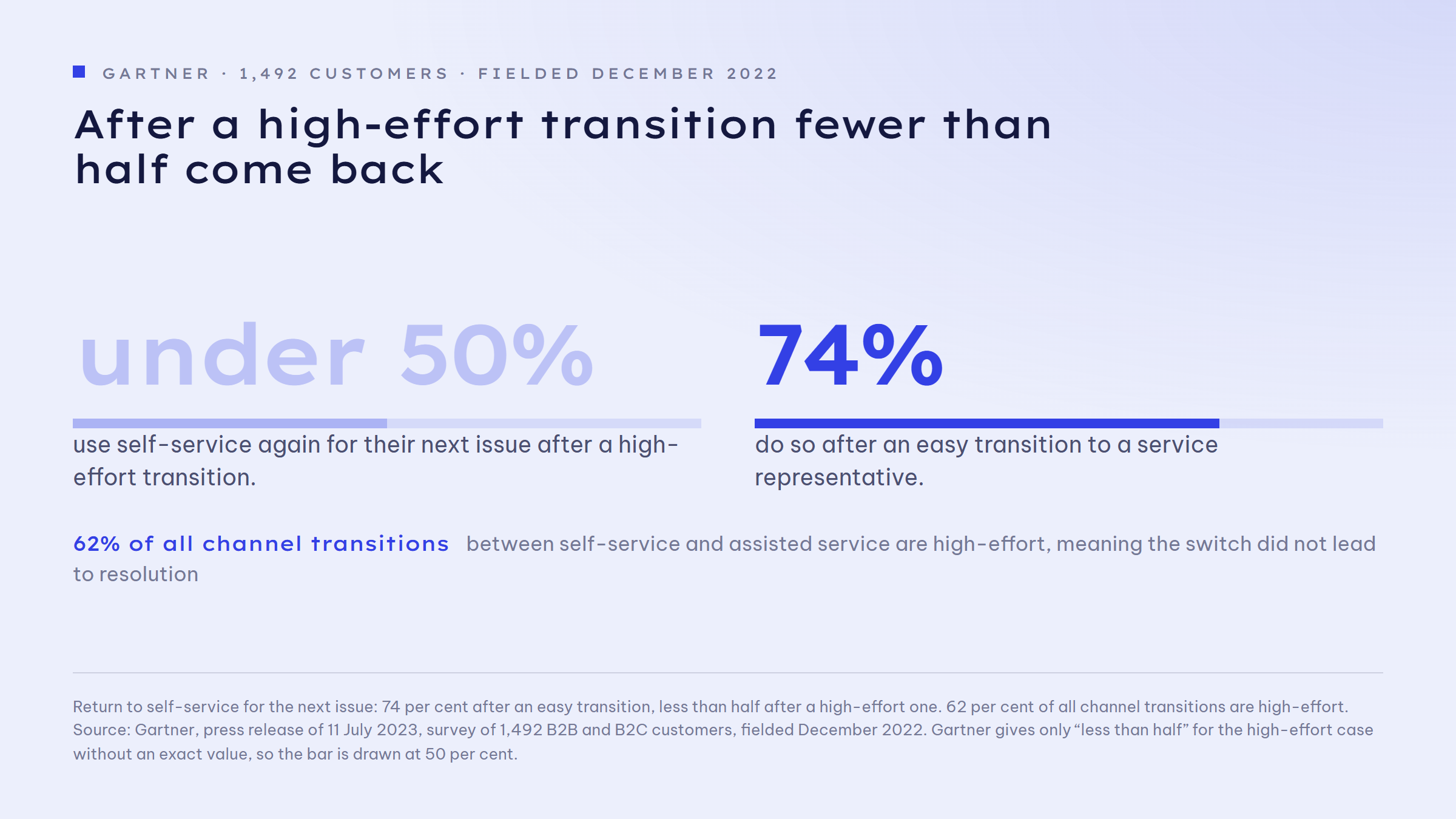
This is well measured, and the number is uncomfortably high. Gartner surveyed 1,492 B2B and B2C customers about channel transitions in December 2022: 62 per cent of transitions between self-service and assisted service are high-effort for the customer, meaning the switch did not lead to resolution. The consequence reaches beyond the single case. Less than half of the customers who experience a high-effort transition use self-service again next time. After an easy transition, 74 per cent do.
The second half of the same survey is the commercial one: after a seamless transition 93 per cent report high satisfaction, and those customers spend 27 per cent less time in assisted channels. Gartner puts the saving at an average of four minutes of representative time per customer journey, with a reason that sums up this whole piece: because representatives are not asking customers to repeat information they have already provided. 88 per cent of customer journeys that start in self-service touch more than one channel. The handover point is not an edge case. It is the normal case.
None of this is about satisfaction in the sense of friendliness. It is about effort. The customer effort score measures exactly that, and in service journeys it says more about repeat business than any delight question. A customer typing their order number for the third time is not unhappy with your product. They are tired.
What has to travel across the handover point?
Four things, and none of them is technology in the narrow sense. The transcript: what was asked and what was answered, verbatim, not as a summary. The issue in one sentence, so the human does not have to read a log first. The ownership: a name, not a shared mailbox. And the deadline by which someone will respond, committed to and told to the customer.
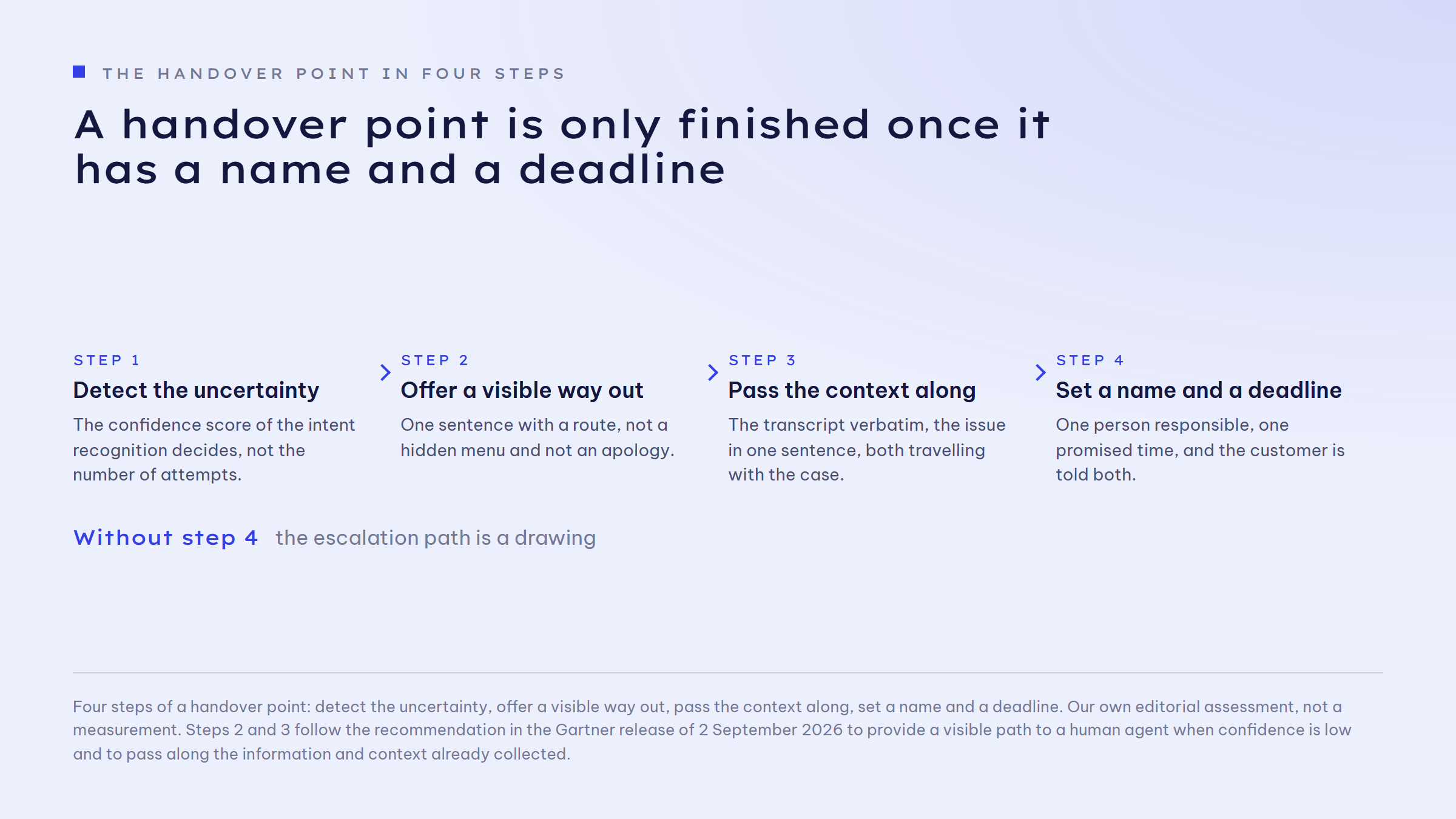
The escalation path is the description of that route, and it is only finished once it has a trigger, a destination, a deadline and a context that travels with the case. Without a destination you get the third inbox nobody opens. Ownership is the part most set-ups fail on, because it is the most uncomfortable: a name means somebody notices when nothing happens. A shared address does not, and that is precisely why it is so popular. Without ownership an escalation path is a drawing.
The matching record in the CRM is not an administrative chore. It is the reason the customer has nothing to repeat at the second contact. If the chat transcript travels by clipboard into an email, you have not built a handover point, you have built a media break with a nicer interface. And the person at the other end is not a failsafe. They are the place where decisions get made. That human-in-the-loop principle is the reason the tool earns any trust at all.
How can you tell your handover point is missing?
By five things, and you can check all five today in twenty minutes. First: send your own assistant a question it cannot answer and count how many messages it takes before a route to a human becomes visible. Second: check whether the transcript arrives anywhere, or whether only a notification without content goes out. Third: does the forwarding carry a name or an address like info@? Fourth: is there a committed deadline, and does the customer know about it? Fifth: read the metric the tool is judged on. If it says "share of conversations resolved without an agent", you are rewarding the dead end.
What customers expect at this point has become very clear. In the same Gartner survey from February and March 2026, 87 per cent say an option to reach a human agent is essential when a company uses generative AI in service. At the same time 50 per cent say their interactions are easier because of it, and 58 per cent of those who use such tools have had one complete a task on their behalf, rising to 74 per cent in B2B. The resistance is not to the tool. It is to the tool as a gatekeeper. When Gartner asked customers who were unwilling to engage with AI what might change their mind, the most common answer was the ability to switch to a human agent if needed.
That repetition is the most expensive imposition in service is echoed by the 2026 Zendesk CX Trends report: 74 per cent of consumers say repeating themselves is a significant frustration. One caveat: Zendesk names neither a sample size nor a field period on the publicly available pages, and it sells software for exactly this problem. The figure fits the picture the Gartner surveys draw, but it does not replace them.
Three levers for this week
One: build the way out before you improve the model. A visible sentence after the second unsuccessful answer that offers a route rather than an apology. That is an hour of work and it acts immediately on the effort your customers have to spend.
Two: give the transition a name and a deadline. Not info@ but a person, with a deputy. And a committed window in which an answer arrives, measured as first response time rather than felt. Only then is your service level a commitment instead of a claim.
Three: change the metric. Do not measure how many conversations the assistant kept. Measure how many issues were resolved and how often a customer had to say something twice. The second figure appears in no dashboard and takes twenty transcripts and a tally to find.
If you want to know what happens at your handover point today: we will walk through what your assistant does when it runs out of answers. 🤝