
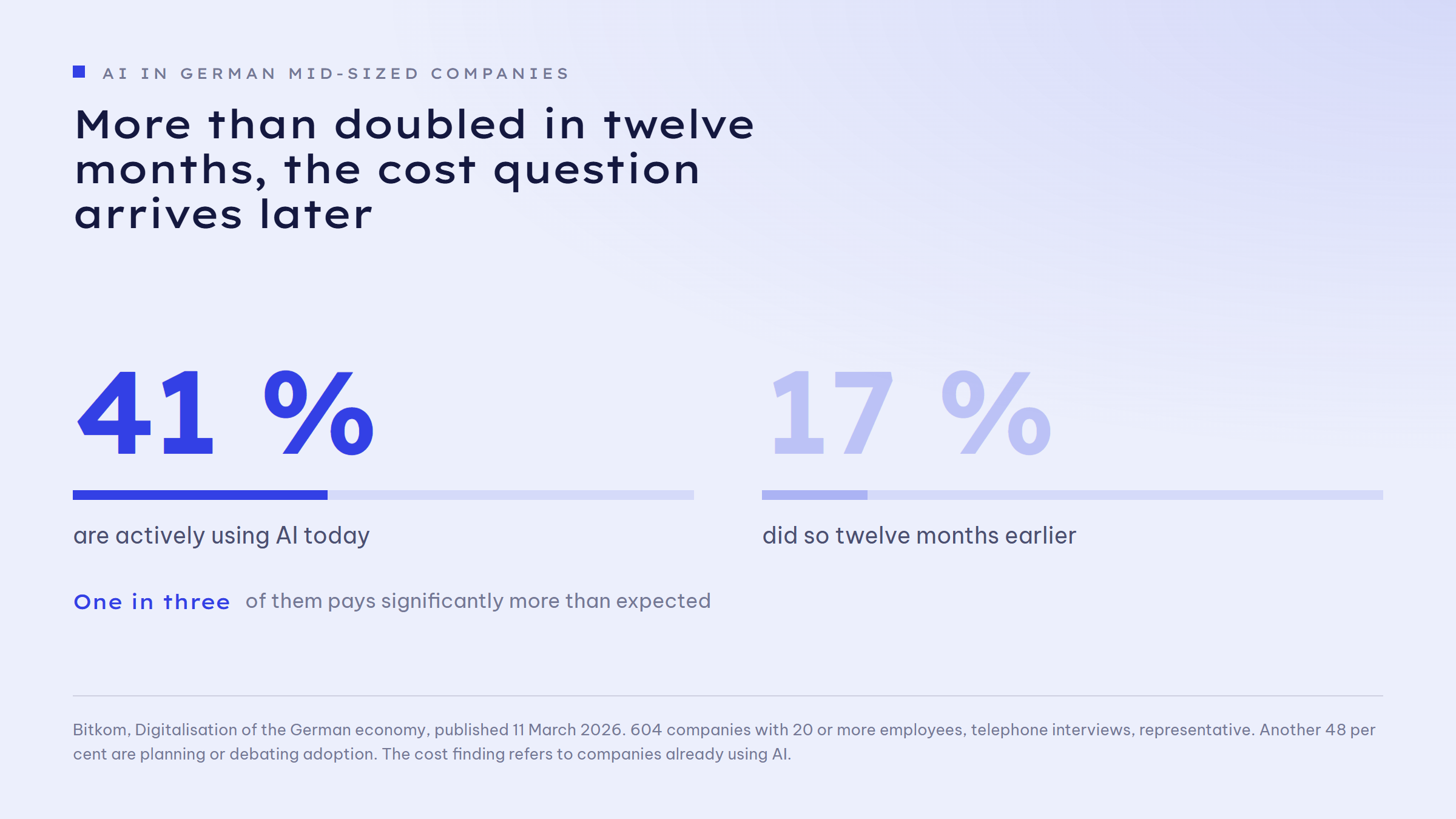
The question is rarely whether to automate. According to the Bitkom survey published on 11 March 2026 (604 German companies with 20 or more employees, telephone interviews, representative), 41 per cent are actively using AI, up from 17 per cent twelve months earlier, with another 48 per cent planning or debating it. The real question is which shape it takes. An AI agent is more expensive, slower and harder to control than a hard-wired sequence of steps, and in some cases it is still the only thing that works. Let us look at what actually separates the two, why so many agent projects die, how to tell that a workflow is enough, when an agent earns its extra cost, and how to make the move without betting everything on it.
What separates an agent from a workflow?
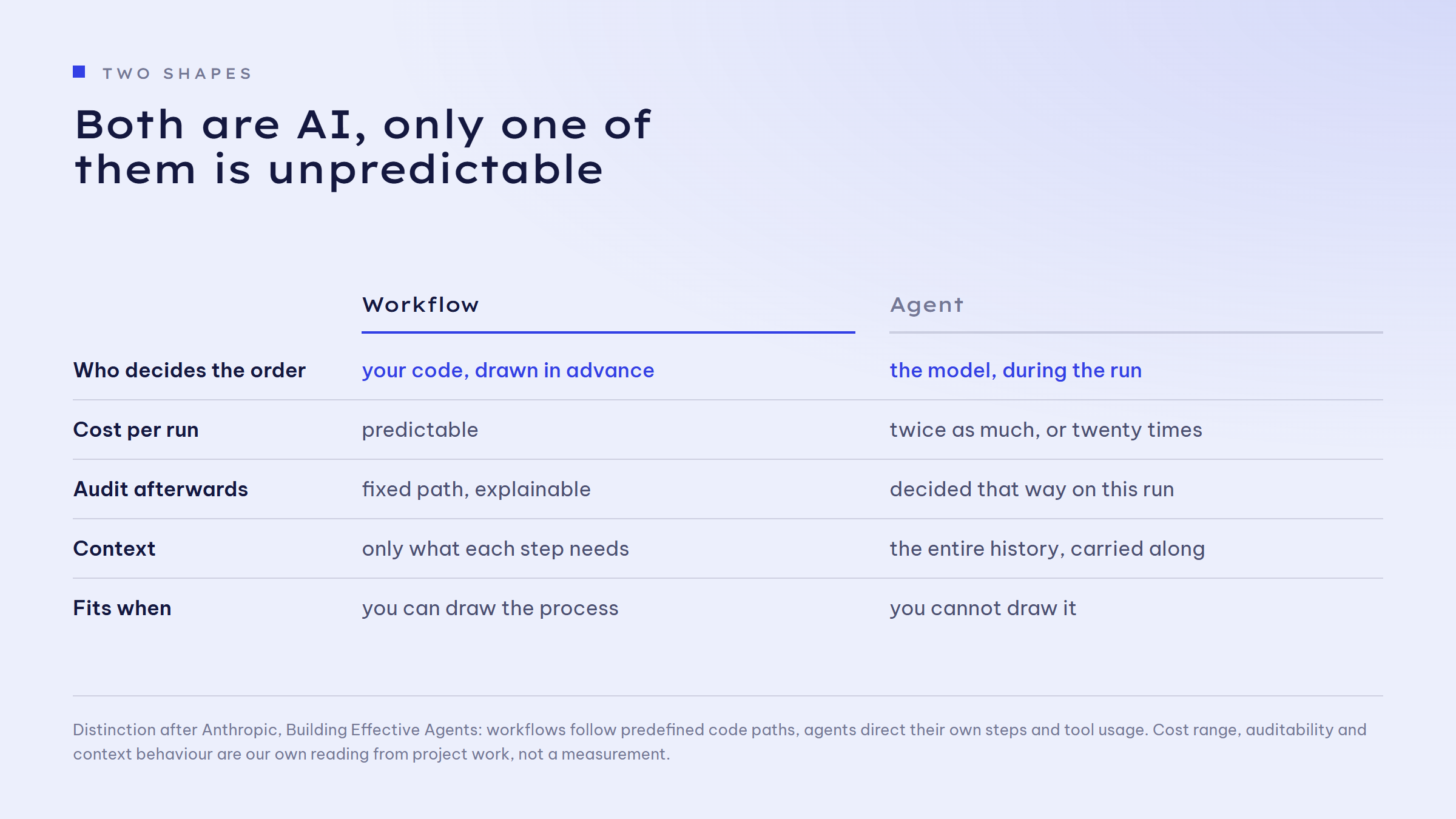
The most useful distinction comes from engineering rather than sales. In Building Effective Agents, Anthropic describes two shapes: workflows are "systems where LLMs and tools are orchestrated through predefined code paths", agents are "systems where LLMs dynamically direct their own processes and tool usage, maintaining control over how they accomplish tasks".
In everyday terms: with a workflow you drew the sequence in advance. Step one reads the enquiry, step two sorts it into one of five categories, step three drafts a reply, step four queues it for approval. A language model does the work, but it does not decide what happens next. With an agent, the model itself decides which tools to use, in what order, and when it is finished. Both are AI. Only one of them is unpredictable.
That distinction tends to disappear during procurement, and not by accident. Gartner calls the phenomenon "agent washing": relabelling existing assistants, RPA tools and chatbots without substantial agentic capability. In its announcement of 25 June 2025, Gartner estimates that of the thousands of vendors promising agents, only around 130 genuinely deliver agentic capability. So when a proposal for an agent lands on your desk, the first sensible question is not the price. It is: who decides the order of the steps here, your code or the model?
Why do so many agent projects get cancelled?
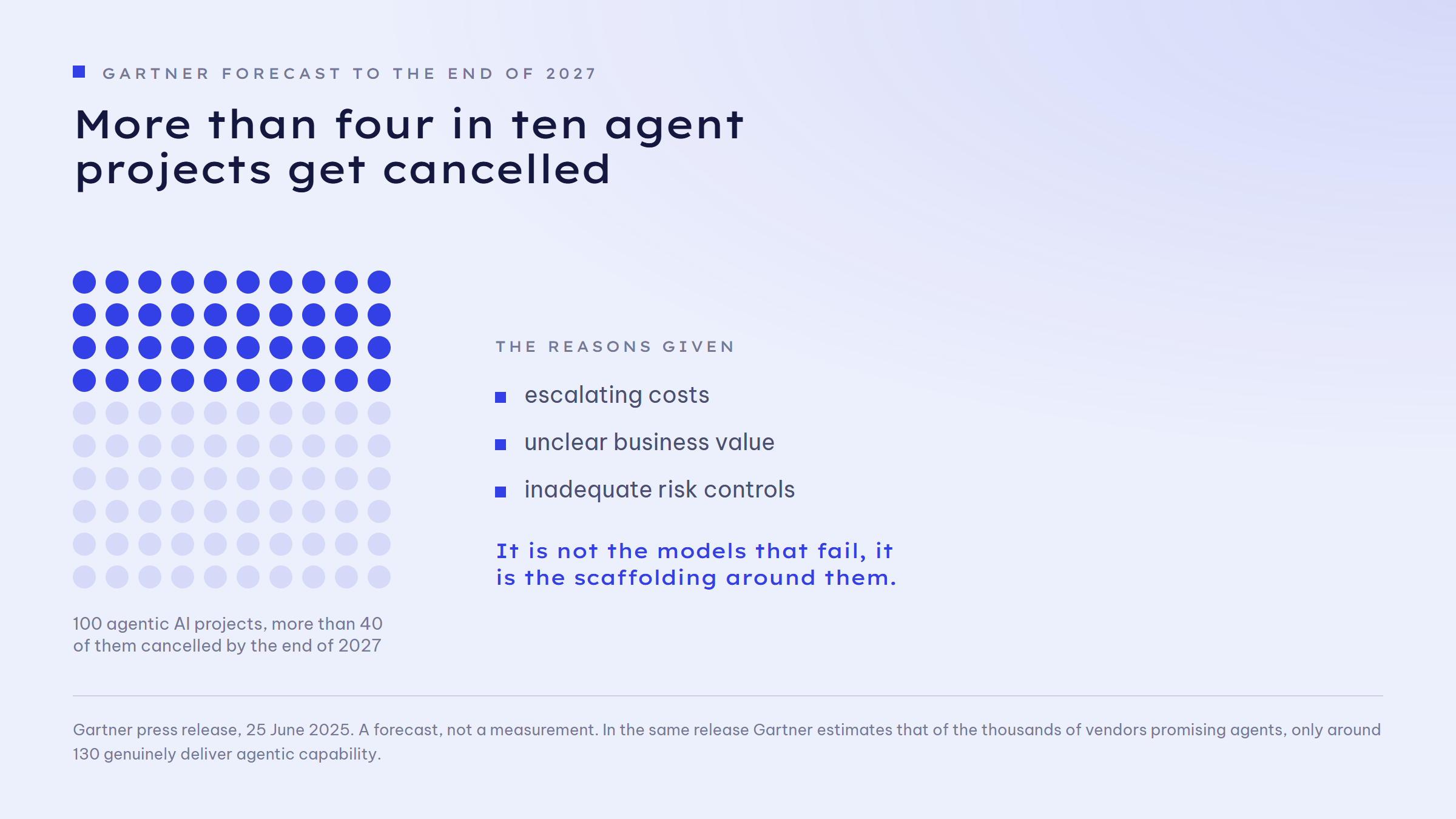
The same Gartner forecast produced the most quoted figure of recent months: more than 40 per cent of agentic AI projects will be cancelled by the end of 2027. The reasons given are strikingly unglamorous - escalating costs, unclear business value and inadequate risk controls. It is not the models that fail, it is the scaffolding around them.
On cost, that matches the Bitkom finding: a third of the companies using AI report that it has led to significantly higher costs than expected. With agents this is structural. A workflow consumes roughly what you budgeted per run. An agent that decides for itself how often to think and ask again consumes twice that on one run and twenty times on another, and the bill arrives at the end of the month.
The second data point deserves care. The MIT report "The GenAI Divide: State of AI in Business 2025" out of Project NANDA finds on page 3 that 95 per cent of organisations get no measurable return from GenAI; turning that into failed pilots shifts what is being counted. Forbes on 26 August 2025 already carries the number in yet another variant: "Only 5% of custom GenAI tools survive the pilot-to-production cliff." In fairness, the report labels its own results "Preliminary Findings" and the base is small: 52 organisations, 153 surveyed senior leaders and more than 300 publicly disclosed initiatives. That is a snapshot, not a statistic. The more interesting finding sits alongside it anyway: bought-in solutions customised with a partner were roughly twice as successful as internal builds. Building the agent yourself means taking on precisely the work most projects fail at.
How do you know a workflow is enough?
Four tests you can run without tools, usually inside a quarter of an hour.
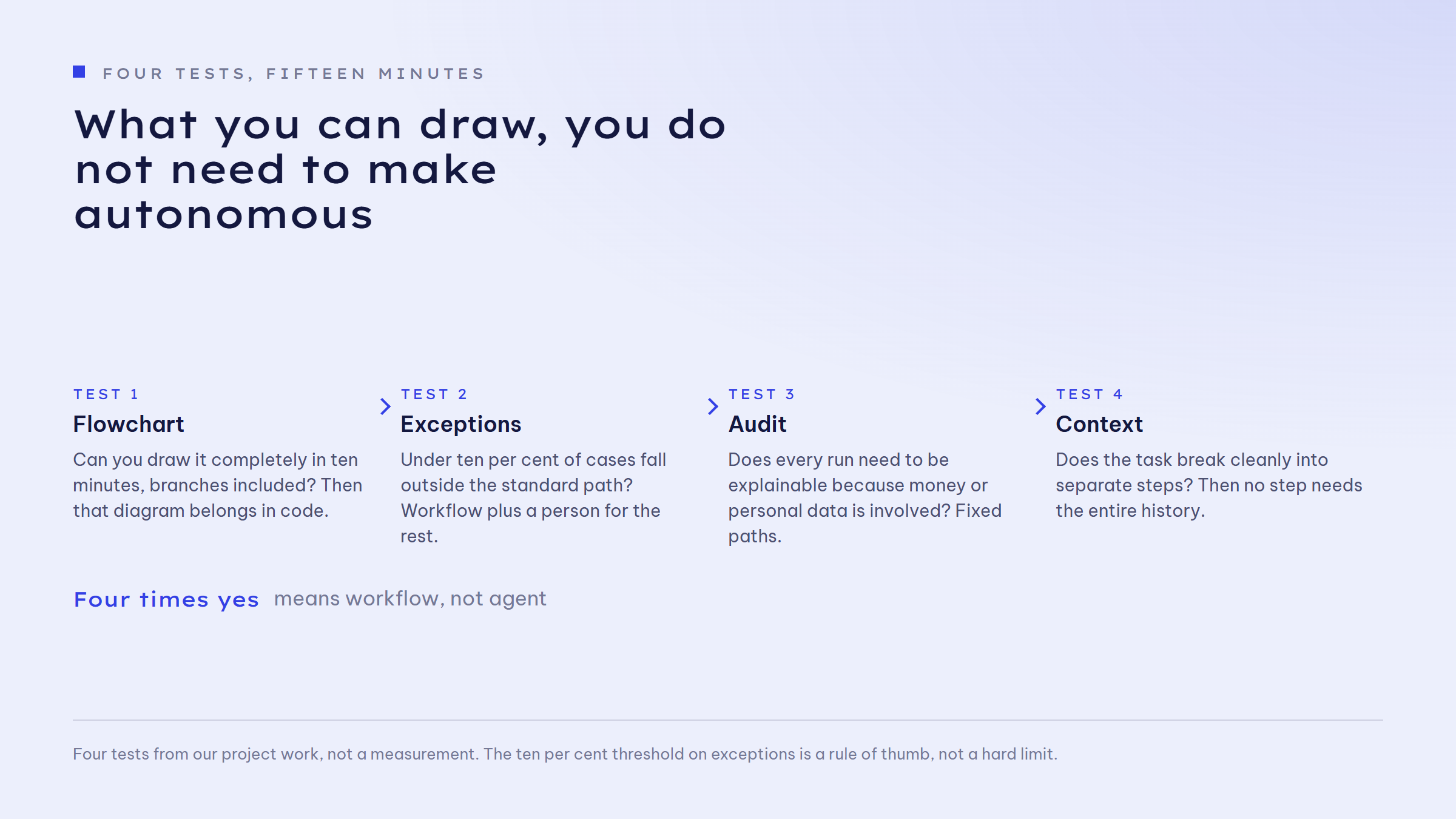
The flowchart test. Draw the process on a sheet of paper. If you can draw it completely in ten minutes, branches included, you do not need an agent - you need that diagram in code. An agent is the answer to a problem you cannot draw.
The exception test. What share of cases falls outside the standard path? Below roughly ten per cent, the right answer is a workflow plus a person for the remainder, not an agent for everything. Exceptions are rarely expensive enough to justify autonomy, and they are usually the exact cases where a mistake hurts.
The audit test. Does every run need to be explainable afterwards because money, invoices or personal data are involved? Then you want fixed paths. With an agentic workflow, the honest answer to "why did the system do that" is often: because the model decided so on that particular run.
The context test. A workflow gives the model only what each step needs. An agent carries its entire history along, and the fuller the context window gets, the more every further step costs and the less reliably early instructions hold. If your task breaks cleanly into separate steps, that is an argument against the agent, not a detail.
When does the agent earn its extra cost?
Some tasks turn any workflow into a caricature. The markers: inputs vary wildly, the route to the answer is not known in advance, several tools are in play, and nearly every step involves a judgement call. Research across scattered sources, fault-finding in a live system, working through an unstructured inbox. There an agent beats the decision tree, because the tree would otherwise need hundreds of branches.
Anthropic states the rule deliberately strictly: add complexity "only when it demonstrably improves outcomes", and agentic systems explicitly trade "latency and cost for better task performance". The word that matters is "demonstrably". Not "it feels more modern", but measured, on the same cases, against the simpler option.
And there is a third route that is almost always missing from this debate. If the task is narrow but tone, format or classification keep coming out wrong, you need neither more autonomy nor longer prompts. You need a specialised model: fine-tuning on a few hundred real examples. It is undramatic, predictable in behaviour, and often cheaper to run than the large agent because the prompt stays short.
How do you make the move without risking everything?
The sequence that has worked for us is boring, which is why it works.
Start with the workflow, even when you are convinced it will not be enough. It is built in days and gives you what the agent decision actually requires: numbers. Then log every exception for four weeks, with the reason and the effort it took. That log becomes the specification later, and in roughly half of cases it answers the question by itself, because three types of exception show up that you simply build into the workflow.
If an agent does get built after that, the limits come before the capabilities. A short tool list instead of full access. A hard budget per run, so a reasoning error does not become an invoice. A human in the loop at exactly the point that cannot be undone: sending, paying, publishing. And a stop criterion written down in advance, because agent errors compound: step two builds on an invention from step one, and by step four everything is wrong but fluently phrased.
Finally, do the honest sum. Total cost of ownership is not just tokens. It includes monitoring, review time and the cost of putting things right. An agent that generates twenty minutes of checking per run is more expensive than the workflow it was meant to replace, whatever the API bill says.
The three levers
1. Draw before you buy. Ten minutes with a flowchart decides more reliably than any demo. What you can draw, you do not need to make autonomous.
2. Log exceptions for four weeks. That log is the only sound basis for justifying autonomy, and often the shortcut to three small extensions instead of one large project.
3. Limits before capabilities. Tool list, budget per run, approval at the irreversible step, stop criterion. Those four are exactly what is missing from the projects Gartner expects to die of cost and control.
If you like, we can walk through your specific process together: what a workflow would already handle today, where the exceptions really sit, and at which point autonomy starts to pay. 🙂