
In 2026 the word "chatbot" covers two tools that have almost nothing in common: the click menu that has lived in the bottom-right corner of websites for years and answers every real question with "Sorry, I didn't understand that" - and the AI agent that understands enquiries, asks follow-up questions, qualifies the lead and books a meeting before your competitor has even opened the email. Lump the two together and you are deciding on false premises. In this article: what the data says about classic bots, how wide the gap between ambition and reality really is - and how to judge whether an agent would generate leads on your website.
What separates a chatbot from an AI agent?
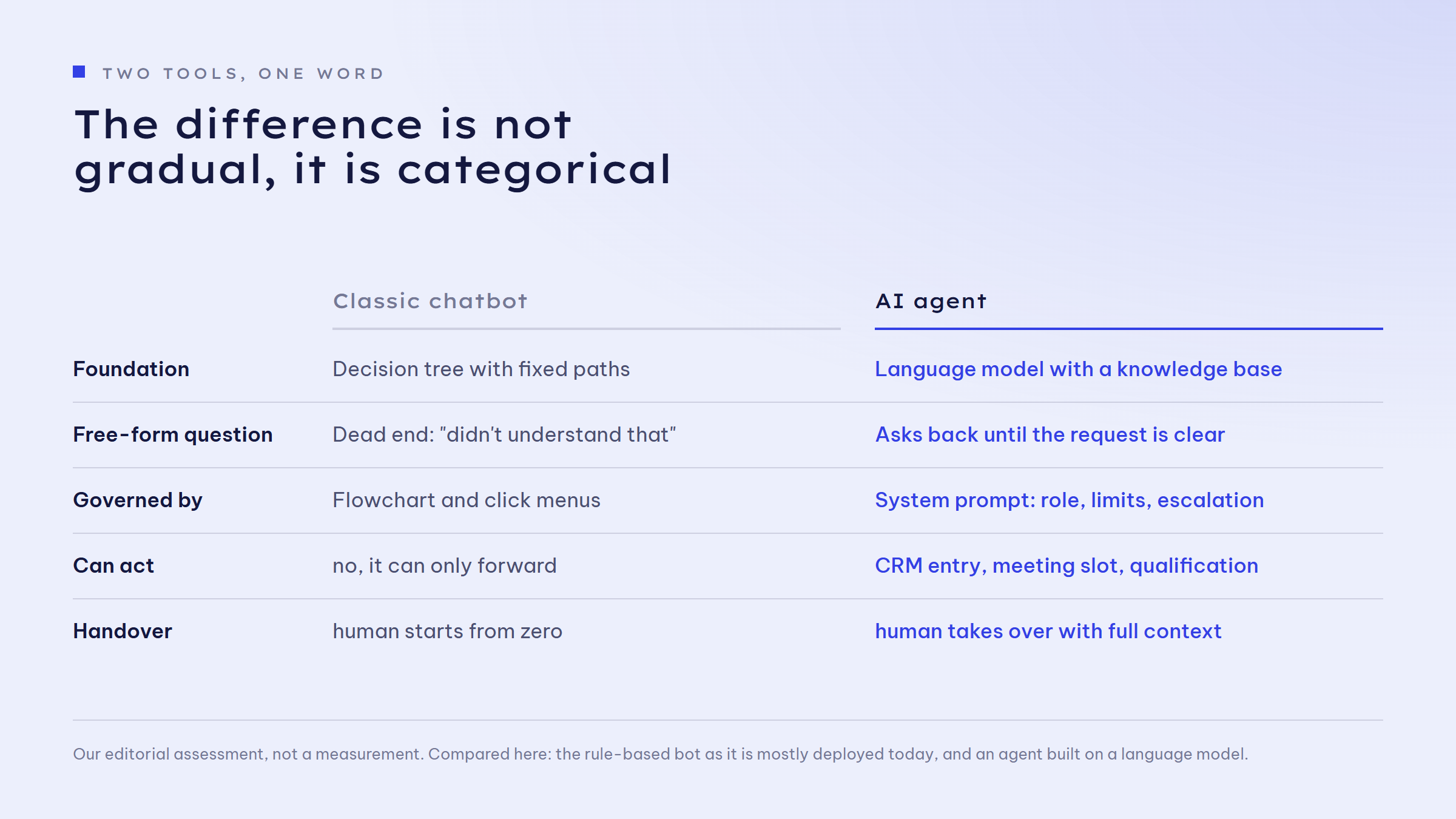
The classic chatbot is a decision tree: it knows predefined paths ("opening hours", "pricing", "support") and walks visitors through them at the push of a button. Anything not in the tree ends in a dead end. An AI agent, by contrast, is built on a language model: it understands freely worded requests, asks clarifying questions, draws on a knowledge base and can take action - writing an enquiry into the CRM, proposing a meeting slot, running a proper lead qualification. Its behaviour is governed not by a flowchart but by a system prompt: role, boundaries, escalation rules. The difference is not gradual but categorical - like the difference between an answering machine and a colleague who picks up the phone.
Why do classic chatbots frustrate so many visitors?
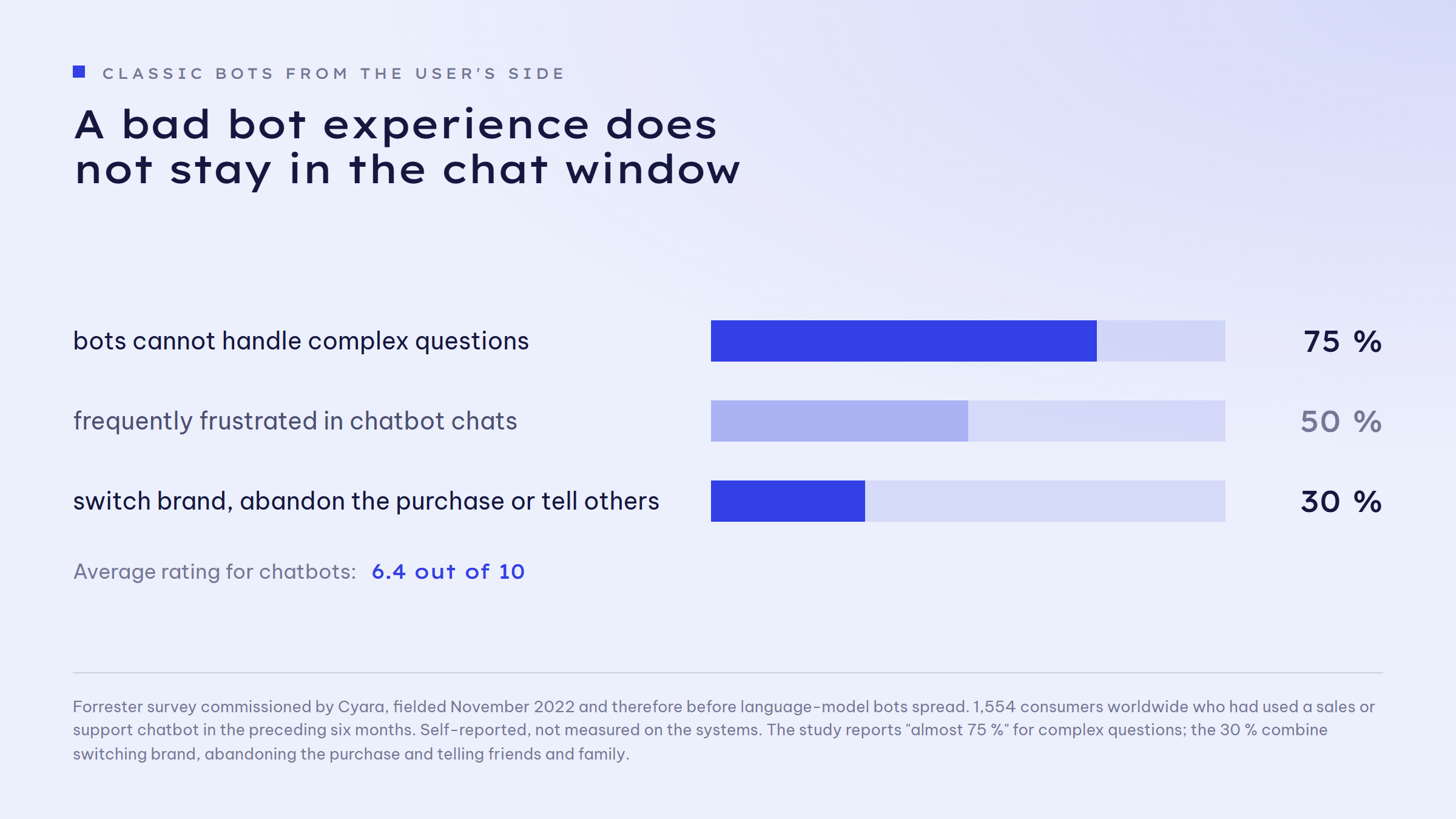
Because they make a promise they cannot keep. A Forrester survey commissioned by Cyara (1,554 consumers worldwide who had used a sales or support chatbot in the preceding six months, fielded November 2022 - firmly in the rule-bot era) found: 50 per cent are frequently frustrated in chatbot interactions, almost 75 per cent say bots cannot handle complex questions, and the average rating came in at 6.4 out of 10 - a "D" grade. The costliest number in the study is the last one: 30 per cent say that after a bad bot experience they are likely to take their purchase to a different brand, abandon it altogether, or tell friends and family about it.
And the scepticism runs deep in the German-speaking market too: according to a Bitkom customer service survey (1,006 people aged 16 and over, 978 of them online shoppers, fielded in calendar weeks 1 to 3 of 2025), only 36 per cent of online shoppers want chatbot help in customer service - 62 per cent want a human being they can reach quickly. Satisfaction with chatbot service sits at 50 per cent, against 86 per cent for human contact. Important context: these numbers largely describe the bots deployed out there today - and those are still mostly decision trees.
How wide is the gap between ambition and reality?
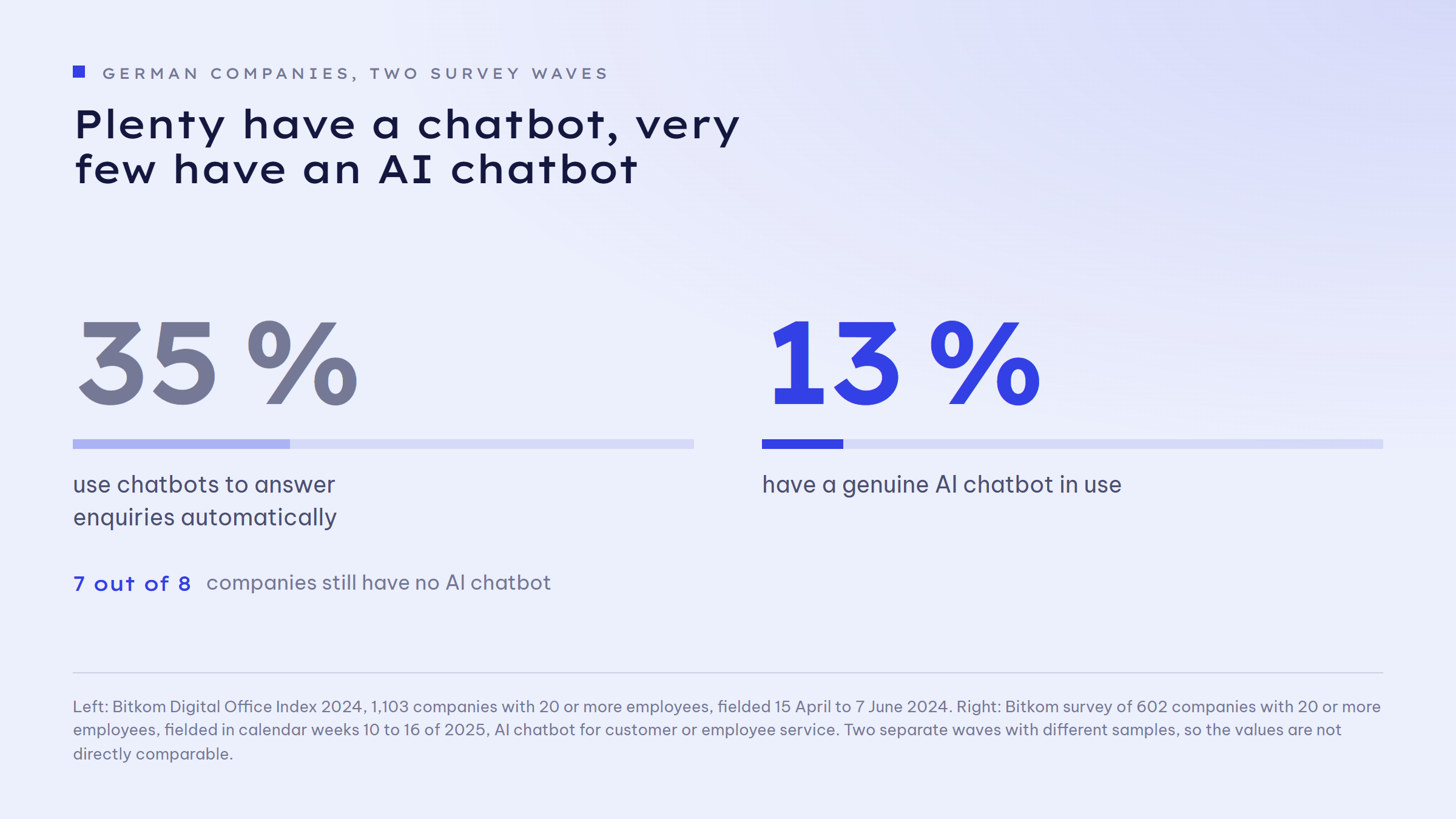
Wider than the buzzwords suggest. According to the Bitkom Digital Office Index 2024 (1,103 companies with 20+ employees), 35 per cent of German companies use chatbots to answer enquiries automatically - ten percentage points more than in 2022. But: a genuine AI chatbot for customer or employee service is in use at just one in eight companies - 13 per cent, per a Bitkom survey (602 companies with 20 or more employees, fielded in calendar weeks 10 to 16 of 2025). The two waves are not directly comparable, but the direction is unambiguous: the majority of installed bots are still rulebooks, not AI.
What the same companies believe is the interesting part: 50 per cent expect chatbots to handle the majority of customer communication in future, and 58 per cent will prefer IT solutions with an integrated AI chatbot going forward. The expectation is there - the execution is running two years behind. For you that means: set up an agent properly now and you are earlier than seven out of eight competitors.
What does an AI agent actually do differently on a website?
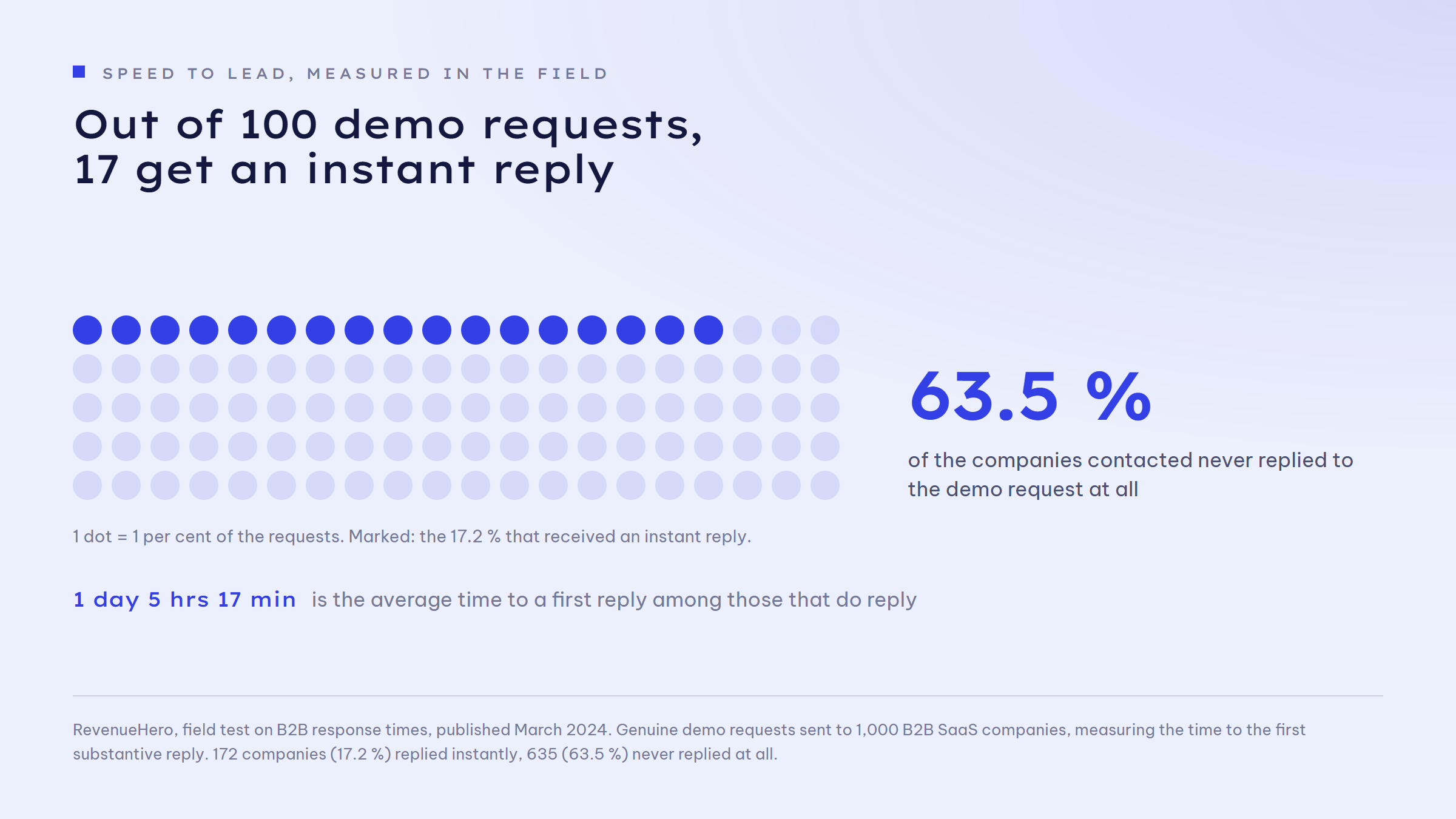
It works in the moment when interest peaks. How bad the status quo is was measured in the field by RevenueHero in 2024: of 1,000 B2B SaaS companies sent genuine demo requests, 63.5 per cent never replied at all. Those that did took an average of 1 day, 5 hours and 17 minutes - only 17.2 per cent responded instantly. Every one of those abandoned enquiries was a visitor who was already on the website, filled in a form and then ran into a void. Speed to lead is the lever an agent solves structurally: it responds within seconds, asks about budget, timeline and requirements, and files the qualified lead with the full conversation into the CRM - at night, at weekends, during holidays.
For this to work credibly, two things belong in the setup that a rule bot never needs: guardrails against hallucinations - naming missing information instead of inventing it, no price promises, no legal advice - and a clean human-in-the-loop handover: the moment things get sensitive or concrete, the agent passes to a person, with full context instead of restarting at "How can I help you?". An agent does not replace a sales team. It makes sure the team only talks to people worth talking to - instead of chasing visitors who left long ago and have to be bought back expensively via retargeting.
Where is this heading - and what does it mean for your decision?
The forecasts are emphatic, even if they remain forecasts: Gartner expects agentic AI to resolve around 80 per cent of common customer service issues without human intervention by 2029. The Zendesk CX Trends Report 2025 (around 5,100 consumers and 5,400 service leaders across 22 countries) shows users are coming along - 64 per cent are more likely to trust AI agents that come across as friendly and empathetic - and issues a warning at the same time: 63 per cent say they would switch to a competitor after a single bad experience. Which is exactly why the order of operations matters: knowledge base and rules first, then the agent - not the other way round.
Where do you start this week?
Three levers that pay off immediately:
Lever 1: Measure your response time honestly. Submit a test enquiry through your own form and time how long it takes to get a substantive reply. If the answer is hours or days, that is your business case - no tool comparison needed.
Lever 2: Collect the 20 real questions. Pull the questions prospects actually ask from your inbox and call notes. That is the knowledge base every agent depends on - and the fastest test of whether your current bot could answer any of them.
Lever 3: Define the handover before you automate. Decide when a human takes over (price negotiation, complaints, uncertainty) and where the context flows. An agent without a defined handover is just a politer way of losing visitors.
If you want to know whether an agent would pay off on your website: write to us - we will look at your enquiries together before anyone installs a widget. 🤖