
Most content teams don't spend the bulk of their time writing. They spend it guessing. What's working right now? Which hooks pull? What are competitors posting that's actually landing? Three hours of research, one hour of content - and at the end the question remains whether the post performs at all.
This article describes a workflow that flips that. No new tool, no subscription. Just a structured interplay of competitor research, AI generation and a clear frame. The end result isn't a single post but a full 39-page content plan, ready to schedule.
The mistake: AI with an empty prompt
Most people using Claude or ChatGPT for social content start from zero. Write me an Instagram post about topic X. The result: generic marketing-speak, interchangeable, with no link to what's actually getting clicked right now. No surprise - the model has no context for what's performing in your niche today.
The decisive step comes earlier. Before AI writes a single sentence, it needs to know: which hooks are working right now. Which carousel structures get saves. Which caption lengths are read to the end. Those aren't guesses, those are data - and they sit publicly on competitor profiles.
Step one: scrape the right profiles
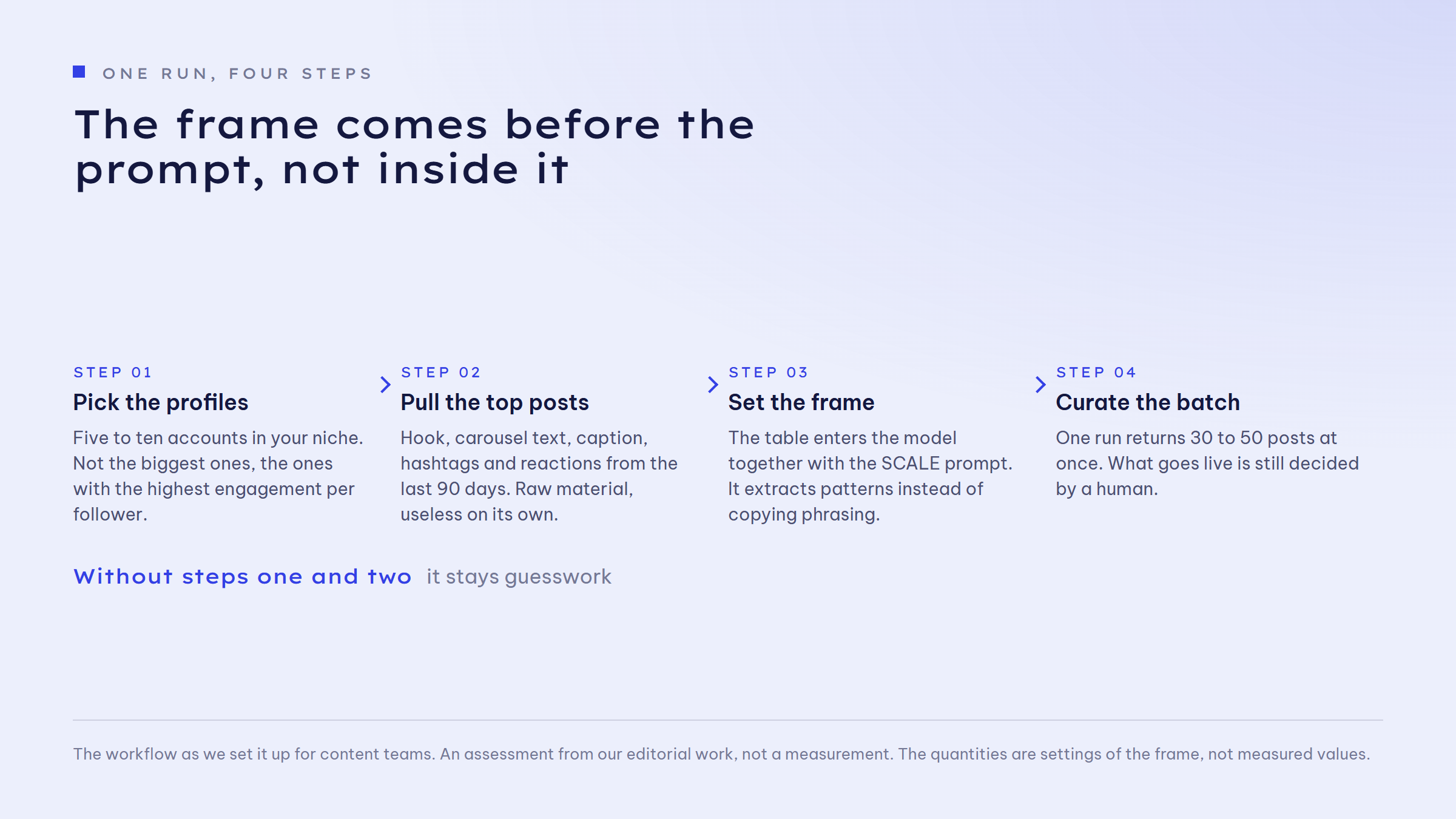
The workflow starts with a list: five to ten accounts that perform above average in your niche. Not the biggest - the ones with the highest engagement per follower. Using tools like Apify, Phantombuster or a lean custom scraper, their top posts from the last 90 days are pulled: hook, carousel text, caption, hashtags, likes, comments, saves.
The result is a table with 200 to 500 rows of performance data. Raw material. Useless on its own - but gold once a model works with it.
Step two: the SCALE frame for the AI
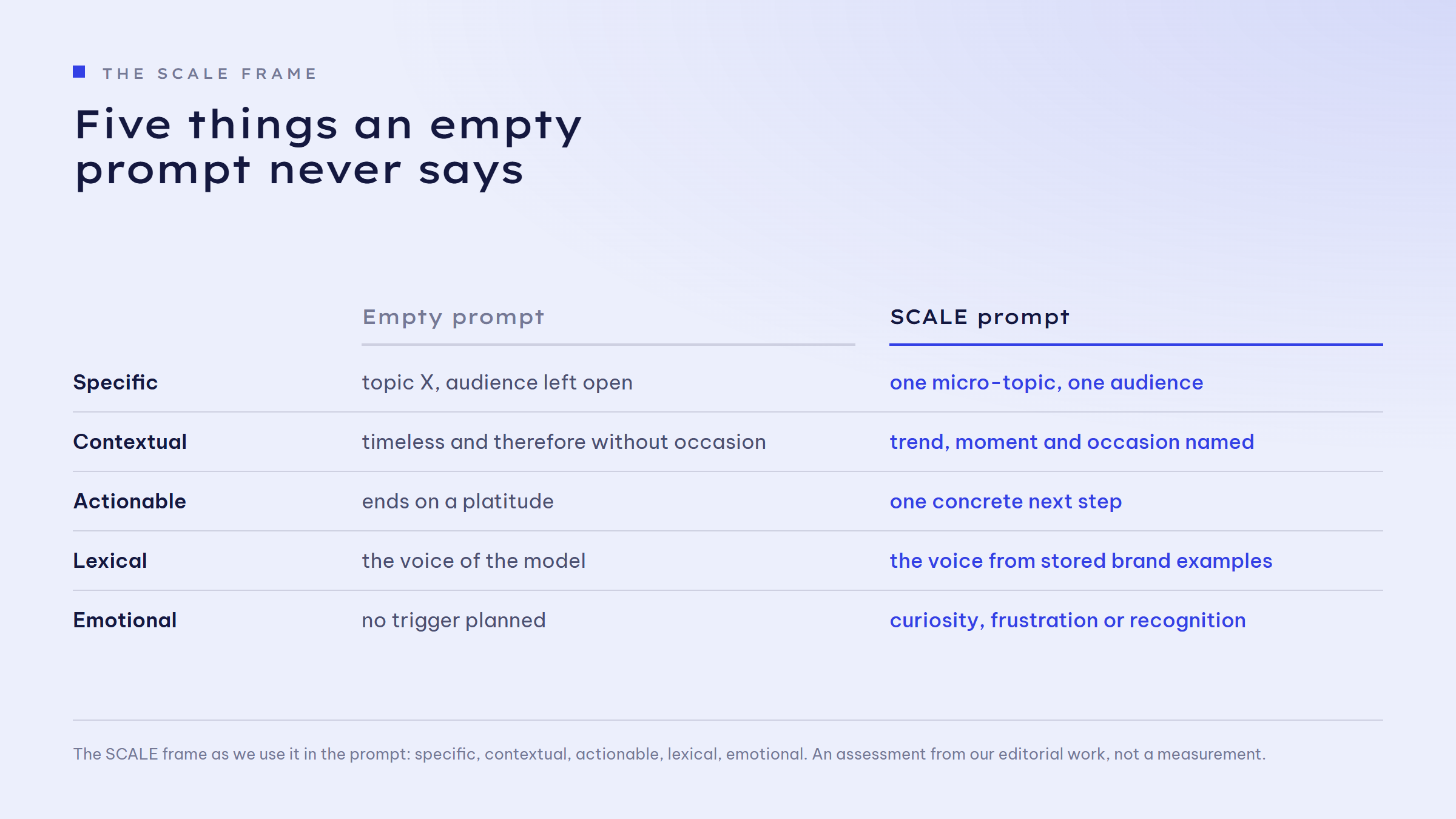
Claude doesn't get this table raw, but together with a structured prompt. We use the SCALE framework: Specific, Contextual, Actionable, Lexical, Emotional. Five dimensions that every generated post has to cover.
- Specific: which concrete audience, which micro-topic.
- Contextual: which trend, which moment, which occasion.
- Actionable: a concrete next step at the end of every post.
- Lexical: tone of voice from stored brand examples.
- Emotional: which trigger - curiosity, frustration, recognition.
The model analyses the competitors' top posts along these dimensions, extracts the patterns, and generates adapted variants that fit the brand - rather than being plagiarism.
Step three: output as a system, not a single post
The common mistake is using AI for one post. That's the wrong unit. Once the workflow is set up, it produces 30 to 50 posts at once - carousel hooks, slide texts, captions, hashtag sets, CTA variants. The result lands structured in a Google Doc or a Notion table, ready for the editorial team.
For one client it was exactly 39 pages. 42 carousel concepts, three hook variants each, finished captions with built-in CTAs, curated hashtag sets per topic. Production time with the old process: around 60 hours. With the workflow: one hour of briefing, four hours of review.
What do humans still have to do?
Every automation has a place where the human stays irreplaceable. Here it's curation. Not every generated post goes live - in our experience roughly 60 to 70 percent of the variants are solid, 20 percent surprisingly good, 10 percent unusable. That is a value from our own runs, not a count. The selection decides whether the feed stays coherent or becomes arbitrary.
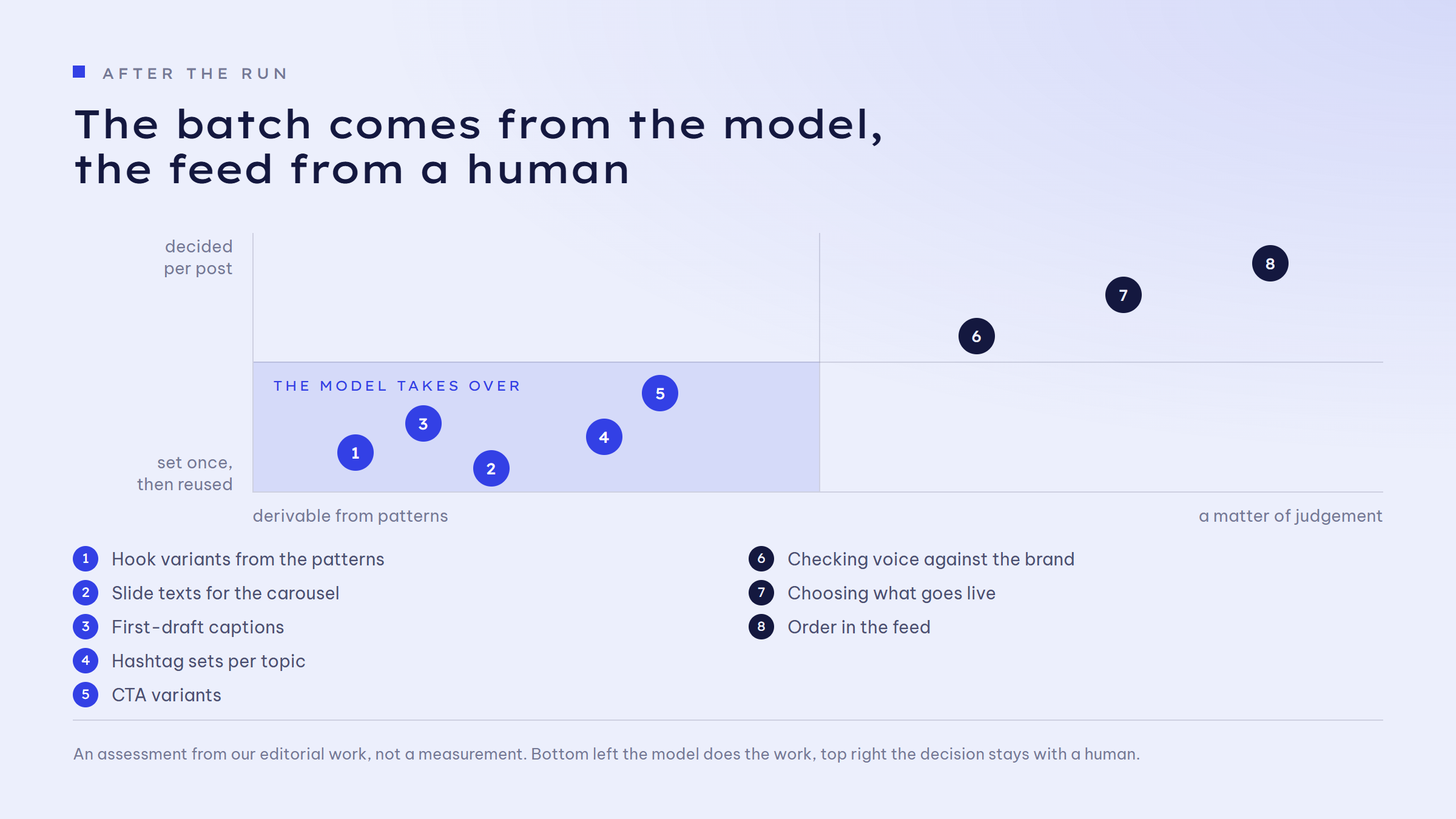
The decisive difference between AI-generated and AI-supported sits exactly in that curation hour. Cut it and you get interchangeable content, just faster. Take it seriously and you get content that genuinely belongs to the brand - in a tenth of the time.
What's relevant for you?
The workflow works for coaches, e-commerce brands, B2B accounts and creators alike - but only if three things are in place first: a clearly defined audience, a short voice document, and the willingness to keep the curation role. Without the first the AI has no frame. Without the second no tone. Without the third no brand.
Once those three are in place, a full month of content is no longer a question of weeks but of an afternoon. And that's where the real lever begins: not in saving hours, but in redirecting those hours into things AI can't do - community, strategy, real conversations.