
In most agencies, the first conversation goes like this: the client talks for twenty minutes about what they need. Someone takes notes. At the end, a proposal is sent. That isn't a briefing - that's order taking. The difference seems small. It decides whether the project ends up delivering what was actually needed, or only what someone said in an email.
This article describes why at agentsie we treat the briefing as its own project phase, not a formal kickoff. And why we sometimes spend more time on it than on the actual delivery.
What's missing from a normal briefing?
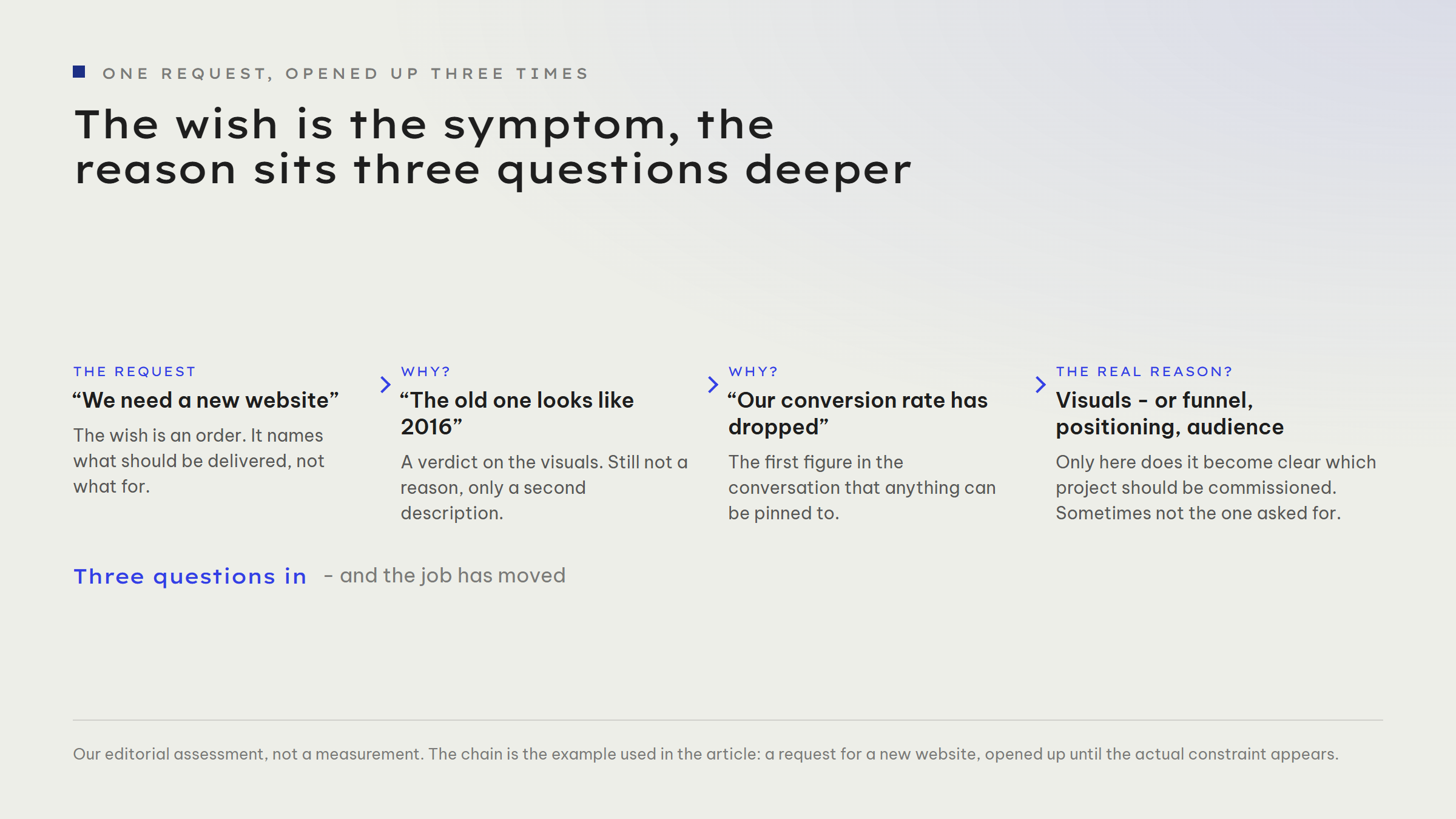
A briefing limited to the client's wishes describes the symptom - not the cause. The client wants a new website. Why exactly? Because the old one looks like 2016. Why is that a problem? Because conversion has dropped. Is it really the visuals? Or the funnel behind it, the positioning, the audience that no longer matches the offer?
The first duty of a briefing is to open up that chain. Not once, but consistently. That costs time - and the willingness to postpone a yes if it turns out the wrong project was described. That's exactly the part many agencies avoid, because the contract matters more to them than the outcome.
Which three questions do we ask every client?
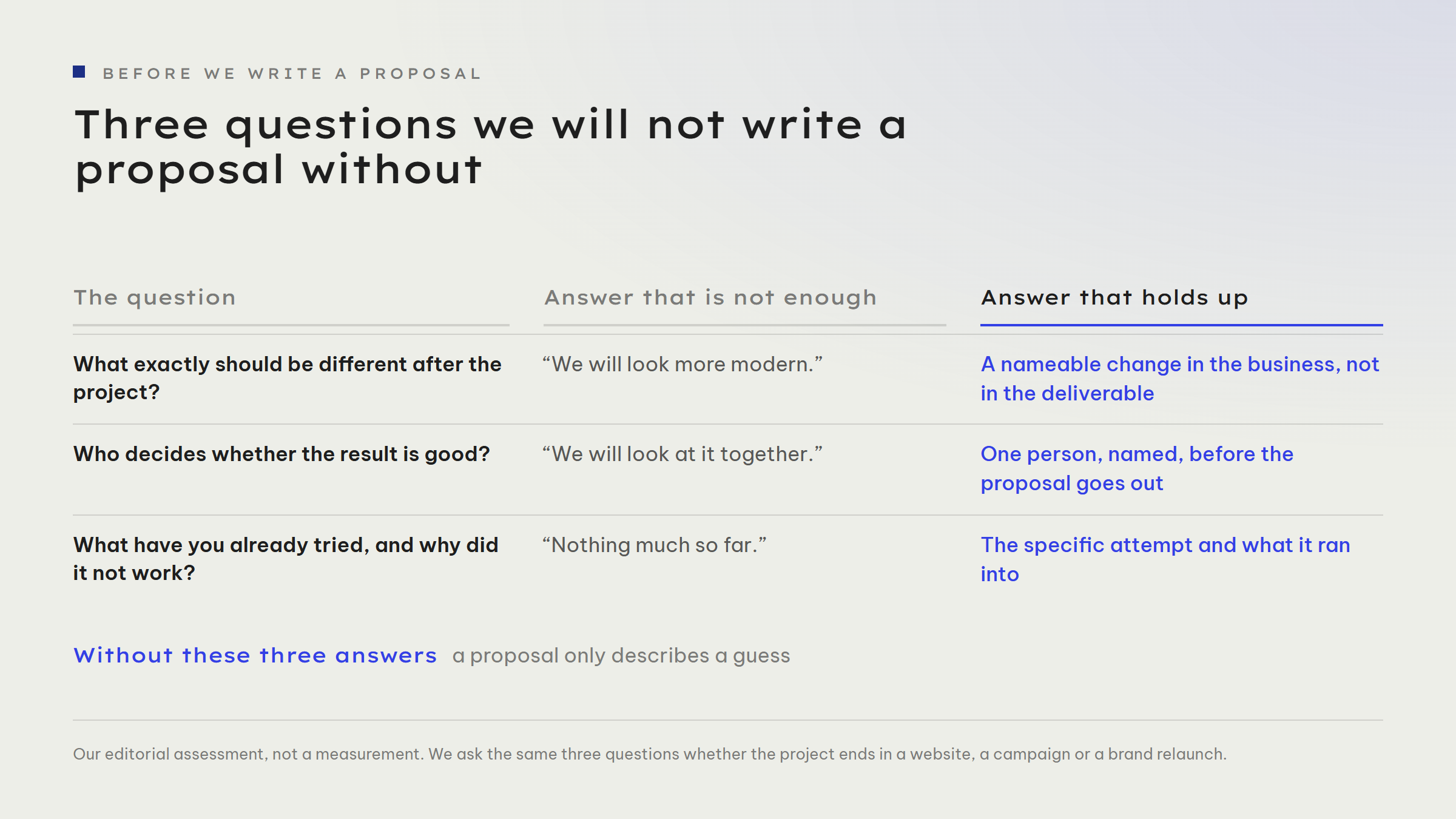
Whether it's a website, a campaign, or a full brand relaunch, there are three questions we won't write a proposal without answers to.
What exactly should be different after the project? Not what we deliver - what changes in the business. If the answer is we'll look more modern, the briefing isn't done yet.
Who in the company decides whether the result is good? A project with three different decision-makers and conflicting views doesn't fail on quality. It fails on sign-off. Clarifying that early protects both sides.
What have you already tried yourselves - and why didn't it work? No client comes to an agency without having tried something first. What didn't work before matters more than what they want now. It describes the actual constraint.
Is scope the boundary or the promise?
The usual handling of scope is defensive: that's not in the proposal. Technically correct, strategically weak. Scope isn't a legal bulwark - it's a shared translation of reality into something concrete. If during the project it turns out scope no longer fits, the right response isn't to defend it - it's to renegotiate it explicitly.
That presupposes a culture where the project matters more than the contract text. For the client that means reliability. For the agency it means estimating well and communicating early. Both are skills that only develop through practice.
Why do short briefings almost always become long projects?
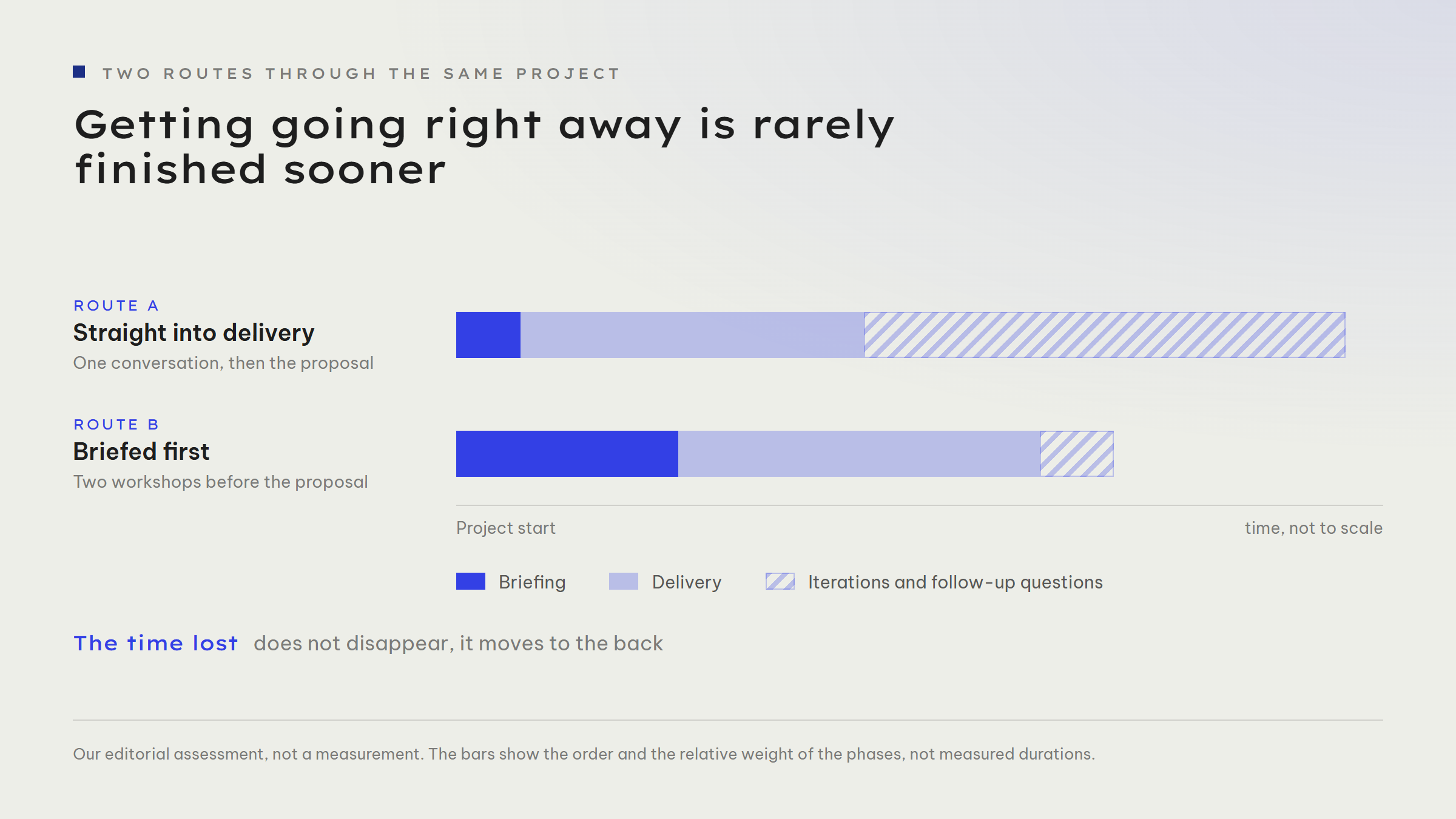
A three-page briefing feels efficient. In reality it often produces ten iterations later because ten assumptions sat in the gaps between the lines, never made explicit. A dense briefing that took two workshops saves three days of follow-up questions per week of execution.
For the client, that feels like luxury at the start - until they compare how long a project with another agency took, one that got going right away. The direct version is almost always slower; the time loss is just hidden elsewhere.
How does a good briefing show up in the result?
You recognise a briefing that held up by the absence of a particular question at the end of the project. Namely: is this what we actually wanted? If that question appears, the briefing was too thin. If it doesn't, the briefing was good.
That isn't luck. It's the result of a clean phase beforehand, in which everyone involved held the same map. Strategy isn't what was written down at the beginning - strategy is what was carried through to the end. And it starts with the decision to brief seriously.
What's relevant for you?
When a next project comes up - regardless of which agency - the only question worth asking up front is: how much time do both sides give themselves for the briefing. Anything under two sessions is an early warning sign. Anything over five is a sign someone's optimising for quality. And that's exactly where the decision falls between something being delivered and something being shipped.